
Traders Rush to Acquire Derivatives Amid Rising Risks: Credit Weekly

Rising Credit Market Risks Prompt Investors to Seek Protection
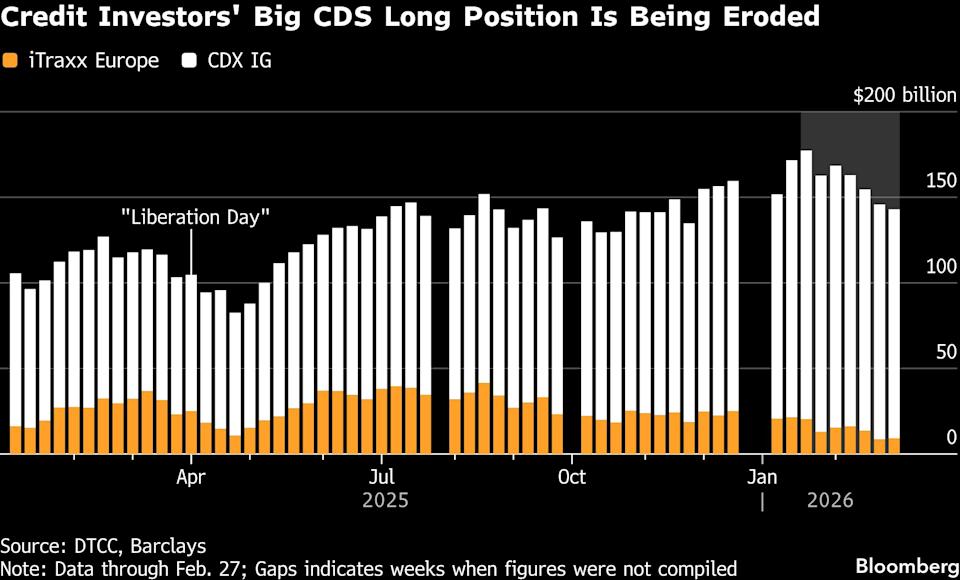
DTCC, Barclays
Key global developments are fueling anxiety in credit markets: escalating conflict involving Iran, signs of a softening US labor market, rapid advances in artificial intelligence threatening traditional industries, and mounting stress in private credit sectors.
With these risks accumulating in both US and European credit markets, a growing number of analysts and investors are advocating for hedging strategies while the cost of such protection remains comparatively low.
Top Bloomberg Headlines
This week, Barclays analysts advised purchasing credit default swap (CDS) protection on the US high-yield index, suggesting that investors offset the cost by selling less likely-to-trigger protection—a strategy known as a payer swap. Morgan Stanley has also recently recommended similar approaches.
Interest in hedging is on the rise. The price of CDS protection on US investment-grade corporate bonds increased by 3 basis points this week, even as cash bond spreads narrowed slightly. This indicates that market participants are turning to derivatives for risk management, rather than selling off company bonds in anticipation of defaults.
Andrew Weinberg, a portfolio manager at Saba Capital Management, remarked, “There’s a significant gap between the risks investors are concerned about—such as private capital and geopolitical tensions—and what’s currently reflected in high-grade bond spreads. Now is an opportune moment to consider credit hedges.”
Geopolitical and Economic Pressures
The ongoing military actions by the US and Israel in Iran show little sign of resolution, and energy markets are pricing in a protracted conflict. Rising oil prices could fuel inflation, which in turn is pushing up global bond yields.
Should inflation accelerate, the Federal Reserve may be forced to slow or even reverse its rate-cutting plans. According to JPMorgan Chase strategists, if the central bank is compelled to raise rates, credit markets could face significant pressure.
Meanwhile, US employers unexpectedly eliminated 92,000 jobs in February, with layoffs spanning multiple sectors. This raises doubts about the resilience of consumer spending in the near future. The continued evolution of artificial intelligence could also lead to widespread job losses, potentially disrupting entire industries. Some investors, wary of these risks, are withdrawing funds from private credit vehicles.
Shifting Sentiment in Credit Markets
Barclays’ analysis of DTCC data reveals that bullish positions in CDS indexes have been declining in recent weeks, particularly amid concerns about the software sector. While the latest data does not yet reflect the impact of the Iran conflict, a surge in CDS spreads and trading volumes suggests that investors are actively repositioning.
Many asset managers have been reducing risk exposure for months as valuations climb and threats—from geopolitical instability to economic slowdowns—become more pronounced. DoubleLine Capital, for instance, reported its lowest-ever allocation to speculative-grade bonds as of June.
Ryan Kimmel, a fixed income strategist at DoubleLine, explained, “We prefer to be proactive rather than reactive during market downturns, positioning ourselves to take advantage of opportunities as they arise.”
Despite the recent uptick in CDS costs, they remain below levels seen in April 2025, when concerns about tariffs under the Trump administration were at their peak. Risk premiums in cash bonds have only inched up over the past month, suggesting that widespread panic has not yet set in.
This relative calm may present a favorable window for investors to trim risk.
Christian Hoffmann, a portfolio manager at Thornburg Investment Management, noted, “There’s still time for investors to adjust their portfolios to account for downside risks. The interplay between recent geopolitical events, AI, software, and private credit is likely to create clear winners and losers in the market.”
Listen to a podcast with Capital Group for insights on high-yield opportunities amid the software sector’s volatility.
Market Recap
-
Debt Issuance and Market Volatility: Early in the week, global debt issuance slowed as Middle East tensions rattled markets and drove up credit risk indicators. Corporate bonds rebounded relative to government debt, as investors grew more confident that US and Israeli strikes on Iran would have limited global economic impact. Meanwhile, many credit investors are unwinding long positions and increasing hedges.
- JPMorgan strategists point out that wars alone rarely have a direct effect on corporate bond spreads or returns; central bank policy tends to be the bigger driver during such periods.
-
Private Credit Under Scrutiny: BlackRock restricted withdrawals from one of its largest private credit funds after redemption requests surged, highlighting growing retail investor unease in the $1.8 trillion private credit market.
- Pacific Investment Management Co. warns that looser underwriting standards in direct-lending vehicles since the 2008 crisis could soon lead to a wave of defaults.
- Blackstone is allowing record redemptions from its flagship private credit fund, with senior leaders contributing $150 million to help meet withdrawals. Blackstone’s president described market concerns as “a ton of noise.” Goldman Sachs executives say withdrawal limits are a normal feature of such funds.
- Goldman Sachs CEO David Solomon sees no immediate cause for alarm in private credit but is monitoring for signs of excess.
- Ares Management CEO Mike Arougheti dismissed UBS’s forecast of a 15% default rate in private credit as “absolutely wrong.”
- Deutsche Bank notes that business development companies, which focus on private loans, also hold large amounts of leveraged loans that could be sold to meet redemptions, potentially widening spreads.
- BlackRock wrote down a private loan to zero at the end of 2025, just months after valuing it at par.
- Blue Owl Capital faces a £36 million exposure to Century Capital Partners, a UK property lender that recently entered administration.
-
Leveraged Finance and Corporate Moves:
- JPMorgan is shifting more debt financing for the record buyout of Electronic Arts toward junk bonds.
- Riskier debt deals are facing challenges: Arclin’s $1.1 billion leveraged loan for an acquisition was sold at a steep discount.
- SoftBank is seeking up to $40 billion in loans, mainly to support its investment in OpenAI, marking its largest dollar-denominated borrowing to date.
- Several major financial institutions, including Elliott Investment Management and Barclays, are exposed to the collapse of Market Financial Solutions, a troubled UK mortgage lender.
- Debt tied to Elon Musk’s X and xAI ventures is expected to be fully repaid, according to Morgan Stanley.
- Toyota Industries is set for a major buyout after a high-profile battle with Elliott Investment Management.
- Former First Brands Group CFO Stephen Graham pleaded guilty to fraud and will testify against the company’s founder and his brother.
- Brazilian sugar and ethanol producer Raízen SA is considering an out-of-court restructuring to address its debt challenges.
Industry Moves
- Richard Zogheb, Citigroup’s global head of debt capital markets, is retiring after 40 years. John McAuley and Chris Munro will co-lead the global debt unit.
- Morgan Stanley has promoted Will Leicht to global head of securitized products group distribution.
- Mesirow Financial hired David Inman as managing director for credit sales; Inman previously played hockey for Notre Dame and was drafted by the New York Rangers.
- Deutsche Bank brought on Gabriel Costelloe from Goldman Sachs to trade Additional Tier 1 bonds, as Nick Gray departs the industry.
- Japan Post Insurance appointed Mana Nakazora, former chief credit strategist at BNP Paribas Securities, as executive fellow to enhance research efforts.
Most Popular from Bloomberg Businessweek
©2026 Bloomberg L.P.
Disclaimer: The content of this article solely reflects the author's opinion and does not represent the platform in any capacity. This article is not intended to serve as a reference for making investment decisions.
You may also like
Crypto Fear and Greed Index falls back down to 'extreme fear' levels
Assessing if Zcash’s $200 support is at risk after ZEC falls by 8%
1 Tech Stock Flying Under the Radar That Wedbush Recommends Owning During Middle East Tensions
In the United States, prediction markets spark debate after bets on Iran
Trending news
MoreCrypto prices
More





