Solana’s trading activity has expanded sharply over the past three years, accumulating roughly $4.4 trillion in total token trading volume.
Early periods showed modest weekly activity, often remaining below $10 billion. This phase reflected the network’s early adoption stage.
However, momentum accelerated through 2024 as weekly turnover climbed steadily. Activity frequently moved into the $20–$40 billion range.
That shift signaled rising participation across decentralized trading venues and memecoin ecosystems built on Solana.
Later, volatility intensified as several weeks recorded dramatic surges. At the peak, trading volume briefly reached about $120–$130 billion.
These spikes aligned with speculative bursts and memecoin-driven liquidity cycles across the Solana ecosystem.

Source: Token Terminal
Yet the surge proved temporary, and activity cooled afterward. Weekly volumes gradually compressed, indicating that speculative enthusiasm faded while core usage persisted.
As of press time, the network generated roughly $12–$15 billion in weekly trading volume. This level remains significantly higher than early-cycle activity.

Source: DeFiLlama
Thus, the trajectory reveals a hybrid structure.
Speculative spikes amplify short-term volume, while stabilized baselines suggest that Solana’s low-fee architecture continues attracting persistent retail trading demand.
Solana overtakes Ethereum in RWA holders
As Solana’s [SOL] trading activity expands, tokenized RWAs provide another lens into how its ecosystem is evolving beyond speculative markets.
Participation data begins to reveal shifting adoption dynamics across major networks.
Ethereum [ETH] still leads in capital concentration, securing roughly $15.45 billion in RWAs across 675 assets. This scale reflects strong institutional issuance and established financial integrations.

Source: RWA.xyz
However, wallet distribution presents a different perspective.
Solana recorded roughly 154,942 RWA holders, slightly exceeding Ethereum’s 153,592 holders. This crossover suggested broader retail accessibility within Solana’s infrastructure.
At the same time, Solana’s total RWA value remained lower at around $1.79 billion, indicating an earlier stage of capital deployment.
Elsewhere, participation declines sharply.
BNB Chain [BNB] hosts roughly 39,218 holders, while Polygon records about 15,482 users.
Taken together, the structure suggests Ethereum remains the institutional hub, while Solana increasingly functions as a retail gateway for tokenized financial assets.
Volume surge test Solana’s liquidity resilience
Solana’s trading surge signals strong activity, yet underlying liquidity reveals a more complex structure.
DeFiLlama data showed $6.53 billion in TVL supporting $14.96 billion in weekly DEX volume. This produces a 0.4 liquidity-to-volume ratio, far thinner than Ethereum’s 4.57 benchmark.
As a result, smaller trades execute with minimal slippage, reinforcing Solana’s appeal among retail traders.
However, larger orders still encounter shallow depth, where price impact rises quickly during demand spikes.
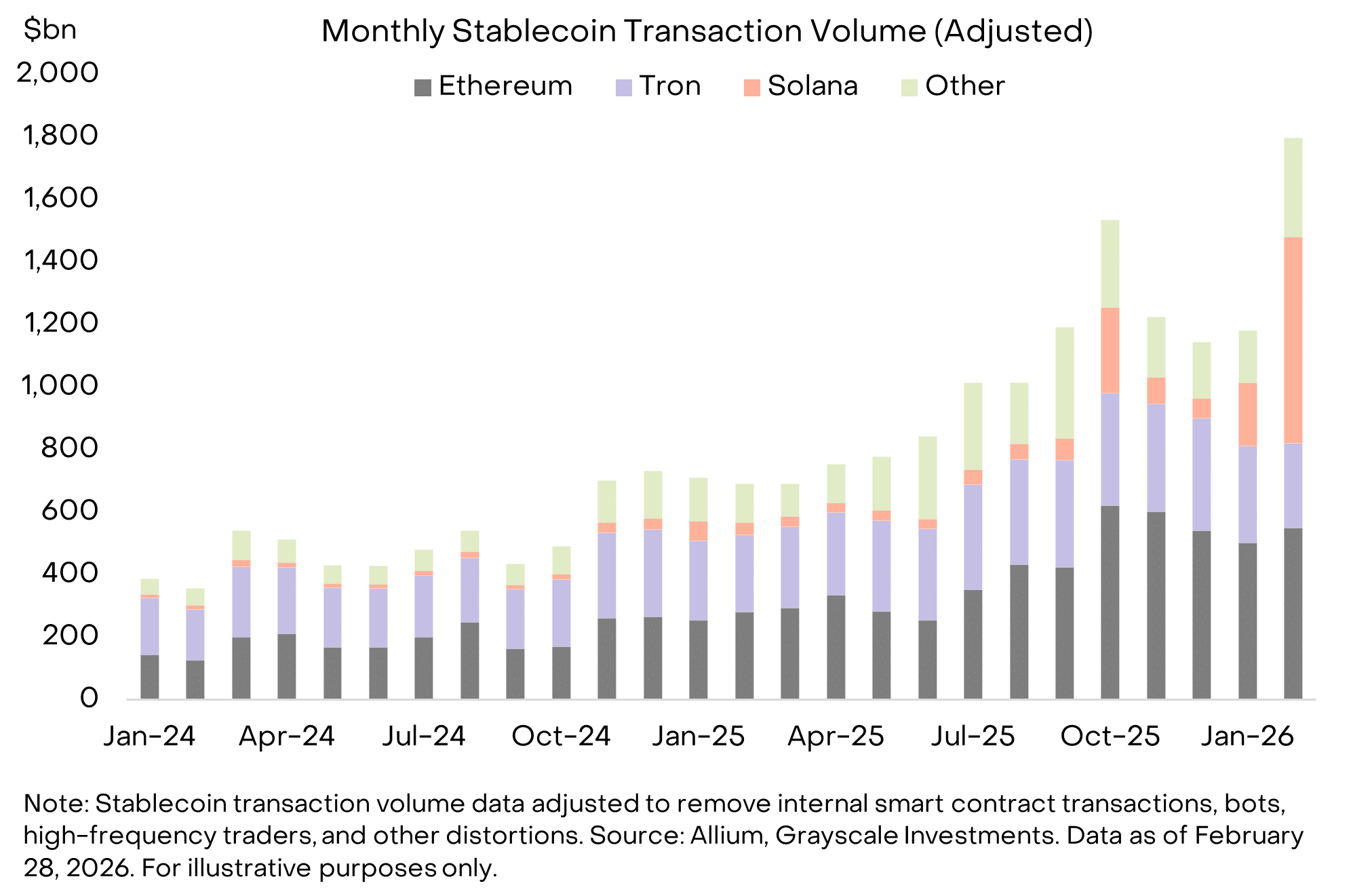
On top of that, roughly $15.4 billion in stablecoin supply supported more than 60% of trading pairs.
This stablecoin liquidity helped maintain continuous market activity across Solana-based exchanges.
Meanwhile, the network processed roughly 3.4K transactions per second while Average Transaction Fees stayed below $0.00025.

Source: Token Terminal
Yet Ethereum preserves a structural edge through $160 billion in stablecoins and expanding RWA liquidity, suggesting a layered market where Solana drives trading velocity while Ethereum anchors institutional settlement.
Final Summary
- Solana continues attracting strong retail trading activity as weekly volumes stabilize near $15 billion, though liquidity depth remains thinner than Ethereum’s institutional capital base.
- Ethereum retains structural dominance through deeper stablecoin and RWA liquidity.