
The US dollar overtakes gold as the top safe haven: Asian stocks plunge, market enters "mini black swan" mode

During the early Asian session on Monday, stocks and precious metals prices fell sharply amid a strong US dollar and surging international oil prices.
As the crude oil market faced the prospect of increased production restrictions and the US threatened to deepen its conflict with Iran, dampening risk sentiment, demand for the US dollar surged. Meanwhile, Iran appointed a new supreme leader, and its armed forces demonstrated their capability for sustained, high-intensity warfare.
Oil prices quickly broke above $100 per barrel after the opening, boosting demand for safe havens, and the US dollar strengthened against all major currencies. As of press time, the US Dollar Index was up 0.76% at 99.65. WTI Crude Oil surged about 20%, trading near $110 per barrel. Matthew Ryan, Head of Market Strategy at the financial services firm Ebury, said, “Due to its liquidity, the US dollar has always been seen as the ultimate safe haven and is also supported by rising oil prices. As long as the war continues without signs of an immediate end, we expect the dollar to keep rising.”
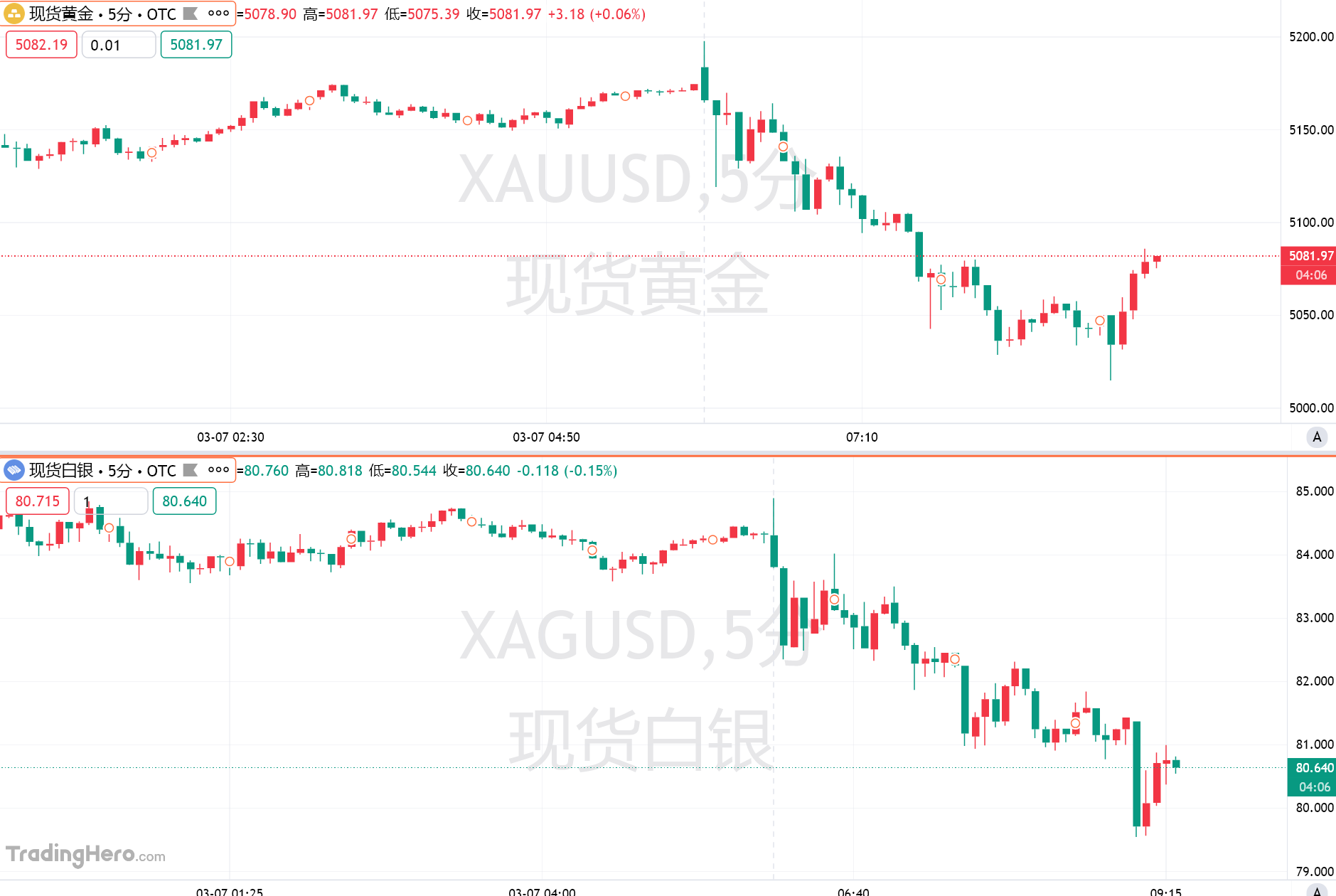
Spot Gold once fell toward the $5,000 per ounce mark, as investors holding non-dollar currencies showed less interest in dollar-denominated assets. Spot Silver briefly fell below $80 per ounce, dropping more than 5%.
Nikos Tzabouras, an analyst at Tradu.com, said in an email, “Driven by safe haven demand due to US and Israeli strikes on Iran, the dollar is now ‘more in favor than gold, making it the preferred safe haven asset.’” The senior market analyst also added: “Reflation risks may prevent the Federal Reserve from cutting rates and further undermine gold’s appeal, paving the way for sharper pullbacks and increased volatility.”
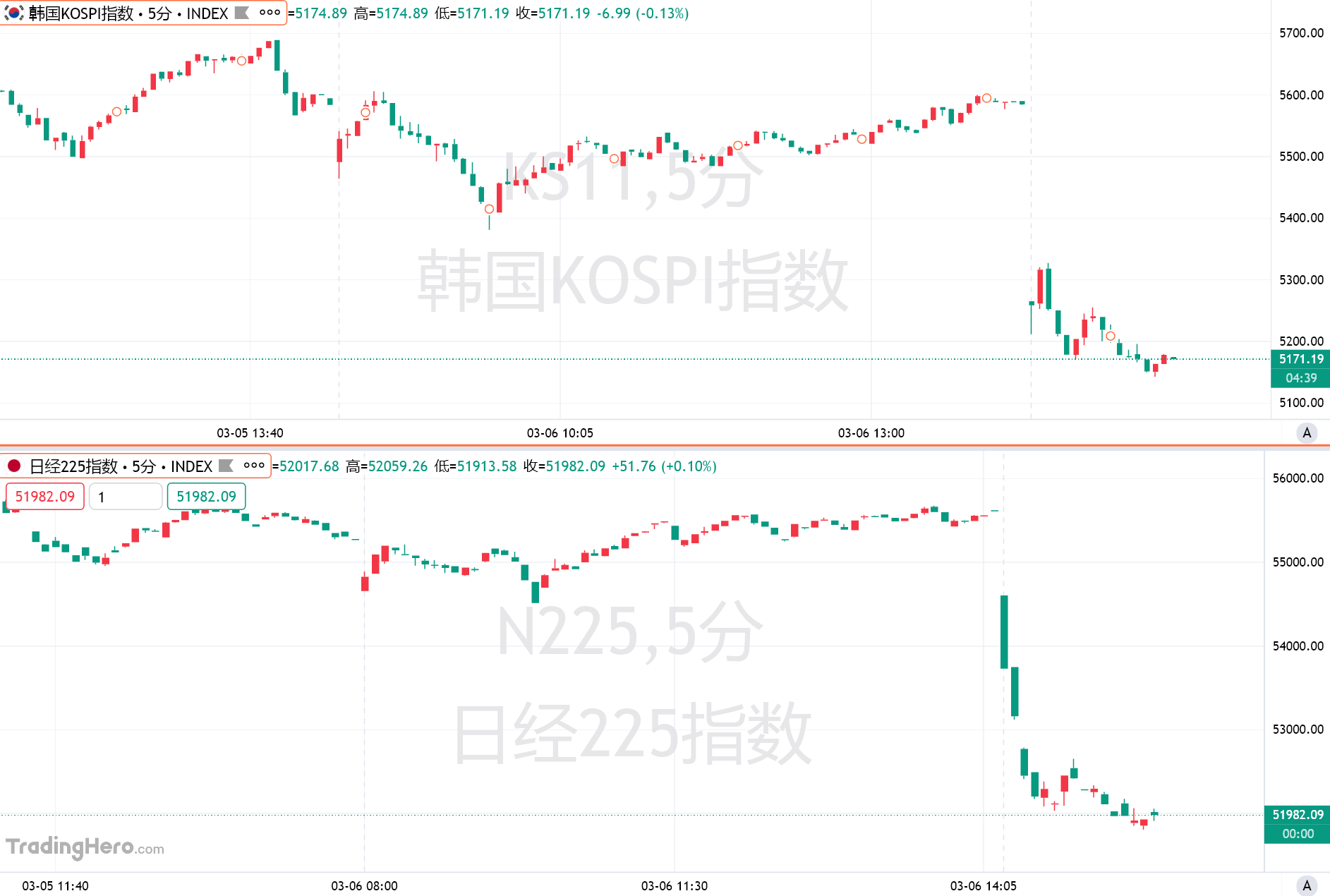
Asia-Pacific stocks came under significant pressure. South Korea’s stock market extended last week’s losses, with the benchmark stock index falling over 7% at the open. Chip giants Samsung Electronics and SK Hynix were again the main drags on the benchmark, with Samsung Electronics falling more than 7% and SK Hynix down over 8%. Korea Exchange triggered a circuit breaker on the KOSPI index by halting program trading for 5 minutes after KOSPI 200 futures fell 5%.
“With investors worried that the Iran conflict may last longer than expected, it’s been another ugly day for the South Korean stock market,” said Jung In Yun, CEO of Fibonacci Asset Management Global. “Reducing exposure is the most prudent approach right now. This is just tactical. I think many investors are watching for the right moment to return.” The oil price surge during the Iran war has been a major concern for investors, as the conflict could spark an inflation spike. With crude prices breaking above $100 per barrel, there are mounting worries about rising costs for net energy importers such as South Korea.
Japan’s stock market saw sharp declines in early Monday trading, with the Nikkei 225 falling more than 6% below the 52,000 level for the first time since January 9. Chip and financial stocks led the losses, with Kioxia dropping 10%, SoftBank Group down 10%, and Mizuho Financial Group down 7.4%. The Nikkei 225 volatility index jumped 19.5 points to 60.56.
Australia’s S&P/ASX200 index fell up to 4.1% to 8492.20, hitting a new low since November 24, 2025. Taiwan’s weighted index opened down 2,051.93 points, a decline of 6.11%.
The MSCI Asia-Pacific index losses widened to 3.1% during trading. Euro Stoxx 50 index futures fell 2.2%, and Germany’s DAX index futures dropped 2.1%. US stocks and bonds also came under broad pressure.
Bloomberg market strategist Mark Cranfield said: “The dollar’s strength in early trading is sufficient to show that FX traders have no appetite to distinguish which currency might outperform. It’s just a scramble for the only safe haven that has proved reliable amid this crisis.”
Meanwhile, positioning data supports the prospect of further US dollar strength.
According to data from the Commodity Futures Trading Commission (CFTC) for the week ending March 3, hedge funds are now the least bearish on the US dollar since January. They currently hold about $12.3 billion in bearish bets, down from $18.9 billion a week earlier.
National Australia Bank strategist Rodrigo Catril said, “Be prepared for rising oil prices and a risk-off mood in the near term.” He added that this means “energy-dependent economies such as Europe and Japan may suffer more than energy-independent economies like Australia.”
Analyst Stephen Innes said that once oil prices decisively break above $110, the market enters a “mini black swan” scenario, with volatility increasing faster than analysts can update forecasts. In such an environment, investors are no longer debating valuations but are asking a much simpler question: “What do we sell first?” This mindset already took hold last week, as selloffs swept across regions and asset classes. Even before the geopolitical conflict erupted, the market had been plagued by two simmering risks: disruptions from AI-related trades, shaking what once seemed like an invincible tech sector; and mounting concerns that cracks were quietly appearing in the credit cycle. With triple-digit oil prices as a further shock, risk managers have abandoned momentum strategies in favor of running black swan scenario models.
Marc Chandler, Managing Director at Bannockburn Global Forex, said that war in the Middle East is not necessarily bullish for gold. If gold breaks below $5,000, long positions may be cut, sending gold further down toward the $4,850 area.
Disclaimer: The content of this article solely reflects the author's opinion and does not represent the platform in any capacity. This article is not intended to serve as a reference for making investment decisions.
You may also like
Nuclear Energy Shares Rise Amid Positive Clean Energy Forecast
4 Best-Rated Stocks With Strong Net Profit Margins to Boost Your Gains
Crypto Researcher: Banks Can’t Begin to Use XRP Until It Hits This Price Level
Trending news
MoreCrypto prices
More





