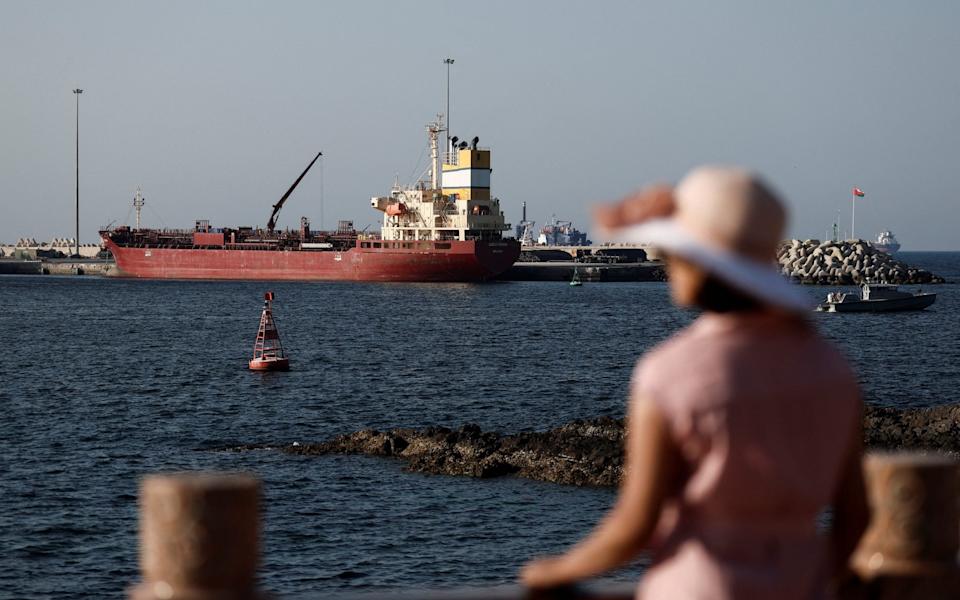
The Strait of Hormuz attracts 40,000 tankers and cargo vessels a year - Benoit Tessier/Reuters
The Strait of Hormuz, just 24 miles wide and surrounded by sunbaked rocky deserts, is among the world’s least appealing seaways. But it is the vast parts of the global economy fed by the trade route that attract 40,000 tankers and cargo vessels a year.
Most of us know the oil and gas riches pumped out by Kuwait, Qatar, Bahrain, Iraq and Saudi Arabia, which travel through the waterway – collectively exporting 20pc of the world’s oil and gas through the narrow strip of water.
But the Persian Gulf is a global choke point for a raft of other vital commodities too – including the fertilisers that feed US and EU farms, the sulphur needed for everything from batteries to metals, and, going the other way, the Indian rice and other grains which keep the region from starvation.
With the war on its 10th day, and the Strait of Hormuz effectively closed over threats from Iran, there are growing fears that the global economy is teetering on the brink of a major crisis.
As key commodities shipped through the region dry up, manufacturers and all manner of production facilities are scrambling to ensure they have enough supplies to keep their output of goods flowing.
Sulphur, for example, is essential for producing sulphuric acid, probably the planet’s most manufactured chemical.
It’s used for extracting metals like copper and cobalt from their ores, producing fertilisers like ammonium sulphate, refining petrol and making car tyres and EV batteries.
But sulphur itself also has to be manufactured, usually from oil and gas, and the Gulf’s refineries are a key global source, producing around 18 million tonnes a year or 21pc of global supplies.
The same goes for fertiliser. Few know it, but the Persian Gulf has become the backbone of global trade, with up to half of global production transiting the Strait of Hormuz, according to market analysts ING.
ING last week warned of likely damage to global farm output – including in the US.
“A prolonged disruption would tighten fertiliser availability in major import-dependent regions such as Brazil, India, South Asia, and parts of the EU,” the bank said.
Worryingly, it raised the prospect of a hit to US food supplies if the war continued. “Rising nitrogen and phosphate prices would pressure farm margins and could reduce yield potential for nitrogen-intensive crops such as corn and wheat,” it added.
A more obvious commodity pushed through the waterway, liquefied natural gas (LNG), another vital Gulf export.
According to the International Energy Agency, over 110 billion cubic metres of LNG passed through the Strait of Hormuz last year.
It said about 93pc of Qatar’s and 96pc of the UAE’s LNG exports move through the Strait, representing almost one fifth of global LNG trade.
“There are no alternative routes to bring these volumes to market,” it added ominously.
Most of that LNG went to Asia, where many economies rely on it. Taiwan is near the top of that list. It gets a third of its gas from Qatar, via the Strait of Hormuz – and has 10 days left till supplies run out.
For those planning summer breaks abroad, however, it is the surge in jet fuel prices that could provide the greatest shock – rising 150pc in the last week according to market analysts Vortexa.
“Europe faces significant risks to jet fuel supply, since the Middle East Gulf is the top supplier to Europe, providing 30pc of Europe’s jet fuel seaborne supplies,” it said in a report.
The situation could be far more dire for people living in the Middle East – who rely on food imported through the Strait of Hormuz.
The region imports 30 million tonnes of grains and oilseeds per year by sea, according to Kpler.
Just one port, Jebel Ali in Dubai, imports 16 million containers a year, including much of the regions fresh food and other consumables, roughly double the next largest port in the region.
“Iran alone was taking in approximately 14 million tonnes of corn annually, much of it from South America. That trade has stopped,” a shutdown that could foreshadow food shortages across the region,” Kpler’s analysts said.
This port serves as the supply lifeline for around 50 million people. There is no overland or air freight alternative that absorbs that volume. Unlike grain, which can be stored in silos for months, fresh produce cannot wait. If container vessel transits remain suspended, this escalates quickly.”
All this makes Gulf ports like UAE’s Ruwais, Saudi Arabia’s Jubail and Ras al-Khair, Qatar’s Ras Laffan, Kuwait’s Al Zour and Shuaiba, and Iran’s Bandar Imam Khomeini – essential to far more than just the fuel industry.
But all of them need free access to the Strait of Hormuz to get their products out to the world and to bring them back in.
Over the weekend, the chances of Hormuz reopening receded as the US and Israel stepped up their attacks on Iran’s oil and gas infrastructure, a move that threatens to widen the conflict to multiple other countries.
0903 China imports from Iran
The attacks, the first on Iran’s oil and gas systems, pose an immediate threat to Iraq and Turkey, which rely on gas piped from Iran, and to China which buys the bulk of Iran’s crude oil.
Turkey has been a vocal critic of the US-Israeli attacks, with President Recep Erdoğan calling it a “completely illegal” violation of international law.
Perhaps the riskiest gamble Trump has taken in attacking Iran is over the impact the blockade might have on China and its reaction.
China’s official import figures often show little oil coming from Iran, but this is because it is often rebranded as “Malaysian” or “Indonesian” to bypass sanctions.
Tracking firms like Kpler and Vortexa suggest that oil is China’s largest import from Iran. The trade is thought to be worth over $40bn |(£30bn) a year and supplies about 15pc of China’s oil.
But there is far more – China also relies on Iran for plastics, chemicals, sulphur, metals and a variety of foodstuffs – much of it also leaving via the Strait of Hormuz.
On Sunday, China made plain its anger at the disruption of that trade, condemning the joint US-Israeli military strikes on Iran, as a “grave violation” of international law.
It added: “The Middle East is engulfed in flames. This is a war that should not have happened—it is a war that does no one any good.
Foreign minister Wang Yi also issued a thinly veiled warning of Chinese intervention, stating: “China stands ready to work with Middle Eastern countries to implement the Global Security Initiative, and restore order to the Middle East, restore tranquillity to the people, and restore peace to the world.”
Richard Meade, editor of Lloyds List, which tracks maritime cargo and shipping, said the halt to Gulf oil and gas movements was the most important factor in terms of global economic impacts – with costs inevitably surging as the blockade continues.
“About 20pc of global crude has to transit a choke point and that volume can’t be rerouted through pipelines. When you’re talking about a very large crude carrier, you’re talking about hundreds of thousands of tonnes of crude oil. It can’t be put in a pipeline, and it can’t be replaced. The same goes for gas.
“And everybody’s becoming a lot less optimistic about how quickly this ends. And you know, that’s why, seeing the oil price going from sort of just under 80 to sort of well over 90, and it’s, if we’re talking another week, it goes up. If we’re talking like two or three weeks, it gets very expensive, very quickly.”
Carole Nakhle, secretary general of the Arab Energy Club, a think tank for energy professionals from across the Arab world, said a prolonged closure of the Strait of Hormuz would feed into global inflation.
“Higher energy prices inevitably raise production costs across petrochemicals, fertilisers and other energy-intensive industries. If prices remain elevated for a prolonged period, this can feed into broader inflationary pressures ... Much will depend on how the conflict evolves over the coming weeks.”
Try full access to The Telegraph free today. Unlock their award-winning website and essential news app, plus useful tools and expert guides for your money, health and holidays.