
Market Meltdown Risks Escalate as Bitcoin Tests Its Role as a Safe Haven

The global financial world is entering a period of intense pressure. Veteran market strategist Ed Yardeni has officially increased the probability of a U.S. market downturn to 35%, up from 20%, while significantly lowering the chances of an unbridled rally scenario to just 5%. Yardeni’s warning stems from a volatile combination of surging oil prices, and the escalating geopolitical conflict in the Middle East.
- Unlock hedge fund-level data and powerful investing tools for smarter, sharper decisions
- Stay ahead of the market with the latest news and analysis and maximize your portfolio's potential
Yardeni Explains the “Iran and a Hard Place” Scenario
Yardeni describes the current economic environment as being “stuck between Iran and a hard place.” The surge in oil prices poses a dual threat to the Federal Reserve’s objectives, as it simultaneously raises the risk of persistent inflation while threatening to dampen employment levels. This creates a difficult balancing act for policymakers, who must navigate these pressures without triggering a deeper economic contraction.
Global equity markets have already begun to reflect this anxiety. With the U.S. dollar recording its strongest weekly gain in a year and the VIX volatility index reaching levels not seen since the market turmoil last spring, investors are shifting into defensive positions.
Bitcoin Faces a Conflicting Narrative
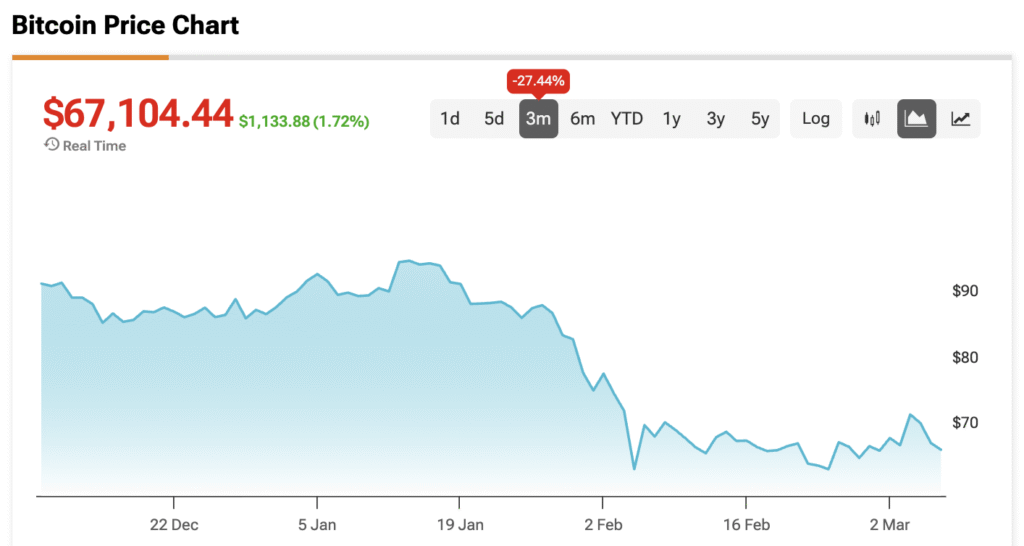
Amidst this climate of uncertainty, Bitcoin (BTC-USD) has shown a level of resilience that is catching the attention of market analysts. While S&P 500 futures have faced sharp declines, Bitcoin has managed to maintain a relatively stable position near $67,000.
For many, this raises the age-old question: Is Bitcoin finally acting as a hedge against market chaos?
Recent research from NYDIG offers a more nuanced perspective. According to Greg Cipolaro, NYDIG’s head of research, Bitcoin’s recent price movements alongside software stocks are likely the result of “shared exposure to the current macro regime” rather than a true structural link. His data suggests that only about 25% of Bitcoin’s price performance can be statistically attributed to its correlation with traditional equities. The remaining 75% is driven by factors unique to the cryptocurrency ecosystem, such as network activity, regulatory developments, and long-term institutional adoption.
The next phase of the market will likely depend on whether the risk-off mood continues to dominate. Historical data shows that Bitcoin has not been immune to major liquidity events, often falling in tandem with equities during past crises. However, the current divergence in the data suggests that institutional investors are increasingly viewing Bitcoin through a different lens than they do for speculative tech stocks.
At the time of writing, Bitcoin is sitting at $67,104.44.
Copyright © 2026, TipRanks. All rights reserved.
Disclaimer: The content of this article solely reflects the author's opinion and does not represent the platform in any capacity. This article is not intended to serve as a reference for making investment decisions.
You may also like
GameStop (GME) Shares Up 20% While Other Meme Stocks Fall in 2026
Call Traders Target Struggling Sports Retailer Before Earnings

Cathie Wood's ARK Warns Of AI Hunger Games: 'Not Every Company Will Survive'
Trending news
MoreCrypto prices
More





