
A Review of Q4 Earnings for Agricultural Machinery Stocks: Comparing The Toro Company (NYSE:TTC) to Its Competitors

Q4 Earnings Overview: Agricultural Machinery Sector
Quarterly earnings reports can provide valuable insight into a company's future trajectory. With the fourth quarter now concluded, let's review the latest performance of The Toro Company (NYSE:TTC) alongside its industry peers.
Industry Trends and Challenges
Manufacturers of agricultural equipment are increasingly focusing on innovation, developing advanced machinery, automation, and smart devices that gather actionable data to help customers boost productivity and efficiency. However, the sector faces inherent seasonality, and unpredictable weather or natural disasters can disrupt operations across the board. Broader economic conditions—such as fluctuations in commodity prices or interest rates—also play a significant role in shaping demand, as they influence both company and customer investment decisions.
Q4 Performance Snapshot
Across the six agricultural machinery companies we monitor, the fourth quarter was robust: collective revenues surpassed analyst forecasts by 1.3%, and guidance for the upcoming quarter was 0.6% above expectations.
Despite these positive results, share prices have struggled, with the group averaging a 5.5% decline since the most recent earnings announcements.
The Toro Company (NYSE:TTC)
During World War II, Toro paused all manufacturing to contribute to the war effort. Today, the company supplies outdoor equipment for residential, commercial, and agricultural markets.
In the latest quarter, Toro reported $1.04 billion in revenue—a 4.2% increase year-over-year—beating analyst projections by 3.5%. The company also exceeded expectations for both EBITDA and adjusted operating income, marking a standout quarter.
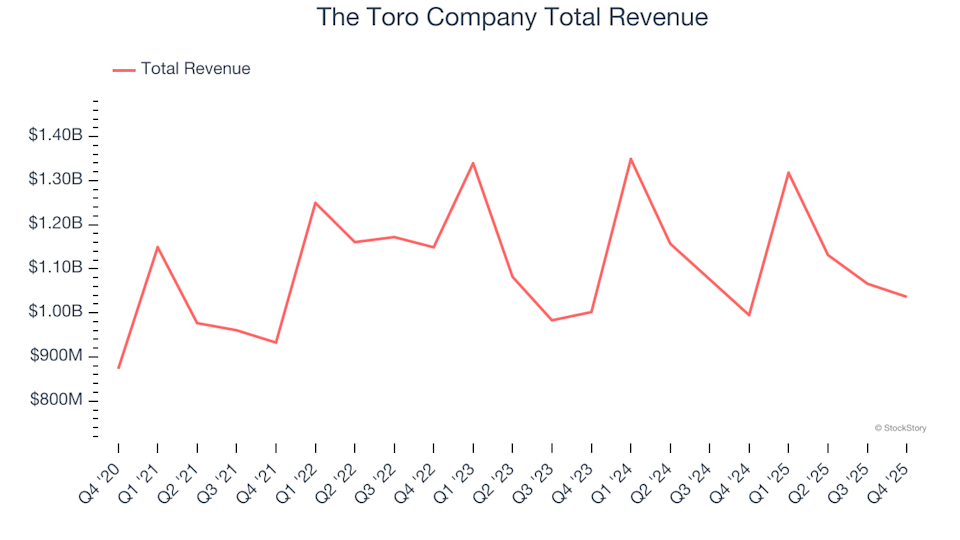
Since releasing its results, Toro's stock has dipped 1.3% and is currently priced at $99.45.
Top Performer: Deere (NYSE:DE)
Deere, known for introducing the first self-polishing cast-steel plow in the 1800s, is a leader in producing advanced equipment for agriculture, construction, forestry, and turf care.
For Q4, Deere posted $9.61 billion in revenue, representing a 13% year-over-year jump and beating analyst estimates by 5.9%. The company also surpassed expectations for both EBITDA and adjusted operating income, delivering an exceptional quarter.
Deere Total RevenueDeere achieved the fastest revenue growth among its competitors. However, this strong performance appears to have been anticipated by investors, as the stock price has remained steady post-earnings and currently trades at $589.09.
Lowest Q4: Alamo (NYSE:ALG)
Alamo, which has grown through strategic acquisitions, specializes in equipment for vegetation management and infrastructure maintenance, serving government, industrial, and agricultural clients.
Alamo's Q4 revenue came in at $373.7 million, a 3% decrease from the previous year and 7.8% below analyst expectations. The company also missed forecasts for both revenue and EBITDA, resulting in a disappointing quarter.
Alamo posted the weakest results relative to analyst estimates in the group. The stock has fallen 23% since the earnings release and is now trading at $168.16.
AGCO (NYSE:AGCO)
AGCO, with a legacy of both organic expansion and acquisitions, designs and sells agricultural machinery and related technologies.
AGCO reported $2.92 billion in revenue for the quarter, up 1.1% year-over-year and surpassing analyst forecasts by 9.6%. The company also delivered strong beats on both EBITDA and adjusted operating income estimates.
While AGCO outperformed analyst expectations by the widest margin, its full-year guidance was the weakest among its peers. The stock price has remained stable since the report and is currently at $122.15.
Lindsay (NYSE:LNN)
Lindsay is recognized for its innovations in center pivot and lateral move irrigation systems, and also offers a range of water management and road infrastructure solutions.
For the quarter, Lindsay reported $155.8 million in revenue, a 6.3% year-over-year decline and 7% below analyst expectations. The company also missed revenue forecasts, resulting in a slower quarter.
Lindsay experienced the slowest revenue growth among its peers. However, its stock has risen 9.1% since the earnings announcement and is now at $129.37.
Market Outlook
The Federal Reserve's interest rate hikes in 2022 and 2023 have successfully brought inflation closer to the 2% target, without causing major disruptions to economic growth—a sign of a smooth economic transition. The stock market flourished in 2024, buoyed by rate reductions (0.5% in September and 0.25% in November) and a significant rally following Donald Trump’s presidential election victory, which pushed major indices to record highs. Looking ahead to 2025, however, uncertainty remains due to potential shifts in trade policy and corporate tax debates, which could influence business sentiment and expansion. The future holds both promise and caution as new policies unfold.
Looking for Strong Investment Opportunities?
Interested in companies with solid fundamentals? Explore our Top 5 Growth Stocks and consider adding them to your watchlist. These businesses are well-positioned for growth, regardless of changes in the political or economic landscape.
The StockStory analyst team—comprised of experienced professional investors—leverages quantitative analysis and automation to deliver timely, high-quality market insights.
Disclaimer: The content of this article solely reflects the author's opinion and does not represent the platform in any capacity. This article is not intended to serve as a reference for making investment decisions.
You may also like
3 Lucrative Stocks That Still Raise Some Questions
Bitway (BTW) 24-Hour Amplitude Reaches 88.0%: Speculative Rally Driven by Over $170 Million Surge in Trading Volume
Rocket Lab Surges 21.9% Over the Last Three Months: Is Now the Time to Invest?
Trending news
MoreCrypto prices
More





