
Iran conflict sparks recession warnings, attracts market bottom seekers, and offers valuable insights on oil prices

Market Turmoil Intensifies Amid Oil Price Surge
Market conditions have become extremely challenging today. Oil prices soared by over 20%, briefly exceeding $110 per barrel after President Trump and Defense Secretary Pete Hegseth indicated that the United States would remain engaged in conflict with Iran until its objectives are achieved.
Although oil has since retreated to below $100 per barrel, the upward momentum persists and continues to pose a significant risk to equities. International indices like the Nikkei and KOSPI have suffered substantial declines.
The spike in oil prices has once again taken a toll on US stocks, with the Dow Jones Industrial Average futures (YM=F) dropping further, extending Friday’s losses that followed disappointing employment data and escalating geopolitical tensions.
It’s important to recognize that we are experiencing an economic shock driven by oil, and this has yet to be fully reflected in stock valuations—regardless of whether a company is cash-rich like Nvidia or facing challenges like Target. The following chart from Deutsche Bank illustrates the potential for oil prices to climb even higher, based on previous oil crises.
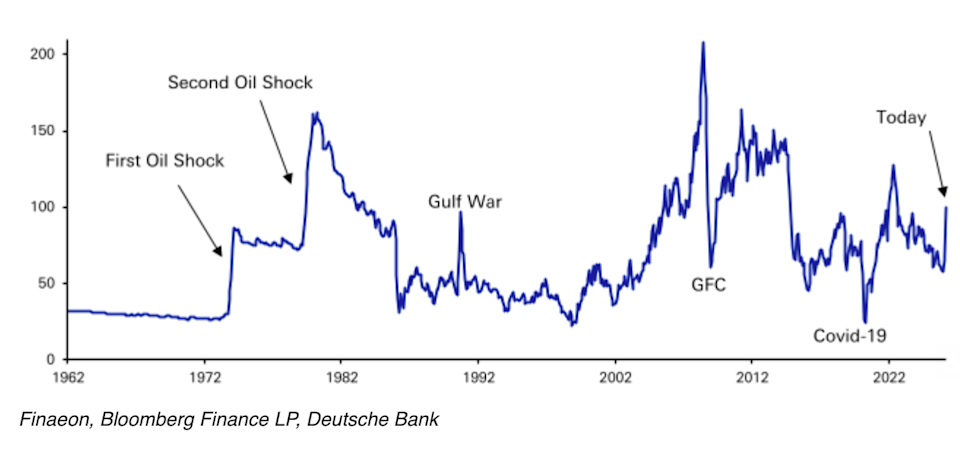
The Oil Shock of 2026. · Deutsche Bank
Three Key Lessons for Investors
- Market Bottoms Are Unpredictable: Attempting to identify the lowest point in the market or in individual stocks by analyzing charts is futile. Focus on evaluating the underlying fundamentals of companies instead.
- Economic Impact Is Real: Anyone claiming that the US-Iran conflict will have minimal economic consequences is mistaken. Be wary of such opinions.
- Ignore Recession Alarmists: Predictions of a US recession by the end of the first quarter are often designed to provoke fear and sell subscriptions. While the economy is more robust than many believe, oil prices above $100 per barrel will still have an effect.
According to retired general and former CIA director David Petraeus, the war will conclude when President Trump chooses to end it. Consequently, a clearer signal of peace could also mark the end of the current stock sell-off.
With that in mind, here are some notable perspectives from Wall Street experts that shed further light on the current market and economic challenges:
Chris Rupkey, Chief Economist at FWDBONDS
"Investors are fleeing the stock market, with S&P 500 futures dropping 1.3%. All the warning signs for a recession are present, and concerns are mounting that the Trump administration’s economic team faces more obstacles than they can manage. With oil prices climbing, it would be remarkable if the economy avoids a downturn. The US economy doesn’t need another blow from rising oil costs. Move your assets to safer options, sell off holdings, and maintain liquidity while possible. The worst may still be ahead."
Fabio Bassi, Strategist at JPMorgan
"Resource constraints are starting to outweigh the limited military progress, and the outcome of the conflict will ultimately depend on three factors: Munitions, Markets, and Midterms."
Stephen Richardson, Oil Strategist at Evercore ISI
"Even a brief disruption has already pushed oil prices into the $90s. The main issue now is uncertainty. Without clarity on when normal supply through the Straits will resume, we anticipate oil could quickly rise to levels that force demand reduction (around $120 per barrel or higher). Strategic petroleum reserves, oil already in transit, and commercial stockpiles will all be crucial if the outage lasts more than a month."
Jim Reid, Strategist at Deutsche Bank
"During the 1970s, the first oil shock occurred in 1973 when Western nations faced an embargo for supporting Israel in the Yom Kippur War. Oil prices nearly quadrupled but then stabilized, allowing inflation to subside. However, by 1978, inflation began rising again, fueled by political turmoil in Iran and strikes in the oil sector.
In early 1979, the Iranian Revolution led to a dramatic drop in Iran’s oil production, which accounted for about 7% of global output. Production fell from 5.5–6 million barrels per day to around 1–1.5 million, before gradually recovering to an average of 3 million barrels per day that year.
Although the global supply loss was only 4–5%, oil prices jumped from about $15 to nearly $38 per barrel between 1979 and 1980—a 150% increase. This surge was driven not just by physical shortages but also by uncertainty, stockpiling, and fears of broader geopolitical instability. The Iran-Iraq war in 1980 added further unpredictability.
Today, there are significant differences. Long-term inflation expectations have remained stable, even during the 2022–23 inflation spike. Modern economies are less dependent on energy, and labor markets have less unionization and wage indexation, reducing the risk of a wage-price spiral like in the 1970s.
Still, the current oil shock has been exceptionally swift. Over the past six days, prices have climbed about 44%, peaking at a 65% increase earlier today in Asia. For comparison, the largest monthly increases during the 1979 crisis were 13% in April, 12% in May, and 22% in June.
The most notable similarity is the pattern of shocks, with Iran at the center of both the 1970s and current crises, each occurring roughly 4–5 years after a previous shock. The main difference is the inflation environment: in the late 1970s, poorly anchored expectations contributed to a wage-price spiral that required aggressive monetary policy. Today, expectations are more stable, and the global economy is less vulnerable to energy shocks than it was fifty years ago."
About the Author
Brian Sozzi serves as Executive Editor at Yahoo Finance and is part of the editorial leadership team.
Disclaimer: The content of this article solely reflects the author's opinion and does not represent the platform in any capacity. This article is not intended to serve as a reference for making investment decisions.
You may also like
GameStop (GME) Shares Up 20% While Other Meme Stocks Fall in 2026
Call Traders Target Struggling Sports Retailer Before Earnings

Cathie Wood's ARK Warns Of AI Hunger Games: 'Not Every Company Will Survive'
Trending news
MoreCrypto prices
More





