
The Diesel Crisis Crushing America Is A Goldmine For These 3 Refiners

Something shocking is happening in diesel markets — and the move could have consequences that extend far beyond energy traders' screens, reaching everything from refinery profits to the price of food in your refrigerator.
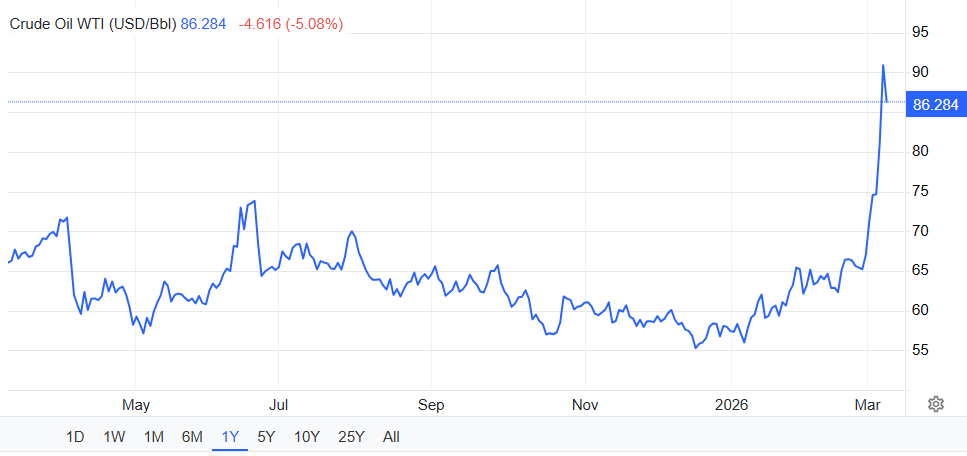
While oil prices have climbed toward $102 per barrel amid the closure of the Strait of Hormuz, diesel prices are moving even faster.
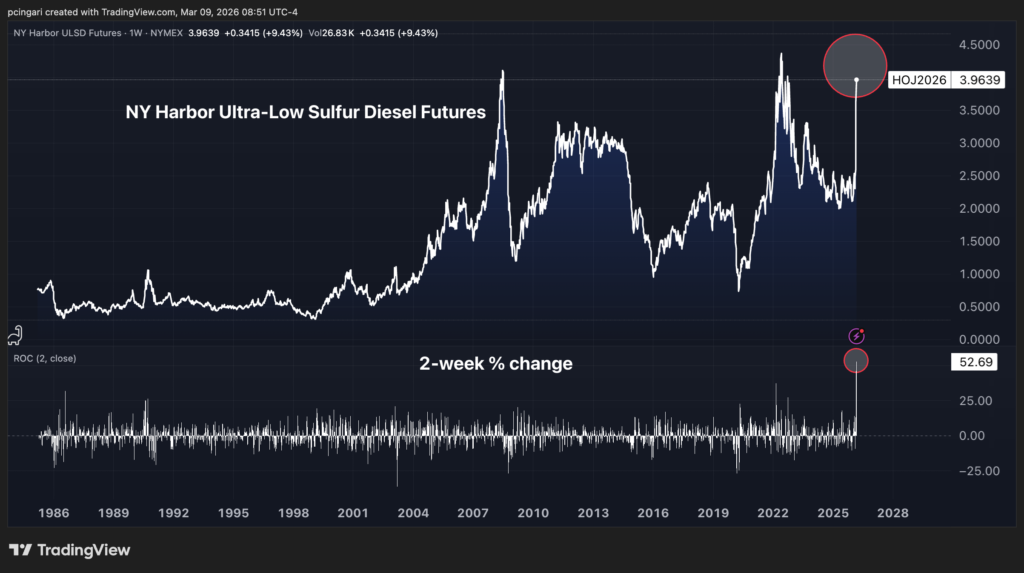
The benchmark ultra-low sulfur diesel front-month futures surged to roughly $4.00 per gallon on Monday, its highest level since June 2022 and within striking distance of the all-time high near $4.67 reached during the global energy crisis that followed Russia's invasion of Ukraine.
The speed of the move is striking.
Wholesale diesel prices have surged about 53% in just seven days since the start of the war in Iran, marking the largest 2-week increase on record for the commodity.
U.S. diesel prices are now trading roughly $1 above wholesale gasoline for the first time since December 2022, highlighting the growing tightness in global distillate markets.
Why Diesel Prices Are Rising So Fast
The surge in diesel prices is largely a supply shock amplified by geopolitical risk and structural demand rigidity.
Diesel demand is far less elastic than gasoline demand because it powers freight transportation, shipping, agriculture and industrial equipment — sectors that often operate under fixed contractual obligations.
"Demand for diesel is less elastic than for gasoline," said Jeff Krimmel, in exclusive comments to Benzinga.
"As gasoline prices spike, people drive less. Diesel is required to meet contractually obligated freight and transportation commitments."
According to the American Automobile Association, the U.S. national average price for diesel stood at $4.656 per gallon as of Monday.
In parts of California, including San Rafael, San Francisco and Santa Rosa, diesel prices have already climbed above $6 per gallon.
Crack Spreads Are Surging: Which Companies Are Going To Benefit?
For refiners, the key metric is the diesel crack spread, which measures the difference between crude oil costs and the value of refined diesel.
With crude trading near $102 and diesel futures around $4.00 per gallon, the implied value of diesel stands near $174 per barrel.
That places the diesel crack spread around $64 per barrel.
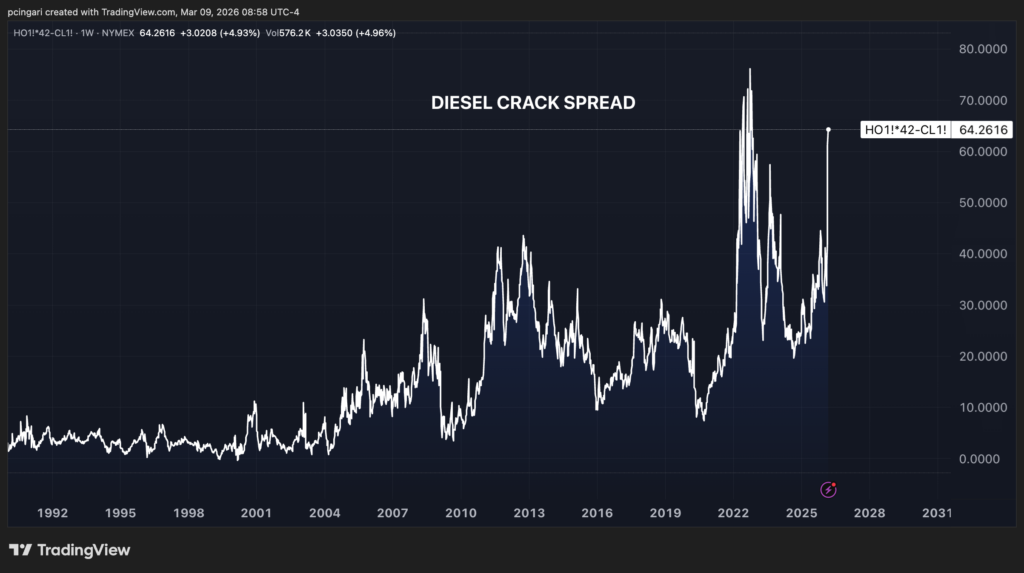
The level sits close to the record $83 spread reached in October 2022 during the global energy crisis.
When crack spreads expand, refining margins typically rise quickly.
That dynamic can significantly boost earnings for large refining companies, including Valero Energy Corp. (NYSE: VLO), Marathon Petroleum Corp. (NYSE: MPC) and Phillips 66 (NYSE: PSX).
These firms generate profit by purchasing crude oil and converting it into refined fuels such as gasoline, diesel and jet fuel.
The wider the spread between input costs and refined fuel prices, the higher their potential margins.
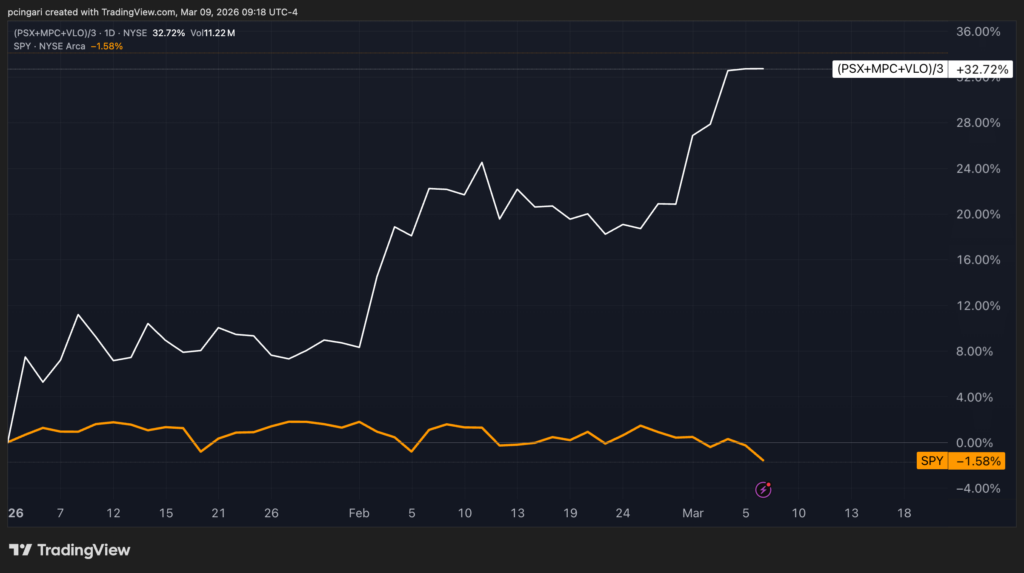
Year-to-date, an equally-weighted portfolio of these three refiners has already outperformed the SPDR S&P 500 ETF Trust (NYSE: SPY) by over 30 percentage points.
Central Banks Are Watching Energy Again
Energy shocks have historically complicated monetary policy. If rising diesel prices begin feeding into transportation and food costs, the inflation outlook could shift again.
"Increased diesel costs tend to propagate through the wider economy more quickly and more durably," Krimmel told Benzinga.
"It's a real area of concern if you’re looking for how higher oil prices can weigh against economic growth."
Prediction markets already reflect rising uncertainty around the path of interest rates.
Traders currently assign roughly a 55% probability of a European Central Bank rate hike in 2026 and about a 37% probability for the Bank of England.
In the United States, traders still see only a 13% probability of a Federal Reserve rate hike this year.
But energy shocks have a history of shifting inflation expectations quickly — and diesel may be the pressure point policymakers are now watching closely.
Photo: Shutterstock
Disclaimer: The content of this article solely reflects the author's opinion and does not represent the platform in any capacity. This article is not intended to serve as a reference for making investment decisions.
You may also like
2 Motives to Consider TTMI and 1 Reason for Caution

Oil is now the hottest topic on Crypto Twitter

Trending news
MoreCrypto prices
More





