EU enlargement commissioner Marta Kos has urged European businesses to engage with candidate countries and help repeat the economic successes seen during previous rounds of EU enlargement, as new report findings from the Confederation of Swedish Enterprise revealed that a large proportion of companies remain hesitant to engage.
"Enlargement boosted exports, boosted supply chains and grew GDP," Commissioner Kos said in her address at a Swedish Enterprise event in Brussels. She further noted how past enlargements have brought strong returns for investors and prosperity to millions of people.
However, she said that the success did not happen by chance and that the key ingredient was "reform", with investors coming when they knew their money was safe.
"This is why we are working closely with our candidate countries to build strong, democratic institutions. We want independent courts, less corruption, and free media. These are the foundations of a healthy economy, they create the conditions for people and business to grow," she said in her opening address.
She also highlighted how the EU is accelerating the gradual integration of candidate countries into the Single Market, adding that it will help make business easier and create new opportunities.
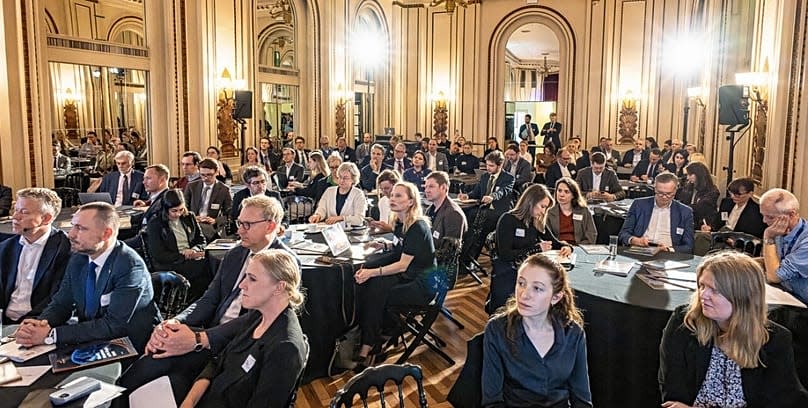
Policymakers, economists and business leaders attended the 4 March event in Brussels
- Confederation of Swedish Enterprise / Paul Marnef
Marta Kos also said at the end of her address that she is convinced that investments in candidate countries will pay off again.
"Ukraine, Moldova and the western Balkans have highly educated and digitally skilled people," she said, adding that as a result, businesses now have the chance to repeat "one of Europe's biggest economic success stories" and urged companies not to let the opportunity pass by.
Following the commissioner’s address, Mathieu Bousquet, Director at DG NEAR (the European Commission’s Directorate-General for Neighbourhood and Enlargement Negotiations), told Euronews’ business editor Angela Barnes that the Commission is keen to hear from European companies now interested in investing in candidate countries, and that it has launched several programmes to encourage engagement.
Mathieu Bousquet, Director at DG NEAR, speaks to Euronews' Angela Barnes
- The Confederation of Swedish Enterprise / Paul Marnef
The event also heard from, in addition to officials at the European Commission, economic analysts, corporate leaders and ambassadors from candidate countries including Montenegro and Serbia.
Speakers examined how the next phase of EU enlargement could affect Europe’s competitiveness, supply chains and labour markets, as well as what it could mean for companies already operating in or considering expansion into candidate countries.
A key theme throughout the discussion was scale. A larger EU Single Market could increase trade opportunities, strengthen supply chains and expand the pool of skilled workers available to European companies.
As Europe faces intensifying competition from global economic powers such as the United States and China, a broader EU market could also help firms achieve the scale needed to remain globally competitive.
Speakers also noted that enlargement could improve economic resilience by integrating neighbouring economies more deeply into EU regulatory and industrial frameworks.
During the discussion, experts presented findings from three new reports examining the economic implications of EU enlargement.
Steven Blockmans of the Centre for European Policy Studies, Eva Rytter Sunesen of Implement Consulting Group and Asees Ahuja from the Confederation of Swedish Enterprise presented research they co-authored analysing the business environment, macroeconomic impacts and the future of the EU’s Single Market.
The reports — EU Enlargement: How and Why it Matters to Businesses, Enlarging Europe – Opportunities for the Swedish Economy, and Future EU Enlargement and the Single Market — provide an assessment of how enlargement could affect companies, competitiveness and Europe’s economic architecture.
Their analysis suggests that integrating candidate countries into the EU could unlock growth through increased investment, trade flows and regulatory alignment. For companies already operating in these markets, EU accession could reduce barriers and create a more predictable business environment.
However, the research also highlighted challenges. Economic convergence between existing EU member states and candidate countries will require sustained investment and reforms, while businesses may need to navigate regulatory transitions and market adjustments.
According to Asees Ahuja, research from the Confederation of Swedish Enterprise shows that only around 39% of companies surveyed said reforms could make candidate countries more attractive business environments, highlighting persistent hesitation among European firms.
Steven Blockmans, Eva Rytter Sunesen and Asees Ahuja present report findings
- Confederation of Swedish Enterprise / Paul Marnef
Corporate leaders also shared practical insights into operating in candidate countries.
Thomas Møller of Alfa Laval, Tina Sundström Karlberg from Sweco, Anton Svensson of EWES Group and Artem Petrenko of Sigma Software Group described how their companies are already working in markets that could eventually join the EU.
For many businesses, enlargement could simplify cross-border operations, harmonise standards and create opportunities in sectors such as infrastructure, engineering, manufacturing and digital services.
At the same time, business leaders stressed that companies need clearer timelines and regulatory certainty in the accession process in order to plan investment strategies effectively.
The discussion also highlighted the importance of supply chains, regulatory alignment and labour mobility, as well as the role of EU funding in supporting infrastructure and reconstruction projects in candidate countries such as Ukraine.
Thomas Møller of Alfa Laval, Tina Sundström Karlberg from Sweco, Anton Svensson of EWES Group and Artem Petrenko of Sigma Software Group joined the business panel
- Confederation of Swedish Enterprise / Paul Marnef
The event concluded with reflections from diplomatic representatives of candidate countries and from Swedish Enterprise.
Petar Marković, Ambassador of Montenegro, and Danijel Apostolović, Ambassador of Serbia, discussed reforms underway in their countries and efforts to strengthen rule of law, public administration and regulatory alignment as part of the EU accession process.
Anna Stellinger, Deputy Director General at the Confederation of Swedish Enterprise, emphasised that EU enlargement should also be viewed through an economic lens.
She argued that expanding the EU could strengthen Europe’s industrial base, deepen the Single Market and support long-term economic growth by integrating neighbouring economies more closely into European value chains.
The conversation reinforced a broader point raised throughout the event: EU enlargement is not only a political or security initiative, but also a strategic economic opportunity for European businesses willing to engage in the process.
Petar Marković, Ambassador of Montenegro, Danijel Apostolović, Ambassador of Serbia, and Anna Stellinger, Deputy Director General at the Confederation of Swedish Enterprise
- Confederation of Swedish Enterprise / Paul Marnef