
Will Bitcoin follow oil’s historic surge and rally to $79K before the end of March?

Key takeaways:
Oil price spikes often precede 20% spikes in Bitcoin value, though initial market reactions remain volatile and unpredictable.
Bitcoin currently mirrors tech stocks with an 81% Nasdaq 100 correlation, making it less sensitive to oil prices.
Oil prices surged to $101 per barrel on Sunday, marking a 55% increase in ten days—the largest move in history. The event caused the S&P 500 to reach its lowest level in 10 weeks on Friday. Bitcoin (BTC) saw an initial positive reaction with prices jumping 16% between Feb. 28 and Wednesday, though it eventually erased the entire move by Sunday.
Traders now question whether Bitcoin price could suffer from the uncertainty brought by the US-Israel war with Iran. Persistently high oil prices could trigger inflation and hurt consumer spending while the US job market remains weak. Bitcoin price has benefited from sudden jumps in oil prices in the past, but the gains usually happen over a four-week period.

West Texas Intermediate (WTI) crude oil prices surged by 15% in a week starting on June 11, 2025, after global agencies assessed that Iran had enriched uranium nuclear warheads and Israel launched air strikes in the region two days later. Initially, Bitcoin price declined by 8% to $101,000 from $110,300, but it ended up reverting the move and posted 10% gains in four weeks.
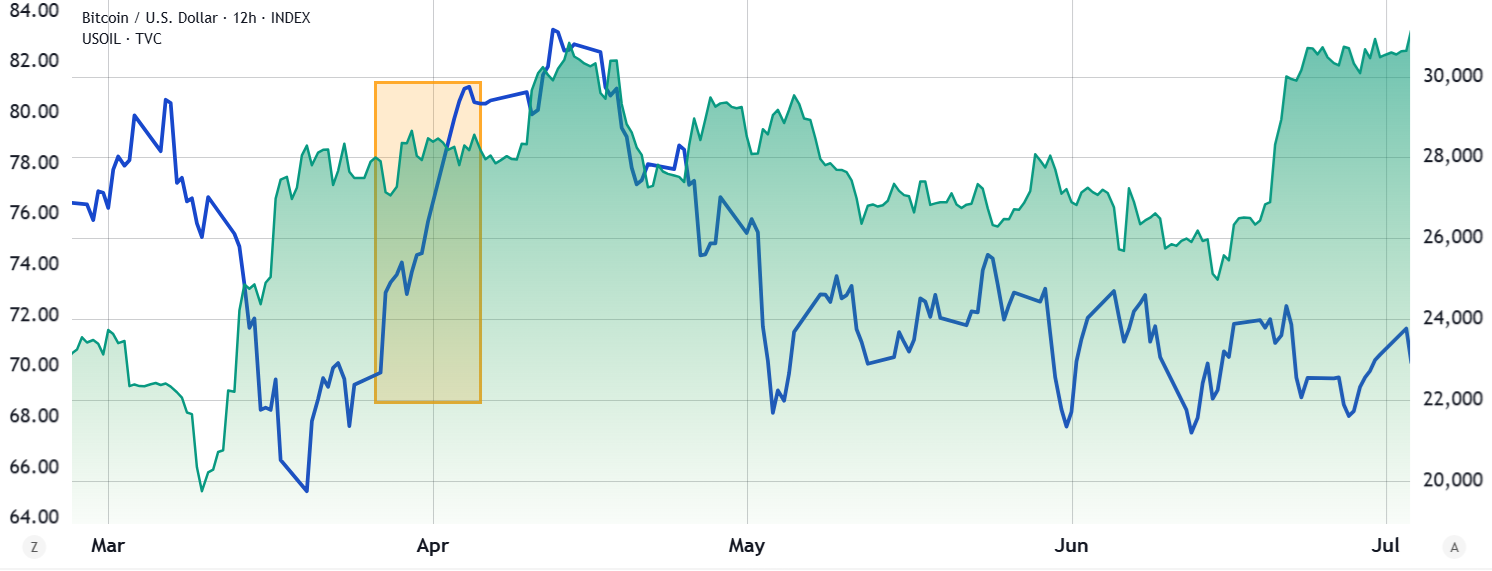
On March 27, 2023, WTI prices jumped by 16% in eight days, fueled by a legal dispute leading to 450,000 barrels per day in exports from Kurdistan and a surprise production cut from OPEC. Bitcoin price gained 12% in two weeks but failed to sustain the bullish momentum, returning to the initial $28,000 level in less than a month.

A 29% weekly rally in WTI oil prices initiated on Feb. 28, 2022, following the full-scale military invasion of Ukraine by Russia, triggered global sanctions on Russian oil exports. Bitcoin prices jumped 17% over the initial two days, but those gains evaporated by the end of the week. Still, Bitcoin price eventually surged by 25% over the next three weeks as its price reached $48,000.

WTI gained 23% in nine days starting on Nov. 2, 2020, as traders anticipated the rollout of COVID-19 vaccines and US oil inventories showed unexpected drops. Bitcoin price followed the trend, gaining 16% during that nine-day window, eventually seeing 45% gains from the initial $13,500 price in under a month.
Bitcoin may reach $79,200 by the end of March if history repeats itself
On average, Bitcoin gained 20% over four weeks during the last four times WTI jumped by 15% or more within 10 days. These instances happened between November 2020 and June 2025, a period that includes the bear market of 2022 and most of 2023. Still, four events are not statistically significant enough to prove a solid correlation.
Bitcoin’s price has been much more closely tied to the tech sector lately, shown by its current 81% correlation with the Nasdaq 100 index. If Iran or the US de-escalate sooner than expected, the stock market may recover, and Bitcoin should benefit from that bullish momentum.
Ultimately, the duration of the war in Iran will decide if a Bitcoin rally to $79,200 is possible by the end of March. That target would match the historical 20% average gain from the $66,000 price seen since the oil rally picked up steam on Feb. 28.
Disclaimer: The content of this article solely reflects the author's opinion and does not represent the platform in any capacity. This article is not intended to serve as a reference for making investment decisions.
You may also like
Barnes & Noble Education Subtly Keeps Things Unchanged
Target Slides 0.54 as $5B Overhaul Picks Up Speed but Places 201st in Trading Activity
3 Altcoins That Could Trigger $30 Million Liquidations This Week
Trending news
MoreCrypto prices
More





