
As bombs fall, gold prices rise — and Poland is taking notice

US and Israeli strikes on Iran have sent gold prices to a record $5,420 per ounce and triggered a rush into physical bullion, with buyers in Shanghai paying a $30 premium over London valuations, as markets recorded their sharpest flight to safe-haven assets in years.
Pawel Mazurek, president of Poland's Mazovia Mint, said demand for physical bullion had jumped sharply in the aftermath of the strikes.
"Some purchases are for hedging purposes, but some are unfortunately driven by emotions and fears of escalation," he explained.
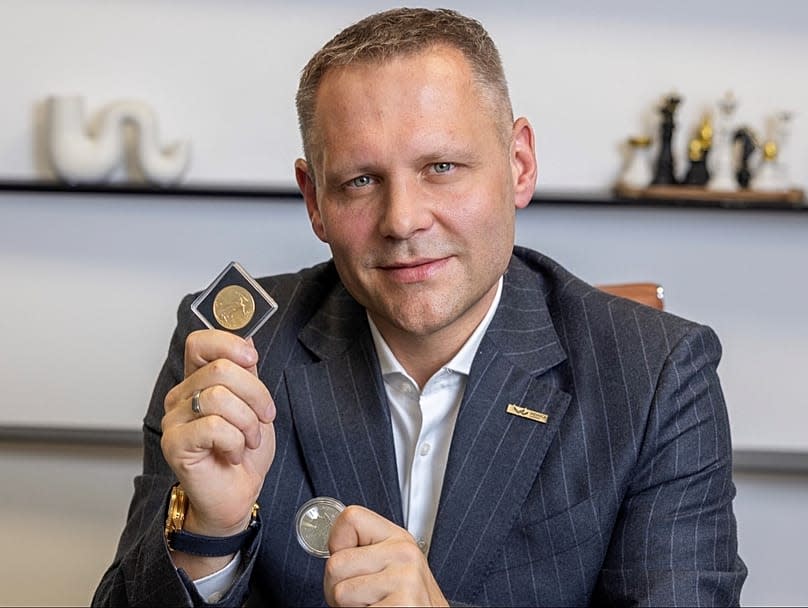
The pattern is not new. When Russia launched its full-scale invasion of Ukraine in February 2022, Mazurek said he learned of the attack not from the news but from his own order books.
"We saw it four years ago when the war in Ukraine broke out. Our company became aware that something bad had happened not [just] because of the headlines or the news, it was because we saw an exponential increase in interest in buying gold, queues in front of the company," Mazurek recalled.
"The war was a factor that influenced people to buy gold en masse [in] panic."
Gold at home vs in Central Banks
According to the Forex Club, 21% of Poles began investing in gold in 2025, with the largest percentage (12%) entering the market between April and November.
Mazurek said the trend was visible in his own sales figures.
"Interest in physical bullion is growing year-on-year by 30%-50%, mainly among individual buyers," he said, noting that the average transaction values had also risen, partly reflecting higher spot prices.
1-50 gram bars and bullion coins are the most popular entry points.
Despite the growth, Poland remains a laggard by regional standards.
Between 10% and 15% of Poles hold gold in their portfolios, against a markedly higher share among their Western neighbours.
In Germany, private households hold an estimated 9,000-9,300 tonnes — more than the Bundesbank's 3,350-3,378 tonnes.
In Poland the position is reversed: the National Bank holds around 550 tonnes, while private holdings are estimated at 200-500 tonnes.
At the start of 2023, the average Pole held roughly three grams of gold while the average German held around 103 grams.
Globally, private gold ownership is concentrated in South and East Asia.
India leads with an estimated 26,000-34,600 tonnes, largely in jewellery passed down through generations.
China holds 23,000-31,000 tonnes, the United States around 26,000 tonnes.
Turkey is a notable outlier in its region: the World Gold Council recorded 80 tonnes of purchases in 2022 alone, driven by inflation that reached 80% annually and deep mistrust in the lira.
Disclaimer: The content of this article solely reflects the author's opinion and does not represent the platform in any capacity. This article is not intended to serve as a reference for making investment decisions.
You may also like
Blackstone-owned AirTrunk secures record $1.24B loan for Tokyo AI data center
STABLE surges 14% – Here’s how shorts can trigger another rally
Sharplink Reports $734 Million Loss: An Accounting Outcome Influenced by Pricing
AUD/USD is starting to target this year's peak as market sentiment improves
Trending news
MoreCrypto prices
More





