
Pi Network enters a pivotal moment in March as market pressure, token unlocks, and ecosystem upgrades converge. The PI token continues to trade inside a weak structure while showing early signs of stabilization near key support levels.
The PI/USDT chart continues to reflect a broader bearish trend. Prices have formed lower highs and lower lows for months. Moreover, the token still trades below key exponential moving averages, which reinforces the weak market structure.
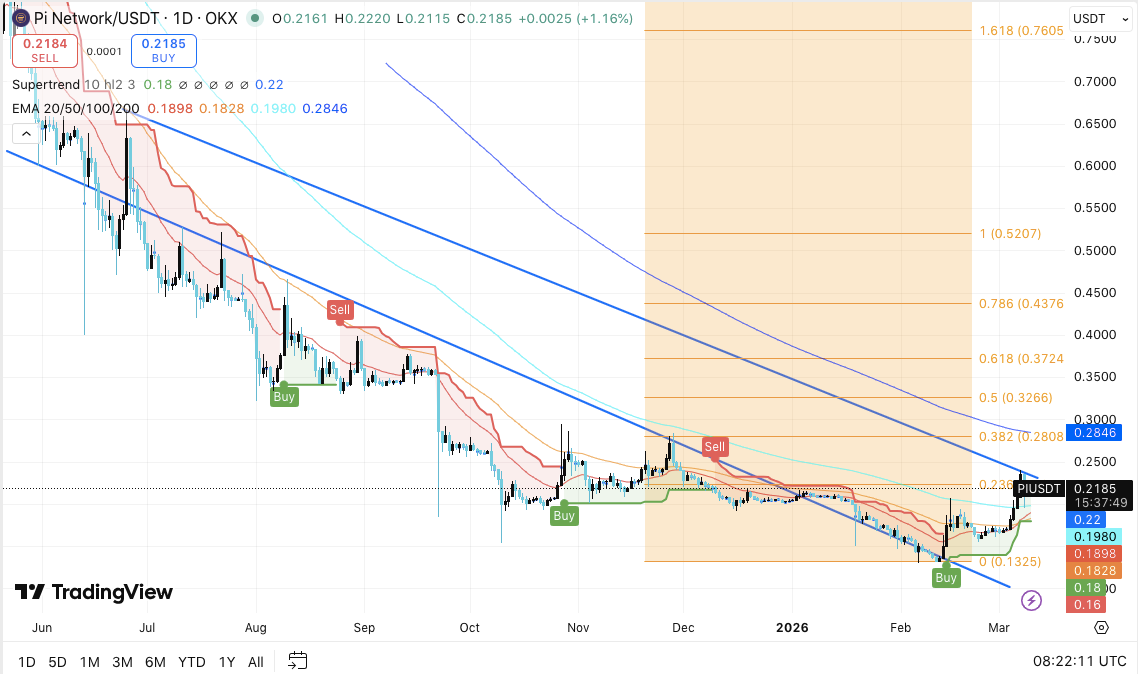
However, recent price activity hints at early stabilization. Buyers stepped in strongly near the $0.13 support zone. This reaction suggests accumulation from traders who expect a potential rebound.
Currently, the token trades around the $0.21 to $0.22 range. This level represents a critical decision area for the market. If the price breaks above $0.22 and holds, momentum could shift upward. Consequently, traders may target the next resistance zones near $0.236 and $0.28.
Related:
Nevertheless, failure to hold support near $0.18 would likely extend the downtrend. In that scenario, the market could revisit deeper support zones around $0.16 or even $0.135.
 Source:
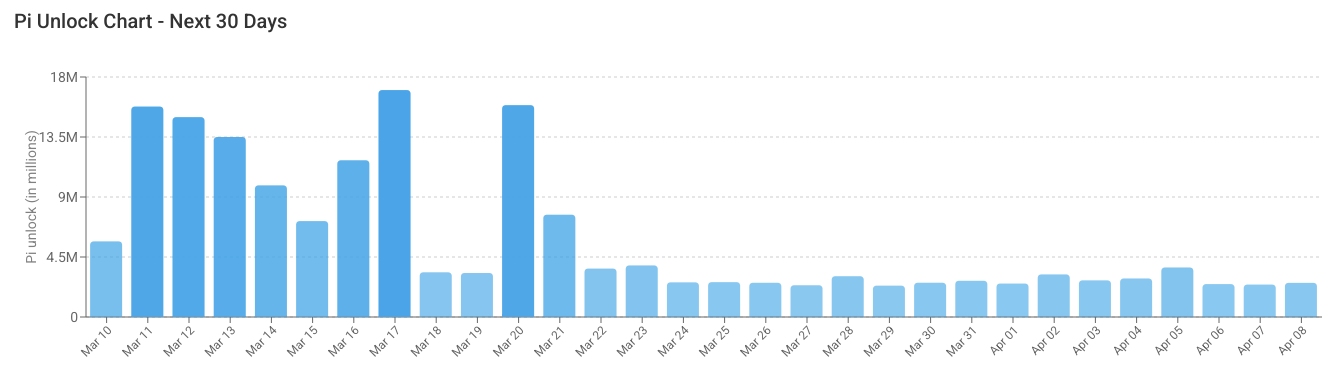
Besides technical signals, token supply dynamics could influence price movements this month. Data shows that more than 5.7 billion Pi tokens remain locked across the network.
Over the next thirty days, approximately 176 million tokens will unlock. This amount equals about three percent of the total locked supply. On average, nearly 5.9 million tokens could enter circulation each day.
Significantly, the largest release will occur on March 17. That day alone could unlock more than 17 million Pi tokens. Such supply increases sometimes trigger selling pressure if holders choose to take profits.
Consequently, traders often watch these unlock schedules closely when evaluating short-term price trends.
Moreover, March marks an important development period for the Pi ecosystem. Node operators must complete a mandatory v20.2 upgrade by March 12. This upgrade aims to improve network stability and operational efficiency.
Additionally, the Pi community expects long-awaited rewards for KYC validators. These participants helped verify millions of user identities across the network. Their efforts ensured that real users joined the ecosystem while limiting fraudulent accounts.
More than 17 million users have already completed verification. Hence, distributing validator rewards represents a significant milestone for the network.
Related:
Furthermore, community discussions suggest that a decentralized exchange could launch around Pi Day on March 14. If introduced, such a platform would allow asset trading within the Pi ecosystem.
Key price levels for Pi Network remain clearly defined as the market moves through a consolidation phase. Although the broader structure still reflects a downtrend, recent price action shows early signs of stabilization near major support zones.
Upside Levels: Immediate resistance appears near $0.22, which has acted as a rejection zone in recent sessions. A successful move above this level could open the path toward $0.236, a key Fibonacci resistance that may confirm stronger momentum. If buyers maintain control beyond that area, the next targets sit near $0.28 and $0.30, which represent the primary breakout zone for a broader trend shift.
Downside Levels: On the downside, $0.18 remains the most important support level in the current structure. Losing this level could push the price toward $0.16, which previously served as a consolidation base. Further weakness could expose the $0.135 demand zone, followed by deeper liquidity near $0.12.
Resistance Ceiling: The $0.28–$0.30 region, aligned with the descending macro trendline and long-term moving averages, represents the key resistance area. A sustained break above this zone would signal a possible medium-term trend reversal.
Technically, Pi appears to be compressing inside a broader descending structure while forming a short-term base above the $0.18 support. Such consolidation phases often precede larger volatility expansions once the market chooses a direction.
Pi Network’s near-term outlook depends largely on whether buyers can maintain support above $0.18 while gradually challenging the $0.22–$0.236 resistance cluster. Holding this support zone could allow the market to build momentum for a recovery toward $0.28 and potentially $0.30.
However, failure to defend the $0.18 level may extend the broader downtrend. In that scenario, the price could revisit $0.16 and eventually retest the $0.13 support region.
For now, Pi remains in a decisive range where both bullish recovery and continued downside remain possible. Upcoming ecosystem developments, token unlocks, and network upgrades may influence market sentiment as traders watch for the next major breakout.