
Hiltzik: The employment figures reveal that Trump's economic performance is actually quite poor

Gas Prices Surge Amid Economic Uncertainty
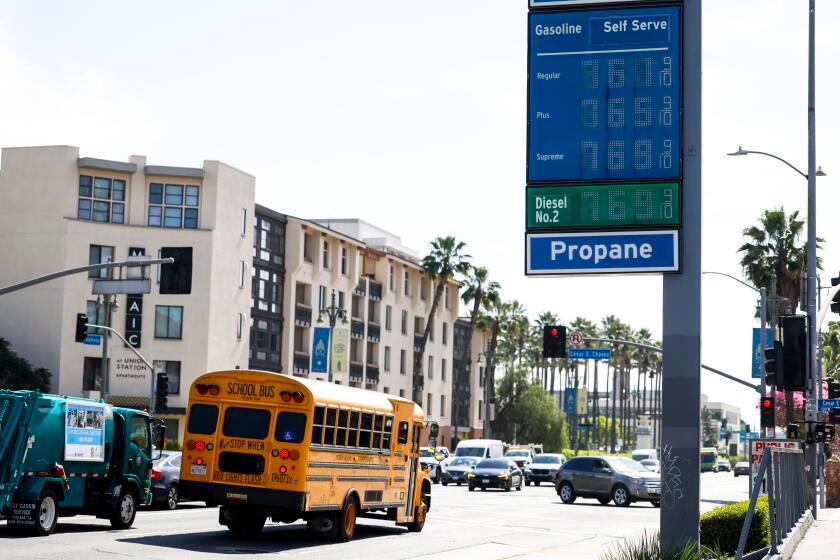
On March 6, a Chevron station in Los Angeles was charging $7.61 per gallon for regular gasoline, while the county's average price stood at $4.724—still considerably higher than the national average.
(Kayla Bartkowski / Los Angeles Times)
A Year of Broken Promises
The landscape has shifted dramatically over the past year. Elon Musk previously claimed his DOGE team could save the federal budget $2 trillion by reducing government jobs. In November, President Trump announced a plan to send $2,000 "tariff dividend checks" to Americans, excluding those with high incomes.
During his campaign, Trump pledged to slash gas and electricity bills by half. Later, he asserted that gas prices had dropped below $2 per gallon in certain regions, and recently claimed most states saw prices under $2.30 per gallon.
The anticipated transition from government-related jobs to a thriving private sector never happened.
Economist Mike Konczal explains the weakness in the U.S. economy.
None of these promises have been fulfilled.
Economic Indicators Point Downward
Most economic metrics are trending negatively, except for inflation and unemployment, which are rising. These figures largely predate the escalation of Trump’s conflict with Iran, which has pushed gas prices—and inflation—even higher.
The Bureau of Labor Statistics delivered a significant blow to Trump’s claims of economic strength, reporting a loss of 92,000 nonfarm jobs in February—contrary to economists’ expectations of growth.
Current forecasts for U.S. GDP through March 31 indicate substantial economic strain, though not an outright recession. The Atlanta Fed’s GDPNow projection dropped to an annual rate of 2.1% after the jobs report, down from 3.1% in late February. The New York Fed’s Nowcast has also declined, settling at 2.23% annually, not accounting for the latest job losses.
Economists monitoring employment data noticed a marked downturn since Trump introduced "liberation day" tariffs on April 2.
Further Reading
Job Market Contradicts Administration Narrative
Throughout the year, employment figures have undermined the Trump administration’s story. They argued that job growth under Biden was inflated by increases in government and healthcare positions, which they labeled "government-adjacent." Trump promised to shift these workers into a robust private sector, but that transition never occurred.
Government and Healthcare Jobs Dominate Growth
According to economist Mike Konczal, government, education, and healthcare jobs accounted for 73% of job growth in 2023-24, and their share increased to 88% during Trump’s term. In 2025, healthcare continued to drive job gains, while other sectors faltered. The expected move from public-sector jobs to private-sector vitality simply did not happen.
Overall job growth vanished in 2025, with nonfarm civilian employment dropping by 213,000 since January 2025 and by 571,000 since April 2024, when Trump announced the tariffs.
Manufacturing jobs, which Trump promised would benefit from tariffs, also declined—down 100,000 since he took office and 89,000 since April (seasonally adjusted).
The administration’s claim that mass deportations would boost employment for native-born workers proved false. The unemployment rate for native-born Americans rose to 4.7% in February from 4.4% a year earlier, surpassing the overall rate of 4.4% .
Meanwhile, the foundation provided by government and healthcare jobs has weakened. Since October, federal employment fell by 231,000, state jobs by 17,000, and healthcare and private education positions by 18,000.
Consumer Sentiment Drops
While most people aren’t experts at forecasting economic trends, they’re clearly dissatisfied with rising prices at grocery stores and gas stations. The University of Michigan’s consumer sentiment index edged up to 56.6 in February from 56.4 in January, but it’s down 12.5% from a year ago, when it was 65.7.
Further Reading
Unfulfilled Promises and Budget Shortfalls
Trump’s assurances of more and better jobs weren’t the only ones broken. Early in 2025, Musk lowered his federal budget savings target from $2 trillion to $1 trillion, but DOGE’s actual savings are estimated at $215 billion.
Tariff checks? The Supreme Court ended the possibility of $2,000 tariff dividend payments by ruling most of Trump’s tariffs unconstitutional. Even before the ruling, the idea was unrealistic—paying $2,000 to most Americans would cost up to $600 billion, far exceeding the $200 billion collected in tariffs and creating a massive budget deficit.
After the court’s decision, focus shifted to tariff refunds, which would mainly benefit importers and large retailers. Treasury Secretary Scott Bessent dismissed the notion that consumers would see any of these refunds, saying, "I get a feeling the American people won’t see it."
Even if Trump’s checks were issued, they would simply reimburse tariffs paid by the public, since tariffs are ultimately borne by importers and their customers. The average U.S. household has paid a steep price—about $1,800, according to Yale Budget Lab.
Tariffs and Inflation Fuel Price Increases
Tariffs contributed to rising inflation throughout 2025 and into this year. This was compounded by the spike in oil prices following Trump’s military action against Iran and the closure of the Strait of Hormuz, a key route for Middle Eastern oil exports. Trump’s claims about low gas prices have been completely disproven in the aftermath.
AAA reports that the national average price for regular unleaded gas hit $3.48 per gallon as of Monday, up from $3 a week ago and $2.90 a month ago. This increase comes before the full impact of oil prices—briefly reaching $120 per barrel—filters through to consumers.
Further Reading
Military Actions and Oil Shocks: Unpredictable Outcomes
Predicting the economic impact of military conflicts and oil price shocks is notoriously difficult. Of five major oil shocks tracked by SG Securities over the past 50 years—2022, 2003, 1990, 1979, and 1973—only the last three led to a U.S. recession within a year: the Gulf War, the Iranian revolution, and the Yom Kippur War.
The stock market often recovers from military upheavals, even if share prices initially drop. For example, the S&P 500 fell 41 points on Monday, about 1.6%, but rebounded by nearly 56 points after Trump declared the Iran conflict "very complete, pretty much."
Oil price spikes tend to benefit the energy sector, boosting profits for oil and gas producers, while hurting industries reliant on oil, such as manufacturers of capital goods.
Looking Ahead: A Clouded Economic Outlook
Economic forecasts are always subject to change, given the multitude of unpredictable influences. If the Iran conflict ends quickly, it could help the oil-dependent economy and stock market. However, stagnant job growth is weighing down the economy in the medium term.
Tariffs remain in place—Trump imposed a 10% duty across the board after the Supreme Court ruling and has discussed raising it to 15%.
In summary, the economic situation has grown increasingly bleak.
The Magic 8-ball, a popular toy from the 1950s and 1960s, offers as much insight as any economist when asked about the future. Its answers range from "Yes definitely" to "Don't count on it." With Trump steering the economy, the most fitting response may be, "Ask again later."
Get the Latest from Michael Hiltzik
Commentary on economics and more from Pulitzer Prize winner Michael Hiltzik.
This article was first published in the Los Angeles Times.
Disclaimer: The content of this article solely reflects the author's opinion and does not represent the platform in any capacity. This article is not intended to serve as a reference for making investment decisions.
You may also like
Saudi Arabia will reroute oil shipments in a matter of days to bypass the Strait of Hormuz

Bitcoin’s quantum upgrade path: What BIP-360 changes and what it does not
Archer's Legal Move in China: Is It a $2 Billion Liquidity Strategy or Just a $20 Million Daily Volume Sideshow?
How to navigate trading in the Trump 2.0 era
Trending news
MoreCrypto prices
More





