
XPeng (XPEV) Viewed Favorably by Analysts: Does the Claim Hold Up?

How Much Do Wall Street Analyst Ratings Really Matter?
Investors frequently turn to Wall Street analyst opinions when deciding whether to buy, hold, or sell a stock. News about changes in these analysts’ ratings can often move share prices. But how much weight should you actually give to these recommendations?
Before diving into the reliability of brokerage advice, let’s review what leading analysts are currently saying about XPeng Inc. Sponsored ADR (XPEV).
Current Analyst Outlook for XPeng
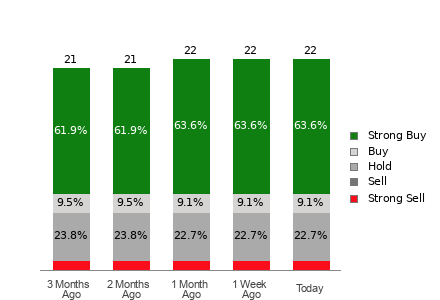
XPeng’s average brokerage recommendation (ABR) stands at 1.70 on a 1-to-5 scale, where 1 means “Strong Buy” and 5 means “Strong Sell.” This figure is based on the ratings from 22 different brokerages, and a 1.70 ABR falls between “Strong Buy” and “Buy.”
Of these 22 analyst ratings, 14 are “Strong Buy” and 2 are “Buy,” making up 63.6% and 9.1% of the total, respectively.
Trends in Brokerage Recommendations for XPEV
Should You Rely Solely on Analyst Ratings?
Although the ABR suggests a buying opportunity for XPeng , it’s important not to base your investment decisions on this metric alone. Research indicates that brokerage recommendations often fall short in identifying stocks with the highest potential for price appreciation.
Why is this the case? Brokerage firms often have a vested interest in the stocks they cover, which can lead to analysts issuing more positive ratings than warranted. In fact, for every “Strong Sell” rating, there are typically five “Strong Buy” recommendations.
This means that analyst interests may not always align with those of individual investors, and their ratings rarely provide clear signals about future price direction. Instead, consider using these recommendations to support your own analysis or to confirm signals from proven indicators.
Comparing ABR and Zacks Rank
Zacks Rank is a proprietary stock rating system with a strong track record, grouping stocks from #1 (Strong Buy) to #5 (Strong Sell). It’s designed to predict near-term price performance. Using the ABR to cross-check the Zacks Rank can help you make more informed investment choices.
Key Differences Between ABR and Zacks Rank
- ABR is based solely on brokerage recommendations and is often a decimal (e.g., 1.28).
- Zacks Rank is a quantitative model that leverages changes in earnings estimates, shown as whole numbers from 1 to 5.
Brokerage analysts tend to be overly optimistic due to their firms’ interests, which can mislead investors. In contrast, Zacks Rank focuses on earnings estimate revisions, which have a strong historical correlation with short-term stock price movements.
Additionally, Zacks Rank maintains a balanced distribution across all covered stocks, while ABR may not always reflect the most current information. Since Zacks Rank updates quickly with changes in analyst earnings estimates, it remains a timely indicator for stock price trends.
Is XPeng (XPEV) a Good Investment Right Now?
Recent changes in earnings estimates for XPeng show that the Zacks Consensus Estimate for the current year has dropped by 81.6% over the past month, now standing at -$0.23.
This significant downward revision, along with other earnings-related factors, has resulted in a Zacks Rank #4 (Sell) for XPeng.
Given this context, it may be wise to approach XPeng’s favorable ABR with caution.
The Next Wave of AI Investment Opportunities
The artificial intelligence sector has already created substantial wealth, but the most well-known companies may not offer the highest returns going forward. Emerging AI firms addressing major global challenges could present more attractive opportunities in the near future.
Disclaimer: The content of this article solely reflects the author's opinion and does not represent the platform in any capacity. This article is not intended to serve as a reference for making investment decisions.
You may also like
Can Clorox's Digital Push Accelerate Operational Efficiency?
CRCL's 88% Increase: The Data Driving the OCC Charter
1 Promising Large-Cap Stock and 2 We Decide to Pass On
Time Traveler: Here’s Why Market Cap Doesn’t Matter for XRP, Solana, and Cardano
Trending news
MoreCrypto prices
More





