
"Tech Bull Leaders" Once Again Support U.S. Software Stocks: Wrongly Hit by AI Panic, Degree of Divergence Unseen in 20 Years

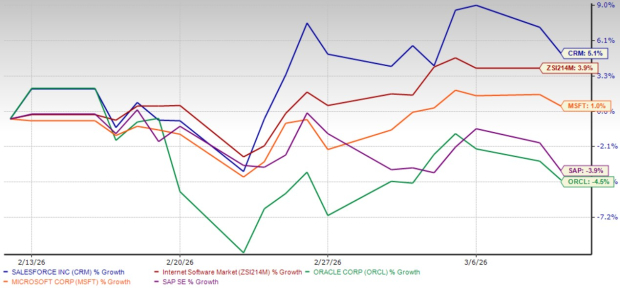
According to Zhitong Finance, Wedbush analyst and widely regarded as a “tech bull flag bearer” Dan Ives on Tuesday disagreed with the ongoing sell-off in U.S. software stocks, calling it "the most disconnected" tech trade he has seen in the past 15 to 20 years. Ives believes the market’s concerns that artificial intelligence (AI) will disrupt traditional software companies are exaggerated, leading to what he describes as “AI ghost trading,” which has unfairly punished the sector. Data shows the iShares Expanded Tech-Software Sector ETF (IGV) is down 19% year-to-date, while the S&P 500 Index is down just 0.4%.
Ives stated: “Ultimately it’s software—from Salesforce (CRM.US) to ServiceNow (NOW.US), through to use cases in the cybersecurity field such as CrowdStrike (CRWD.US), Palo Alto (PANW.US)—that is key. I believe this is the most severe sell-off in the sector that I’ve seen in decades.”
The analyst pointed out that recent progress made by AI company Anthropic in agents could signal a bottom for software stocks. He insists the real value of AI lies in established software platforms, not in pure AI companies.
Ives commented: “My view is that AI may disrupt some pure software vendors who rely on a single product line. But the reality is that data and value reside within the technology stack. It exists in the install bases of Salesforce, ServiceNow, Workday, Oracle, and so on.”
Ives predicts 30% of AI spending will ultimately flow to software companies and noted that Palantir (PLTR.US) has already demonstrated monetization potential. He further expects the sector to consolidate. He said: “Now, even taxi drivers in Miami are bearish on software, but I consider that a bullish signal relative to my view on the software sector this year.”
It’s worth noting that Dan Ives and his Wedbush analyst team stated in early February that although AI could put some short-term pressure on traditional software business models, the market is overreacting to this risk. The current software stock sell-off is already pricing in an extreme scenario of “industry-wide AI disruption,” which they believe is not feasible in reality.
Ives pointed out that enterprise clients are much more cautious about AI migration than the market assumes. Many companies are unwilling to chase AI gains at the expense of exposing core data to not-yet-mature new platforms, and are even less willing to abandon software infrastructure built up over decades and at a cost of hundreds of billions of dollars. He said: “AI is a headwind in the short term, that’s for sure, but the way the market is currently pricing it seems to suggest the software industry is facing 'doomsday,' which in our view is entirely divorced from reality.”
Wedbush emphasized that the existing large enterprise software ecosystem contains trillions of data points, and emerging AI companies like OpenAI and Anthropic are unlikely to fully take over these complex systems in the short term, whether in terms of data handling capacity or enterprise-level security protections. This means AI is more likely to be integrated as an "embedded tool" within existing software platforms, rather than entirely replacing them. Wedbush also highlighted Microsoft (MSFT.US), Palantir, CrowdStrike, Snowflake (SNOW.US), and Salesforce as the five software stocks most worth holding amid the “software winter.”
In addition, several market observers have also voiced concerns that U.S. software stocks are being excessively sold off. Nvidia (NVDA.US) CEO Jensen Huang in early February dismissed concerns that AI will replace software and related tools, calling such notions “illogical.” Speaking at an artificial intelligence conference in San Francisco hosted by Cisco Systems, Huang said that worrying about AI diminishing the importance of software companies is misleading. He believes AI will continue to rely on existing software rather than rebuilding foundational tools from scratch.
Huang stated: “There’s a view out there that the tools of the software industry are waning and will be replaced by AI… that’s the most illogical thing in the world, and time will prove it. If you are human or a robot, either artificial or general-purpose, would you use the tools or reinvent the tools? The answer is obvious: you’d use the tools… That’s why the latest breakthroughs in AI are about the use of tools, because tools were designed with specific functions in mind.”
J.P. Morgan strategists have also noted that while it is unclear whether traditional software companies will be replaced by AI in the long term, current market pessimism about AI-driven disruption is already an “overreaction” at this stage. Microsoft and CrowdStrike are mentioned by J.P. Morgan as examples of companies with AI resilience, likely to benefit from AI-enhanced workflow efficiency. The team stated that high switching costs for enterprise software and multi-year contracts provide a buffer against short-term shocks.
Disclaimer: The content of this article solely reflects the author's opinion and does not represent the platform in any capacity. This article is not intended to serve as a reference for making investment decisions.
You may also like
Paradigm-backed Across Protocol explores letting ACX holders exchange tokens for equity
EUR/USD declines after US CPI aligns with forecasts
CRM Shares Rise Over 5% in the Past Month: Is It Time to Buy, Sell, or Hold?
McEwen Mining earnings up next: Can miner deliver turnaround?
Trending news
MoreCrypto prices
More





