
US and Global Stocks: Is the Divide Shrinking?

Global Equity Markets: Shifting Performance Trends
In the past year, there has been a marked difference in returns between major global stock markets, with international equities outperforming their US counterparts. This represents a significant change from the previous decade, when US indices consistently led the way, especially compared to developed international markets like those tracked by the EAFE index (Europe, Australasia, and the Far East).
Between the early 2000s and the aftermath of the Global Financial Crisis, EAFE stocks—represented by the ETF—delivered returns similar to US equities. However, starting around 2013, US stocks began to pull ahead, with the S&P 500 compounding at 15.2% annually versus EAFE’s 7.1%. This trend reversed in 2025, as EFA nearly doubled the return of SPY (+31.6% compared to +17.7%), and this momentum continued into the first months of the current year.

Image Source: Zacks Investment Research
For years, investment theory has recommended diversifying portfolios with international equities alongside US holdings. Yet, for much of the past decade, this approach resulted in underperformance compared to a US-only strategy.
This leads to a key question: Is the recent outperformance of international stocks a temporary cycle or a more permanent shift? While a definitive answer is elusive, analyzing the sources of returns in these markets can offer insight into whether this trend will endure.
Additionally, recent geopolitical tensions—such as the escalation of the Iran conflict—have made EFA more sensitive to market volatility. Whether this signals a reversal of international equities’ recent gains remains to be seen.
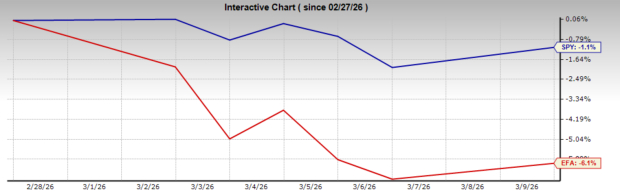
Image Source: Zacks Investment Research
EFA: Composition and Performance Drivers
The EFA ETF tracks large and mid-cap companies across 21 developed markets outside the US and Canada, including regions such as Europe, Japan, and Australia. Japan holds the largest allocation at about 22%, followed by the UK, France, Germany, and Switzerland. Financials and Industrials are the dominant sectors, making up 25% and 19% of the index, respectively, while Technology accounts for just 8%. Leading holdings include ASML, HSBC, AstraZeneca, Novartis, and SAP.
In 2025, EFA’s impressive 31.6% return was driven by four main factors: a weaker US dollar (which contributed roughly 8%), strong performance in Financials, a surge in Industrials—partly due to increased European defense spending—and generally attractive valuations compared to historical averages and US stocks.
The difference in returns between EFA and its currency-hedged version, HEFA, highlights the significant impact of currency movements in 2025. The weaker dollar directly boosted EFA’s performance, while for US investors, it acted as a headwind.
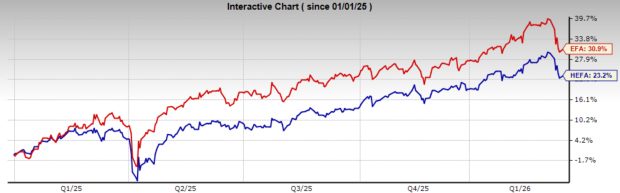
Image Source: Zacks Investment Research
Is the Shift Cyclical or Structural?
The US stock market’s dominance over the past decade was underpinned by strong fundamentals. S&P 500 companies saw earnings grow by about 8% annually, while EAFE companies managed only around 3%. This persistent gap justified higher valuations for US stocks and explained the lag in international allocations. The rise of the “Magnificent Seven” tech giants further widened the divide, as they benefited from trends like cloud computing, digital advertising, consumer tech, and more recently, artificial intelligence.
In contrast, EAFE entered 2025 trading at a significant discount, with forward price-to-earnings ratios well below its long-term average of 15x. The rally in 2025, fueled by faster earnings growth and improved valuations, brought EAFE’s multiples back in line with historical norms. Meanwhile, the S&P 500 remains elevated at about 22x forward earnings, compared to its historical median of 19x.
Looking forward, earnings growth will be crucial. Projections suggest S&P 500 earnings could rise by 13–14% in 2026, while EAFE is expected to grow by 10–11%—its strongest outlook in years. If these forecasts hold, the earnings gap that has persisted since 2012 may finally begin to close. However, it remains uncertain whether this convergence will last or if it’s simply a short-term effect driven by currency trends. EAFE has a history of missing optimistic earnings targets, so 2026 will be a year to watch closely.
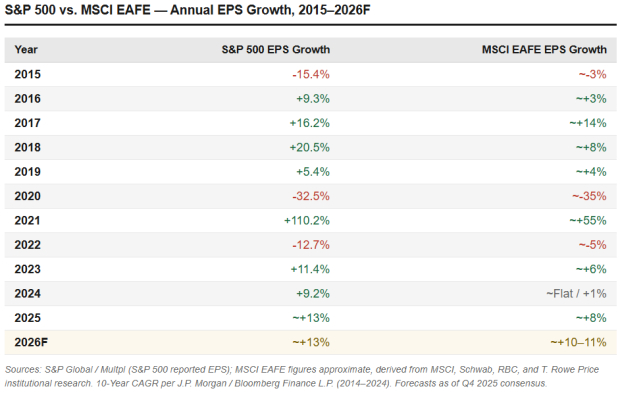
Image Source: MSCI, S&P Global
Beyond a Zero-Sum Perspective
Viewing global equity allocation as an either-or decision may be misleading. As we approach 2026, both US and international markets appear to have solid growth drivers, and the forces that caused their divergence are gradually stabilizing rather than reversing.
Despite being outperformed in 2025, the S&P 500 still posted robust absolute returns. Earnings growth remains strong, the US economy is resilient, and the index’s largest sectors—such as AI, cloud computing, and digital platforms—continue to thrive. A period of slower relative gains does not equate to weakness.
For EAFE, 2025 marked a turning point. Earnings growth picked up, valuations returned to historical averages, and structural changes—like increased European defense spending, corporate reforms in Japan, and a weaker dollar—provided a more stable foundation. The index enters 2026 in a stronger position than it has seen in years.
It’s also important to recognize that the distinction between US and international exposure is less clear-cut than index names suggest. Many S&P 500 companies generate significant revenue abroad, while EAFE firms are often more reliant on their domestic markets.
Quantum Computing: The Next Big Investment Opportunity
Quantum computing is poised to become the next major technological breakthrough, potentially surpassing even artificial intelligence in its impact.
Although some believed widespread adoption was still years away, the technology is advancing rapidly. Major tech companies—including Microsoft, Google, Amazon, Oracle, Meta, and Tesla—are racing to incorporate quantum computing into their systems.
Kevin Cook, a senior stock strategist, has identified seven stocks that are well-positioned to lead in the quantum computing revolution, detailed in his report, Beyond AI: The Quantum Leap in Computing Power.
Having recognized NVIDIA’s potential early on in 2016, Kevin now highlights quantum computing as the next transformative trend. Investors have a unique opportunity to get ahead of this emerging sector.
Disclaimer: The content of this article solely reflects the author's opinion and does not represent the platform in any capacity. This article is not intended to serve as a reference for making investment decisions.
You may also like
Privia Health (PRVA): Should You Purchase, Sell, or Retain After Q4 Results?
2 Reasons to Appreciate PTC and 1 Reason to Remain Cautious

No longer outrageous: Gold now has a path to $10,000 by 2029 - Capitalight’s Schieven
Cosmos Health Purchases $600,000 of Bitcoin, Expands Digital Asset Holdings to $3,100,000

Trending news
MoreCrypto prices
More





