
Microsoft’s P/S Ratio Is Above Average: Should You Buy, Sell, or Hold the Shares?

Microsoft: Premium Valuation and Shifting Investment Outlook
Microsoft has traditionally traded at a higher valuation compared to its technology peers. As the company moves into 2026, it faces a complex investment environment shaped by record-breaking cloud achievements and growing concerns about increased capital spending.
Currently, Microsoft’s forward 12-month Price/Sales ratio stands at 8.38, above the Computer – Software industry average of 7.02. With a Value Score of D, Microsoft’s growth prospects remain strong, but the current share price offers less appeal for new investors seeking an attractive risk-reward profile.
Valuation Overview
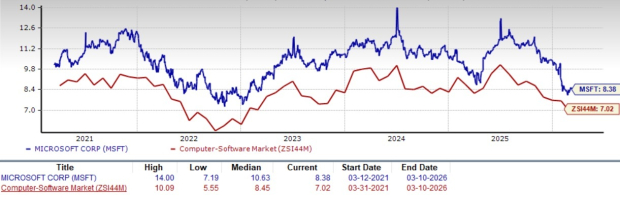
Image Source: Zacks Investment Research
Azure’s Performance: Strong Numbers, Investor Concerns
In the second quarter of fiscal 2026, Microsoft posted revenues of $81.3 billion—a 17% increase year over year—surpassing analyst expectations. Cloud revenue reached a record $51.5 billion, up 26% in constant currency. The Intelligent Cloud division brought in $32.9 billion, a 29% rise, while Azure and related cloud services grew by 39% (38% in constant currency). Adjusted earnings per share were $4.14, up 24%, and operating income climbed 21% to $38.3 billion, with a 47% operating margin. The company also returned $12.7 billion to shareholders via dividends and buybacks during the quarter.
Despite these strong results, Microsoft’s stock price fell sharply after the earnings announcement. Azure’s growth rate slowed compared to previous quarters, and capital expenditures jumped 66% year over year to $37.5 billion, raising questions about when these investments will pay off. Management noted that customer demand continues to exceed supply, a situation expected to last through at least the end of fiscal 2026.
Outlook: Sustained Growth Expected
For the third quarter of fiscal 2026, Microsoft anticipates total revenue between $80.65 billion and $81.75 billion, representing 15% to 17% growth year over year. The Intelligent Cloud segment is forecasted to generate $34.1 billion to $34.4 billion, with Azure expected to grow 37% to 38% in constant currency. Productivity and Business Processes should contribute $34.25 billion to $34.55 billion, reflecting 14% to 15% growth. Microsoft Cloud’s gross margin is projected to be around 65%, slightly lower than last year due to ongoing investments in AI infrastructure.
On a positive note, management now expects operating margins for fiscal 2026 to improve slightly, thanks to strong first-half performance and a favorable revenue mix. Capital expenditures are predicted to decline sequentially in the third quarter, which may ease investor concerns about cash flow. The Zacks Consensus Estimate for Microsoft’s fiscal 2026 earnings is $16.97 per share, signaling 24.41% growth and robust earnings momentum.
Microsoft Price and Consensus Trends
For more details, see the latest price and consensus charts for Microsoft Corporation.
Copilot Expansion and Product Innovation in 2026
Microsoft has continued to broaden its AI product offerings into early 2026. In February, the company introduced major updates to Microsoft 365 Copilot, such as mobile widgets for iOS and Android, Copilot Chat integration with Microsoft 365 Search, and enhanced scheduling tools for Outlook. These enhancements reflect Microsoft’s strategy to deeply integrate Copilot across its commercial suite and boost per-user monetization.
By March 2026, Copilot Search integration expanded to more workflows, and Microsoft launched new AI-focused certifications, reinforcing its commitment to transforming the enterprise workforce. The company also enhanced Defender for Cloud, creating a unified security experience within the Defender portal. Additionally, Microsoft adjusted commercial cloud pricing in several European currencies to better align with local markets, supporting international revenue growth.
Stock Performance and Industry Competition
Over the past six months, Microsoft shares have declined 20.4%. This performance is better than the Computer – Software industry’s 25% drop but lags behind the broader Computer and Technology sector, which gained 3.4%.
In the global cloud market, Amazon led with a 28% share in Q4 2025, followed by Microsoft at 21% and Google (owned by Alphabet) at 14%, according to Synergy Research Group. While Amazon remains the leader, Microsoft and Alphabet have achieved higher growth rates. Oracle consistently ranks fifth in global cloud infrastructure, holding a 3% market share in Q4 2025. Microsoft’s competitive position remains strong, but addressing the supply-demand imbalance is crucial for further market share gains.
Microsoft’s Recent Stock Performance
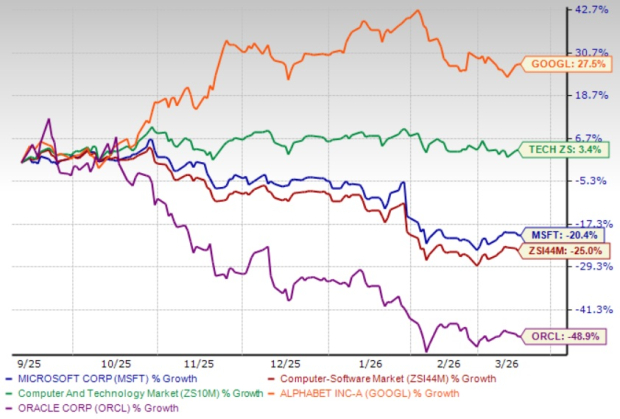
Image Source: Zacks Investment Research
Summary and Investment Perspective
Microsoft’s core strengths are evident, but its premium valuation, Azure’s capacity constraints, and the long-term nature of AI-related capital expenditures suggest that new investors may want to wait for a more attractive entry point. For current shareholders, the company’s leadership in cloud, ongoing Copilot monetization, and a substantial commercial backlog of $625 billion support the long-term investment case. At present, maintaining a Hold rating appears prudent, with a more favorable buying opportunity potentially emerging in 2026. Microsoft currently holds a Zacks Rank #3 (Hold).
Quantum Computing: The Next Major Tech Revolution
Quantum computing is rapidly emerging as a transformative technology, potentially surpassing the impact of AI. Major tech companies—including Microsoft, Google, Amazon, Oracle, Meta, and Tesla—are racing to incorporate quantum computing into their platforms.
Senior Stock Strategist Kevin Cook has identified seven stocks poised to lead in quantum computing, detailed in his report, Beyond AI: The Quantum Leap in Computing Power. Kevin, who recognized NVIDIA’s potential early on, now highlights quantum computing as the next significant opportunity for investors. This is a unique chance to position your portfolio at the forefront of this technological shift.
Disclaimer: The content of this article solely reflects the author's opinion and does not represent the platform in any capacity. This article is not intended to serve as a reference for making investment decisions.
You may also like
ESPR's fourth-quarter earnings fall short of expectations, while revenue surpasses forecasts, shares decline
Carvana Drops 2.87% During Turbulent Trading Session – What’s Driving the Decline?
Rheinmetall reports 45% growth and defence pivot but shares fail to lift
Revolut secures long-awaited banking license following dispute with Reeves

Trending news
MoreCrypto prices
More





