
KMX or CVNA: Which Offers More Value Compared to the Growth Option Right Now?

Shifting Trends in the U.S. Auto Market
Mounting affordability challenges are starting to transform the landscape of the American automotive sector. Data from Cox Automotive indicates that new car sales are projected to decrease compared to last year, as elevated prices and steeper loan rates deter potential buyers. Consequently, more consumers are expected to seek out pre-owned vehicles as a cost-effective alternative, opening up new prospects for businesses in the used car industry.
CarMax vs. Carvana: Two Leaders, Distinct Strategies
Among the top contenders in the used car market are CarMax and Carvana. Although they operate in the same arena, their approaches differ significantly. CarMax leverages a vast network of physical locations combined with online sales, offering customers flexibility and scale. In contrast, Carvana operates exclusively online, known for its innovative digital purchasing process and unique car vending machines, and has experienced rapid growth.
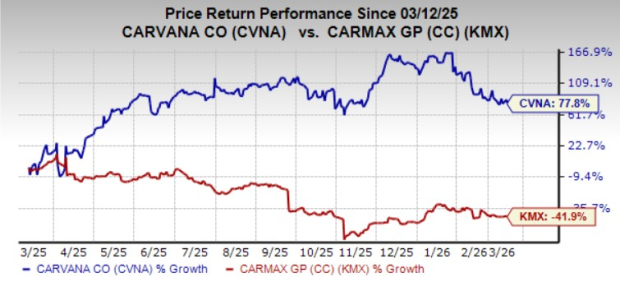
Over the past year, these companies have seen divergent stock performances: CarMax shares have dropped by approximately 42%, while Carvana’s stock has soared by about 78%.
Source: Zacks Investment Research
Valuation metrics further highlight their differences. Carvana is valued at a forward sales multiple near 2.46x, significantly higher than CarMax’s 0.23x.

Source: Zacks Investment Research
Given these contrasts, is CarMax now a value opportunity after its decline, or does Carvana have more room for growth? Let’s examine both companies in detail.
Why CarMax Stands Out
CarMax is the largest used car retailer in the nation, generating revenue not only from vehicle sales but also from its financing arm, CarMax Auto Finance, and services such as extended warranties, repairs, auctions, and vehicle reconditioning. This comprehensive model enables CarMax to profit at multiple points in the used car lifecycle, utilizing both brick-and-mortar and digital channels.
In the third quarter of fiscal 2026, CarMax delivered mixed results. While both earnings and revenue surpassed analyst expectations, they declined year-over-year due to weaker demand for used vehicles. Retail used car sales dropped by 8%, and comparable store sales fell by 9%. However, the financing division remained robust, with CarMax Auto Finance posting over $174 million in income—a 9% increase from the previous year—helping to stabilize overall profitability.
CarMax’s extensive national presence and logistics capabilities are key advantages. Its widespread locations allow efficient sourcing, preparation, and distribution of vehicles. The company has also invested in reconditioning centers closer to major markets, reducing transportation expenses and accelerating inventory turnover, which should improve efficiency and lower costs over time.
Strategic acquisitions and partnerships have further strengthened CarMax’s ecosystem. The acquisition of Edmunds has enhanced its digital offerings and provided valuable automotive data, while collaboration with Recurrent has improved insights into the condition of used electric vehicle batteries, boosting the company’s credibility in the growing EV segment.
Operational efficiency is a core focus, with management aiming for at least $150 million in annual SG&A savings by fiscal 2027. Early progress includes workforce reductions and technology-driven improvements in customer service centers.
CarMax is also committed to shareholder returns, having repurchased over $200 million in stock last quarter, with more than $1.3 billion remaining authorized for future buybacks.
The Growth Story of Carvana
Carvana has become the second-largest used car seller in the U.S., yet it still commands only about 1.6% of the fragmented automotive retail market, indicating significant growth potential.
In 2025, Carvana’s retail sales surged 43% to nearly 600,000 vehicles, with revenue climbing 49% to over $20 billion. Profitability also improved, as adjusted EBITDA rose more than 60% to $2.2 billion and margins expanded from 10.1% to 11%. These figures underscore Carvana’s ability to scale while enhancing profitability per vehicle.
However, rapid growth has introduced operational challenges. In the fourth quarter of 2025, reconditioning expenses—costs associated with preparing vehicles for sale—increased notably, reflecting the company’s ongoing expansion of its preparation facilities. Some new sites are still overcoming early inefficiencies, which has temporarily elevated costs and reduced profit per vehicle.
Investors are also monitoring Carvana’s guidance, which remains somewhat vague. The company anticipates “significant growth” in retail sales and adjusted EBITDA for 2026 but has not provided specific targets. Sequential improvements are expected in the first quarter, consistent with typical seasonal trends.
Despite these uncertainties, Carvana’s leadership is optimistic about long-term prospects. They believe that strong demand and operational improvements could eventually support annual sales of 3 million vehicles. The company already owns real estate and facilities capable of handling up to 1.5 million vehicles per year.
Why CarMax May Be the Better Choice Right Now
Both CarMax and Carvana are well-positioned to benefit from increased demand for used vehicles. Carvana’s rapid growth and expanding market share are impressive, but this momentum comes with increased operational risks, as seen in rising reconditioning costs. Additionally, Carvana’s high valuation suggests that much of its growth potential may already be reflected in its stock price.
CarMax, by contrast, offers a more stable and value-driven investment. Despite recent softness in sales, the company’s established national network, diversified revenue streams, and profitable financing operations provide resilience during market downturns. Ongoing cost reductions, logistics enhancements, and continued share repurchases could further bolster margins and shareholder value.
From a valuation perspective, CarMax appears attractively priced, trading at a much lower forward sales multiple than Carvana. Investors are paying less for a company with substantial scale, infrastructure, and multiple avenues for profit. Carvana currently holds a Value Score of D, while CarMax boasts a Value Score of A.
Given these factors, CarMax presents a more balanced risk-reward profile at current levels, making it a compelling investment option. CarMax holds a Zacks Rank #2 (Buy), whereas Carvana is ranked #3 (Hold).
Disclaimer: The content of this article solely reflects the author's opinion and does not represent the platform in any capacity. This article is not intended to serve as a reference for making investment decisions.
You may also like
3 Top Performing Stocks Set for Significant Growth at This Moment
Bitcoin to $78K? Pro traders price in less than 17% odds of a breakout

Q32 Bio Breaks Out — But Can It Hold the Momentum?
Trending news
MoreCrypto prices
More





