
Mideast Shipping Emergency Escalates as Additional Tankers Struck in Gulf

Escalating Tensions in the Persian Gulf Disrupt Global Oil Markets
Recent Iranian assaults on maritime vessels in the Persian Gulf have triggered a surge in crude oil prices, briefly pushing them above $100 per barrel. The International Energy Agency has described the resulting turmoil as the most significant disruption the oil market has ever faced.
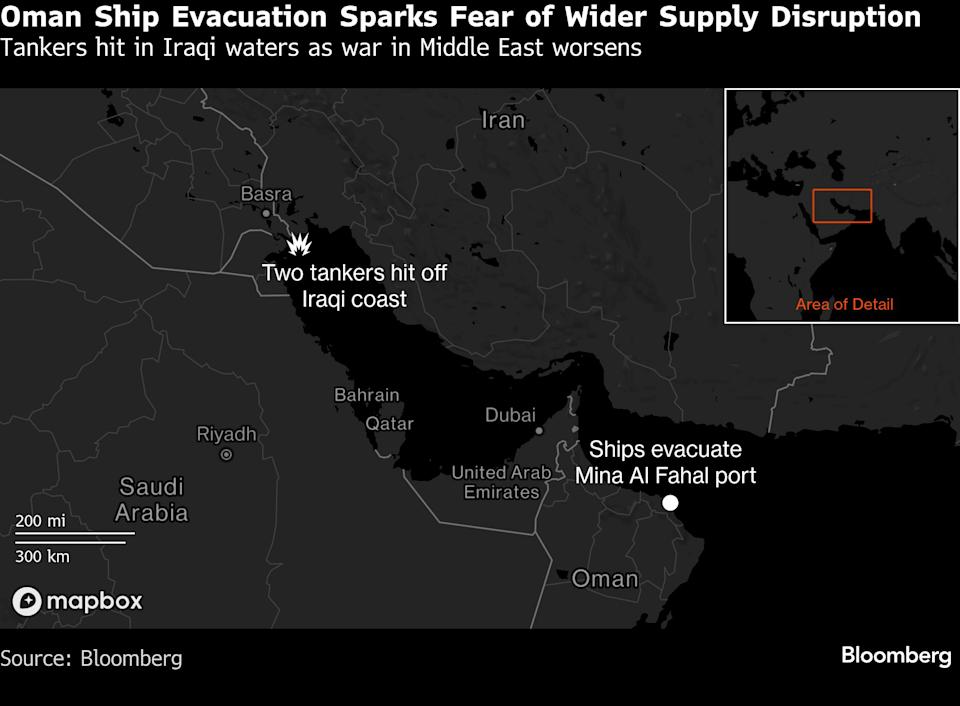
Two ships were attacked near Iraq’s coastline, prompting the closure of the country’s oil terminals. This escalation is expected to further discourage global shipping companies from navigating the crucial Strait of Hormuz.
Top Stories
The ongoing conflict is having a growing impact on energy markets, with fuel costs climbing and some regions already facing shortages. Saudi Arabia and other oil-producing nations in the Middle East have recently reduced their output and are urgently seeking alternative export routes that bypass the Strait of Hormuz. Since the outbreak of hostilities, this vital passage—responsible for about 20% of global oil shipments—has been largely inaccessible, severely restricting the flow of commodities worldwide.
Fuel prices, including diesel and jet fuel, are rising sharply as regional refineries scale back or halt operations. Meanwhile, refineries elsewhere are reluctant to buy crude at elevated prices. The International Energy Agency has warned that this month’s supply could drop by 8 million barrels per day, marking an unprecedented disruption in oil production.
Recent Developments in the Region
Attacks on ships have become more frequent. According to the UK Maritime Trade Operations, a vessel was hit by an unidentified projectile north of Jebel Ali in the UAE on Thursday, following three separate incidents the previous day.
Brent crude, the global oil benchmark, soared by up to 10% on Thursday as the crisis worsened. Even the announcement of a record 400-million-barrel release from reserves, coordinated by the International Energy Agency, failed to ease the price rally. Market participants are still waiting for details on how quickly these reserves can be deployed.
Iraq’s State Organization for Marketing of Oil (SOMO) identified the targeted tankers as the Safesea Vishnu, registered in the Marshall Islands, and the Malta-flagged Zefyros. As a result, Iraq halted operations at its oil terminals, according to statements from the General Company for Ports of Iraq.
Impact on Ports and Shipping
SOMO stated that these events threaten Iraq’s security and economy and endanger maritime safety and oil activities within its territorial waters.
Ships at Oman’s Mina Al Fahal oil terminal were also evacuated as a precaution, though the port resumed normal operations after several hours. This incident highlights how the conflict is spreading, jeopardizing even those ports outside the Strait of Hormuz that are still able to export Middle Eastern oil.
Warren Patterson, head of commodities strategy at ING Groep NV, noted that disruptions in Oman have heightened concerns about broader regional supply, suggesting that the market must now consider risks beyond just the Strait of Hormuz.
Escalation of Attacks
The evacuation at Mina Al Fahal followed drone strikes at other Omani ports the previous day. Drones also targeted fuel tanks at Salalah Port, leading to the suspension of operations at its container and general cargo terminals. Other ports in Oman, such as Duqm, continue to function normally, according to Inchcape Shipping Services.
Xu Muyu, a senior crude oil analyst at Kpler Ltd., remarked that while the near two-week closure of the Strait of Hormuz seemed like the worst-case scenario, the recent naval evacuations in Oman suggest the situation could deteriorate even further.
Omani Oil Exports and Market Effects
Approximately 1 million barrels of Omani crude are exported daily from Mina Al Fahal, with prices on Thursday significantly higher than the Brent benchmark. Disruptions at Oman’s export terminals are particularly important because this grade is one of only two still used to set the Middle East’s Dubai price benchmark, which influences the value of most regional oil supplies. Last week, S&P Global Energy excluded varieties loaded from within the Persian Gulf from this pricing mechanism.
S&P Global Energy did not provide a comment on the situation.
Regional Oil Flows and Limitations
The effective closure of the Strait of Hormuz has forced Iraq, Kuwait, and Saudi Arabia to cut production. While exports continue from Fujairah—the UAE’s main terminal outside the strait—some shipping companies are avoiding the port due to security risks. Saudi Arabia is also transporting oil via pipeline to Yanbu on the Red Sea coast. However, these alternative routes cannot handle the roughly 20 million barrels per day that typically pass through the strait, and the impact of the IEA’s emergency release will be limited.
“Even with a record coordinated release of emergency reserves, the volume reaching the market will only offset a small portion of the current supply losses,” said ING’s Patterson.
Reporting assistance by Rong Wei Neo, Sherif Tarek, and Anthony Di Paola.
More from Bloomberg Businessweek
©2026 Bloomberg L.P.
Disclaimer: The content of this article solely reflects the author's opinion and does not represent the platform in any capacity. This article is not intended to serve as a reference for making investment decisions.
You may also like
Why MercadoLibre (MELI) Stock Is Dropping Today
Inspired and Offerpad Shares Decline, Key Information You Should Be Aware Of
PLANCK (PLANCK) 24-hour volatility at 62.2%: Trading volume surge triggers fluctuation without news event driver
Here’s Why This XRP Pundit Says $1,200 Remains His Target
Trending news
MoreCrypto prices
More





