
Bitdeer shares drop 20% after posting $266M quarterly loss

Shares of Singapore-based Bitcoin miner Bitdeer Technologies fell nearly 20% on Monday after the company reported a jump in quarterly losses.
Bitdeer recorded a net loss of $266.7 million for the third quarter of 2025, compared with a net loss of $50.1 million for the same period a year ago, largely due to non-cash losses resulting from the revaluation of its convertible debt.
Revenue climbed to $169.7 million, up 174% from the previous year, driven by the expansion of its self-mining operations, according to the company.
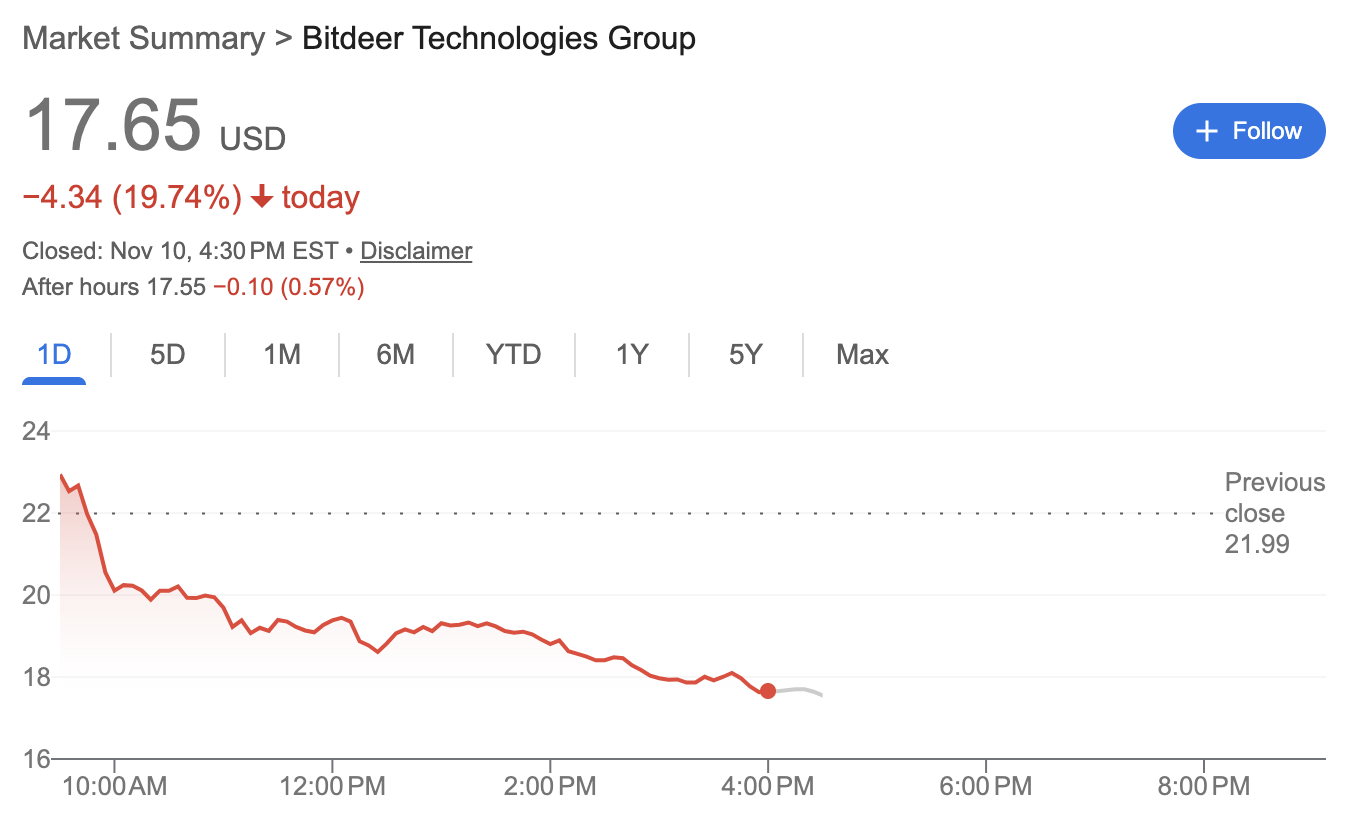
Bitdeer also reported gains in its operating performance, with adjusted EBITDA rising to $43 million from a $7.9 million loss in the same period in 2024. The company also doubled its Bitcoin production, mining 1,109 BTC during the quarter.
Bitdeer reported its first revenue from high-performance and AI cloud services, bringing in $1.8 million in Q3 as it began shifting part of its computing power toward artificial intelligence.
Matt Kong, chief business officer at Bitdeer, said the company was “uniquely positioned to capitalize” on AI and the surge in demand for computing power. He added that allocating “200 MW of power capacity to AI cloud services could generate an annualized revenue run-rate exceeding $2 billion by the end of 2026.”
Bitdeer ended the quarter holding 2,029 BTC, up from 258 BTC a year earlier, and managed 241,000 mining rigs, compared with 165,000 at the same time last year.
Related: EToro stock jumps on Q3 results, $150M buyback plan
Bitcoin miners turn to AI
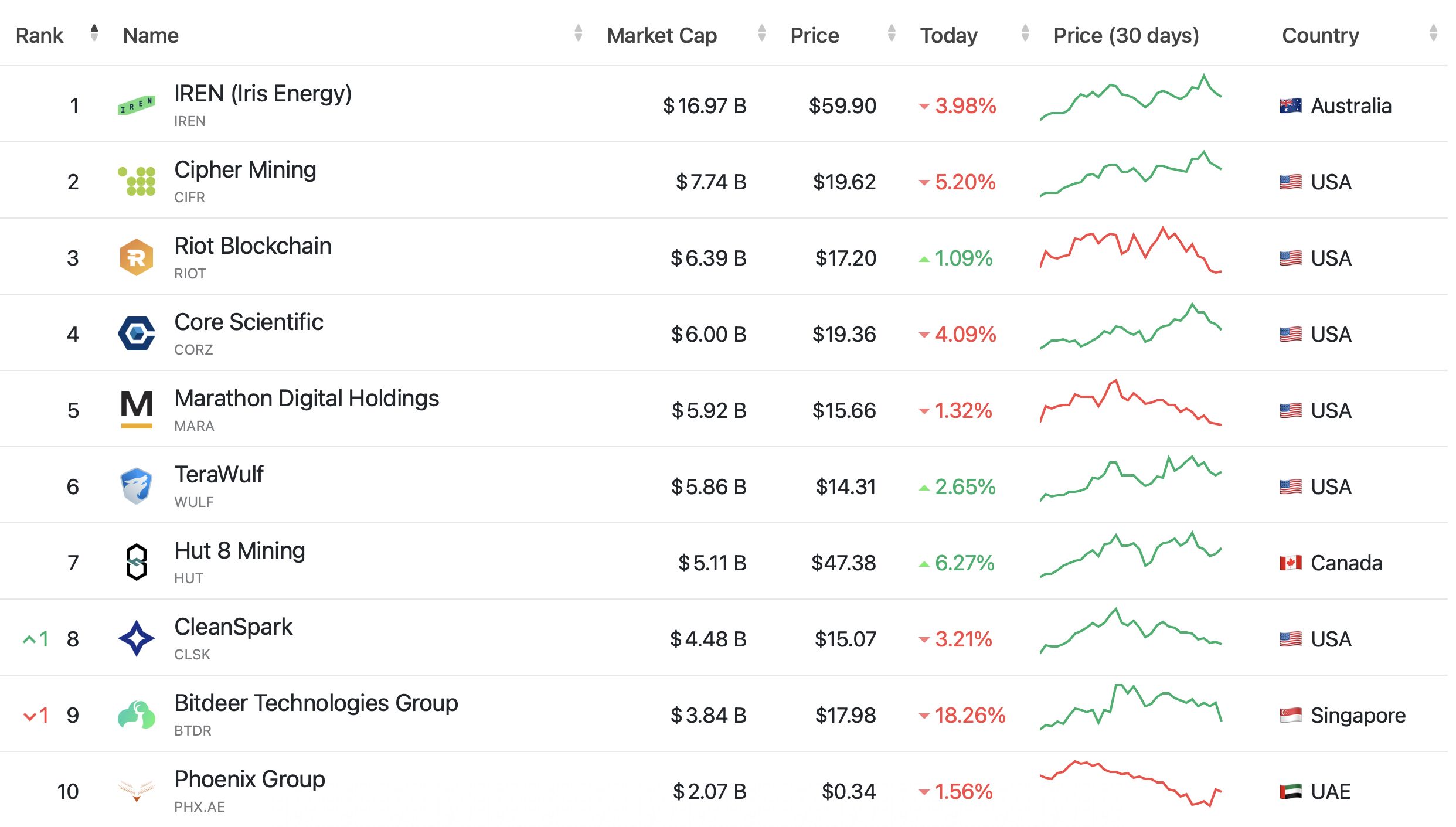
An increasing number of Bitcoin mining companies are pivoting to AI and high-performance computing (HPC), repurposing a portion of their power capacity to meet the fast-growing demand for computing power.
In August, MARA Holdings announced a $168 million deal to acquire a 64% stake in Exaion, a subsidiary of France’s EDF, to expand into low-carbon AI infrastructure, while TeraWulf signed 10-year colocation agreements with AI company Fluidstack worth $3.7 billion in contract revenue.
On Nov. 3, Bitcoin miner IREN announced a five-year, $9.7 billion GPU cloud services deal with Microsoft, giving the tech giant access to Nvidia GB300 chips hosted in IREN’s data centers.
While the pivot by Bitcoin miners into AI and HPC has been picking up momentum this year, it isn’t entirely new.
In July 2023, HIVE Blockchain Technologies rebranded as HIVE Digital Technologies, reflecting its shift to an HPC strategy, alongside its traditional cryptocurrency mining operations.
In March 2024, Core Scientific signed a multi-year, $100 million deal with GPU cloud firm CoreWeave to host HPC workloads at its Texas data center.
Magazine: How Chinese traders and miners get around China’s crypto ban
Disclaimer: The content of this article solely reflects the author's opinion and does not represent the platform in any capacity. This article is not intended to serve as a reference for making investment decisions.
You may also like
Moonbirds to launch BIRB token in early Q1 2026

Aligning Universities with Emerging Industries: The Critical Need for STEM Investment
- Global industries demand AI, renewable energy, and biotech skills faster than traditional education systems can supply, creating a critical skills gap. - Universities like MIT and Stanford are embedding AI across STEM curricula while industry partnerships accelerate hands-on training in automation and biomanufacturing. - Renewable energy programs with apprenticeships and public-private funding are addressing talent shortages as $386B global investments outpace workforce readiness. - Biotech's fragmented

PENGU Token Value Soars: Blockchain Data and Institutional Interest Indicate Optimal Timing for Investment
- PENGU ranks #81 with $706.5M market cap, showing rising institutional interest and whale accumulation. - The pending Canary PENGU ETF, if approved, could unlock institutional capital by including NFTs in a U.S. ETF. - Mixed on-chain signals (RSI 38.7, OBV growth) and 2B tokens moved from team wallets highlight uncertainty. - Partnerships with Care Bears and Lufthansa, plus Bitso collaboration, expand utility but face regulatory risks. - Recent 8.55% price rebound and 2.6% gain post-BNB listing suggest ca
Evaluating How the COAI Token Scandal Influences Cryptocurrency Regulatory Policies
- COAI Token's 88% price crash and $116.8M loss exposed systemic risks in centralized AI-DeFi projects with opaque governance. - Global regulators responded with stricter frameworks, including EU's MiCA and Singapore's asset freezes, to address jurisdictional gaps. - Institutional investors now prioritize compliance, with 55% of hedge funds allocating to digital assets via tokenized structures in 2025. - Emerging solutions include AI-driven risk platforms and anthropological governance models to enhance tr

Trending news
MoreCrypto prices
More





