
The disparity between company earnings and employee pay is now at its greatest point ever

Corporate Profits Soar as Worker Compensation Lags
A recent economic indicator that measures the relationship between company earnings and employee pay has reached its highest level since the end of World War II. This widening gap highlights growing frustration among Americans from all walks of life.
The following chart, created by KPMG economist Diane Swonk, illustrates the share of gross domestic product attributed to corporate profits compared to the portion allocated to workers’ wages. The visual is reminiscent of the so-called "K-shaped" economy, where the financial well-being of the wealthy improves while those with fewer resources fall further behind.
“The last several decades have been increasingly challenging for workers,” Swonk explained in an interview with USA TODAY. “Conditions have steadily deteriorated, and we’re now reaching critical turning points.”
Swonk noted that, despite official statistics suggesting the economy is relatively stable, consumer confidence has sharply declined, leaving many Americans feeling divided and disillusioned.
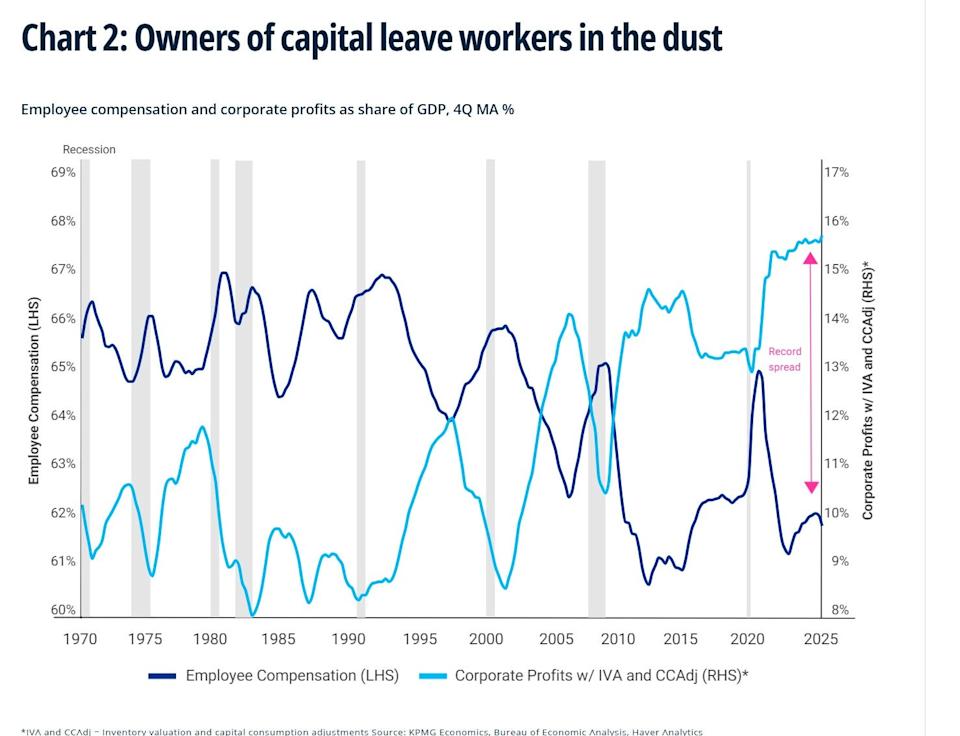
The disparity between corporate profits and employee compensation as a share of GDP has reached unprecedented levels.
Understanding the 'K-Shaped Economy'
Is the U.S. experiencing a 'K-shaped economy'?
Many Americans are left wondering why they struggle to get ahead, even after following conventional advice such as pursuing higher education. Some feel frustrated that they are not as financially secure as earlier generations, while others face daily challenges just to cover basic expenses.
“This is how narratives of mistrust develop,” Swonk observed. “There’s a widespread feeling of being let down.”
Policy Challenges and Lingering Discontent
Swonk described the current economic mood as so grim that it’s difficult to recommend effective policy solutions. For instance, temporary subsidies for health insurance introduced during the COVID-19 pandemic provided relief for a time, but their expiration in 2025 left many Americans without support. These measures, she noted, merely masked deeper issues in a health care system that often fails patients, providers, and insurers alike. Many people became reliant on these subsidies, exposing the system’s underlying fragility.
Although Swonk admits she has few concrete answers, she believes it’s crucial to highlight the data that reveal underlying problems. “It’s important for the public to see the real picture,” she said, “because the economy is not the same as the stock market.”
Adapted from USA TODAY: Corporate profits v. worker wages: a record-high gap
Disclaimer: The content of this article solely reflects the author's opinion and does not represent the platform in any capacity. This article is not intended to serve as a reference for making investment decisions.
You may also like
Altseason Mentions Hit Extreme Lows: Is Dogecoin About To Benefit?

GMX mounts rally as projects reevaluate effectiveness of buybacks
EXCLUSIVE: Why US, Iran War May Not Spark The Oil Crisis Everyone Fears
CVS cautions that the proposed legislation could result in the closure of 134 pharmacies within this state
Trending news
MoreCrypto prices
More





