
Philip Morris Stock Dips as Executive Sales Clash with Institutional Buying and 173rd-Ranked Trading Volume Near 52-Week High

Market Snapshot
Philip Morris International (PM) closed February 27 with a 0.36% decline, trading at $187.44 per share. The stock’s volume of $0.94 billion ranked it 173rd in daily trading activity, reflecting moderate investor engagement. The company’s 50-day moving average stood at $173.12, while its 200-day average was $163.67, indicating a steady but unremarkable upward trend. The stock’s 12-month range was $142.11 to $191.30, with the current price near the upper end. Analysts highlighted a market capitalization of $291.78 billion and a P/E ratio of 25.78, suggesting a mix of growth and value positioning.
Key Drivers
Executive Share Sales and Institutional Activity
Philip Morris’s CEO, Jacek Olczak, sold 80,000 shares at $182.18 apiece, totaling $14.57 million. The transaction reduced his ownership by 11.23% to 632,344 shares valued at $115.2 million. Similarly, CFO Emmanuel Babeau sold 33,800 shares at $181.61, cutting his stake by 17.05%. These sales, disclosed via SEC filings, may signal executive liquidity needs but could also raise questions about insider confidence in the stock’s near-term trajectory.
Institutional investors, however, showed a contrasting pattern. Capital International Investors increased its stake by 13.7% in Q4, now holding 101.4 million shares valued at $16.3 billion. Vanguard Group Inc. and Capital Research Global Investors also boosted holdings by 1.6% and 25.3%, respectively. Collectively, institutional ownership accounts for 78.63% of shares, underscoring strong institutional confidence.
Analyst Outlook and Earnings Performance
Analysts maintained a cautiously optimistic stance. Barclays and Needham & Company LLC reiterated “overweight” and “buy” ratings, setting price targets of $205. However, Jefferies Financial Group and Wall Street Zen downgraded the stock to “hold,” citing mixed market conditions. The consensus price target of $196.83 implies a 5% upside from the current price.
Earnings data provided a mixed picture. For Q1 2026, PM reported $1.70 EPS, meeting estimates, and revenue of $10.36 billion, slightly below the $10.40 billion forecast. Year-over-year revenue growth was robust at 6.8%, driven by international markets. The company’s Q1 guidance of $1.80–$1.85 EPS and full-year projection of $8.38–$8.53 EPS align with analysts’ expectations of $7.14 EPS for FY 2026. Despite a negative return on equity (-130.95%) and net margin of 12.09%, the firm’s smoke-free product portfolio and dividend yield of 3.1% (via a $1.47 quarterly payout) remain appealing to income-focused investors.
Market Sentiment and Strategic Positioning
The stock’s recent performance reflects broader trends in the tobacco sector. While PM’s pivot to smoke-free alternatives aligns with global health trends, regulatory pressures and shifting consumer preferences persist. The company’s 3.1% dividend yield, coupled with a payout ratio of 80.88%, highlights its commitment to shareholder returns but raises sustainability concerns.
Institutional buying and analyst optimism suggest confidence in PM’s long-term strategy, particularly its focus on international markets. However, executive share sales and mixed analyst ratings indicate some uncertainty about short-term momentum. The stock’s beta of 0.39, well below the market average, further positions it as a defensive play in volatile markets.
Conclusion
Philip Morris’s stock faces a tug-of-war between strong institutional support and mixed executive sentiment. While earnings growth and dividend stability provide a foundation for long-term appeal, near-term volatility may persist due to analyst divergences and regulatory risks. Investors appear to balance optimism about the company’s strategic shift toward reduced-risk products against caution around leadership actions and sector-wide challenges.
Disclaimer: The content of this article solely reflects the author's opinion and does not represent the platform in any capacity. This article is not intended to serve as a reference for making investment decisions.
You may also like
American Bitcoin posts $59M Q4 loss
Ripple CEO: Gary Gensler Apologizes to Ripple (XRP), Says “Sorry, I Was Wrong”
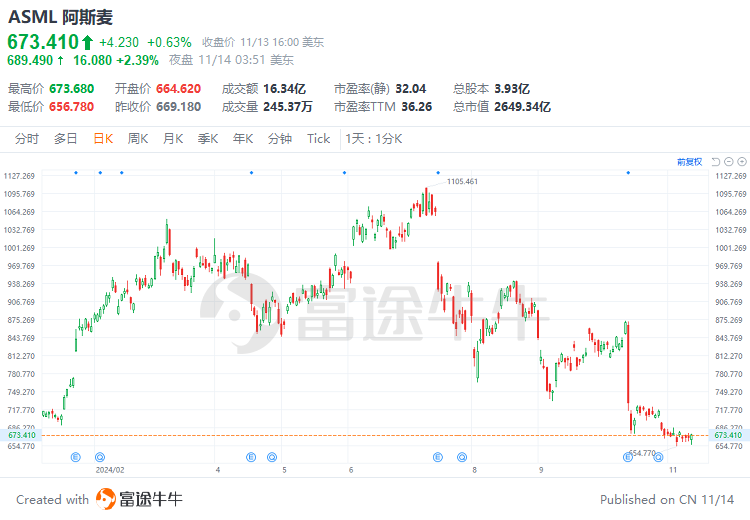
AI需求依然强劲,ASML预计未来五年销售增长率平均为8%-14%
The Saturday Spread: Leveraging a Lesser-Known Signal to Evaluate Genuine Market Risk
Trending news
MoreCrypto prices
More





