
‘Popular’ Dispersion Strategy Shaken Amid Escalating Concerns Over Iran

Middle East Tensions Disrupt Popular Hedge Fund Strategy
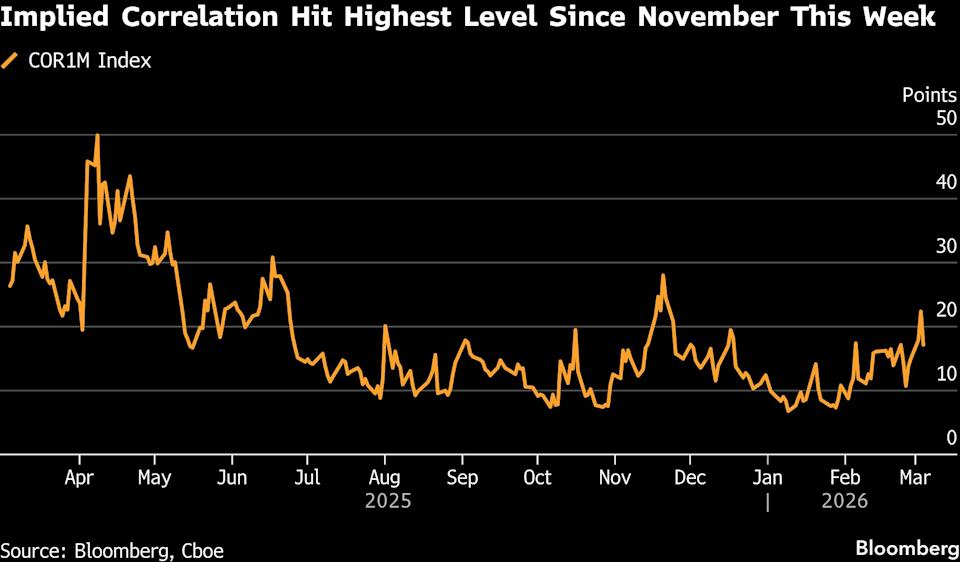
Recent escalations in the Middle East have shaken a widely used hedge fund approach, raising concerns that ongoing volatility could ripple through the broader financial markets.
The dispersion trade, which involves using options to capitalize on the gap between the volatility of a major index and its individual stocks, has been a go-to tactic for many investors. This strategy tends to succeed when the S&P 500 continues its gradual climb, even as individual stocks experience significant fluctuations—a pattern that has held for several months.
Top Stories from Bloomberg
However, investors were caught off guard earlier this week when renewed conflict in Iran triggered a wave of risk aversion. On Tuesday, a key measure of implied one-month correlation surged to its highest point since November, as both individual stocks and the broader indexes experienced sharp declines.
Although correlations eased as markets recovered the following day, the episode has left those employing the dispersion strategy on alert for further volatility spikes.
“We may be approaching a pivotal moment,” noted Amy Wu Silverman, head of derivatives strategy at RBC Capital Markets. “Geopolitical events often lead to sudden increases in correlation.”
In a typical dispersion trade, hedge funds purchase options on single stocks while selling options on the index itself.
Matthew Thompson, co-portfolio manager at Little Harbor Advisors, observed that the trade has become crowded, making it more susceptible to rapid unwinding if market conditions shift. Such a scenario could intensify declines in major indexes as many investors attempt to exit similar positions simultaneously.
“When a large number of participants are making the same bet based on shared assumptions, and those assumptions are challenged, it can easily trigger a domino effect,” Thompson explained.
Despite ongoing geopolitical uncertainty, positive economic data and easing inflation helped lift stocks on Wednesday. The VIX, which tracks expected S&P 500 volatility over the next month, dropped to just above 21 after peaking at 28 earlier in the week.
“The US dispersion trade is like a ticking time bomb,” said Alexis Maubourguet, founder and chief investment officer of Adapt Investment Managers. “But it hasn’t exploded yet.”
Nevertheless, signs suggest Wall Street is bracing for further market swings. Thompson pointed out that an inverted VIX futures curve appeared on Tuesday, indicating strong demand for protection against near-term volatility.
Potential Triggers for Further Market Turbulence
Beyond the conflict in Iran, Thompson highlighted growing concerns in credit markets as another possible catalyst. Private credit funds, including those managed by Blue Owl Capital Inc. and Blackstone Inc., are facing significant withdrawals, and analysts warn that default rates could climb if artificial intelligence disrupts corporate America as much as some expect.
“Credit-related issues can drive the VIX to elevated levels and spark widespread selloffs,” Thompson said. “That risk remains present.”
Most Read from Bloomberg Businessweek
©2026 Bloomberg L.P.
Disclaimer: The content of this article solely reflects the author's opinion and does not represent the platform in any capacity. This article is not intended to serve as a reference for making investment decisions.
You may also like
Bilibili's Q4 2025: The Profit Beat Was Priced In, the Revenue Miss Wasn't
Iran Tensions: Cryptocurrency Movement Response and Divergence
Ladbrokes parent company discloses £500m loss due to Reeves’s tax increase
The Dow plunges 750 points as higher oil prices keep inflation fears alive
Trending news
MoreCrypto prices
More





