
Bitcoin is now a main player in the global energy war

Opinion by: Vugar Usi Zade, chief operating officer of MEXC
Bitcoin is meant to be apolitical. It doesn’t take sides because it can’t. Its task is to continue producing blocks approximately every 10 minutes and maintain a full record of all historical transactions.
For the past 16 years, it’s done that job very well. Just because Bitcoin, as a technology, is neutral doesn’t mean that Bitcoin (BTC), as an asset, is neutral. As governments increasingly weaponize energy markets, Bitcoin’s transformation from a neutral protocol into a strategic geopolitical asset is accelerating far faster than most observers realize.
It’s subject to the same political forces that are brought to bear on other ostensibly neutral assets, such as oil, whose supply and demand pits nation-states against one another. Both assets, after all, are synonymous with energy: oil, which powers the automotive and manufacturing industries, and Bitcoin, whose proof-of-work consumes vast amounts of energy.
It was therefore inevitable that, once nations began circling Bitcoin, it would become a casualty of the global energy arms race. The creation of strategic Bitcoin reserves, coupled with governmental support for mining in countries with excess energy capacity, has placed BTC on the frontlines of a global resource war. Hashpower is the new soft power for countries intent on becoming superpowers.
Bitcoin is now in the crosshairs of nations of all sizes. In the past, governments attacked it. Now, they’re attempting to enlist it as a defensive weapon in the resource wars that may define the next two decades of human struggle.
The quest for absolute power
The energy arms race is a scramble for dominance in a world where power generation is literal and figurative. Nations flush with surplus electricity from renewables or underutilized fossil fuels are increasingly channeling that excess into mining Bitcoin, whose annual energy consumption now runs at 5-7x that of Google, about 38% of which is derived from renewables.
Around the world, excess electricity is increasingly being used for Bitcoin mining — from Ethiopia, where authorities have officially authorized the use of excess hydropower to attract foreign mining companies, to France, where data centers are increasingly using excess renewable energy to power digital asset operations.
What was once a hobby for tech libertarians, bitterly opposed to big government, has been commoditized into a state-sponsored industrial policy where hashpower serves as a proxy for geopolitical clout. And where states compete for a finite resource, politicking abounds, including China accusing the US of hacking its mining pools.
At a glance, converting idle kilowatt-hours (kWh) into Bitcoin is just economic efficiency. When nation-states sanction such a strategy, they risk turning Bitcoin into an unwitting pawn in a resource rivalry that echoes the OPEC oil shocks of the 1970s. This shift marks a pivotal moment because state-sanctioned mining no longer reflects simple economic optimization but a deliberate attempt to convert energy dominance into monetary influence.
Bitcoin’s proof-of-work consensus demands energy-intensive computation to secure the network, with global mining consuming an estimated 202 terawatt-hours annually. This voracious appetite creates a natural arbitrage for energy-rich locales. Stranded assets, like flared natural gas in Russia’s Arctic fields or curtailed wind power in Texas, find new purpose in humming server farms.
Mining rigs, efficient at absorbing variable supply, act as a “flexible demand” buffer, stabilizing grids while generating revenue in the form of block rewards and transaction fees. This effectively transforms excess energy into exportable value: a barrel of oil’s worth of joules, but digitized and borderless.
So far, this doesn’t sound so bad. Who cares who’s behind the hashpower, after all, provided the Bitcoin network is secure?
Related: Nine myths about Bitcoin energy use challenged by data, ESG expert says
The risks only come into focus when envisioning a future in which nations competitively accumulate Bitcoin through a combination of mining, criminal seizures and open-market purchases. In such a scenario, any country that acquires a significant tranche of coins will possess a formidable economic weapon.
Battling with Bitcoin
The establishment of a national reserve of any asset introduces the risk of its use for political purposes and the potential to distort market dynamics. Indeed, there are clear parallels between a strategic Bitcoin reserve and the Strategic Petroleum Reserve, which has faced accusations of being used for short-term political gain — for example, by releasing oil to lower gas prices ahead of an election.
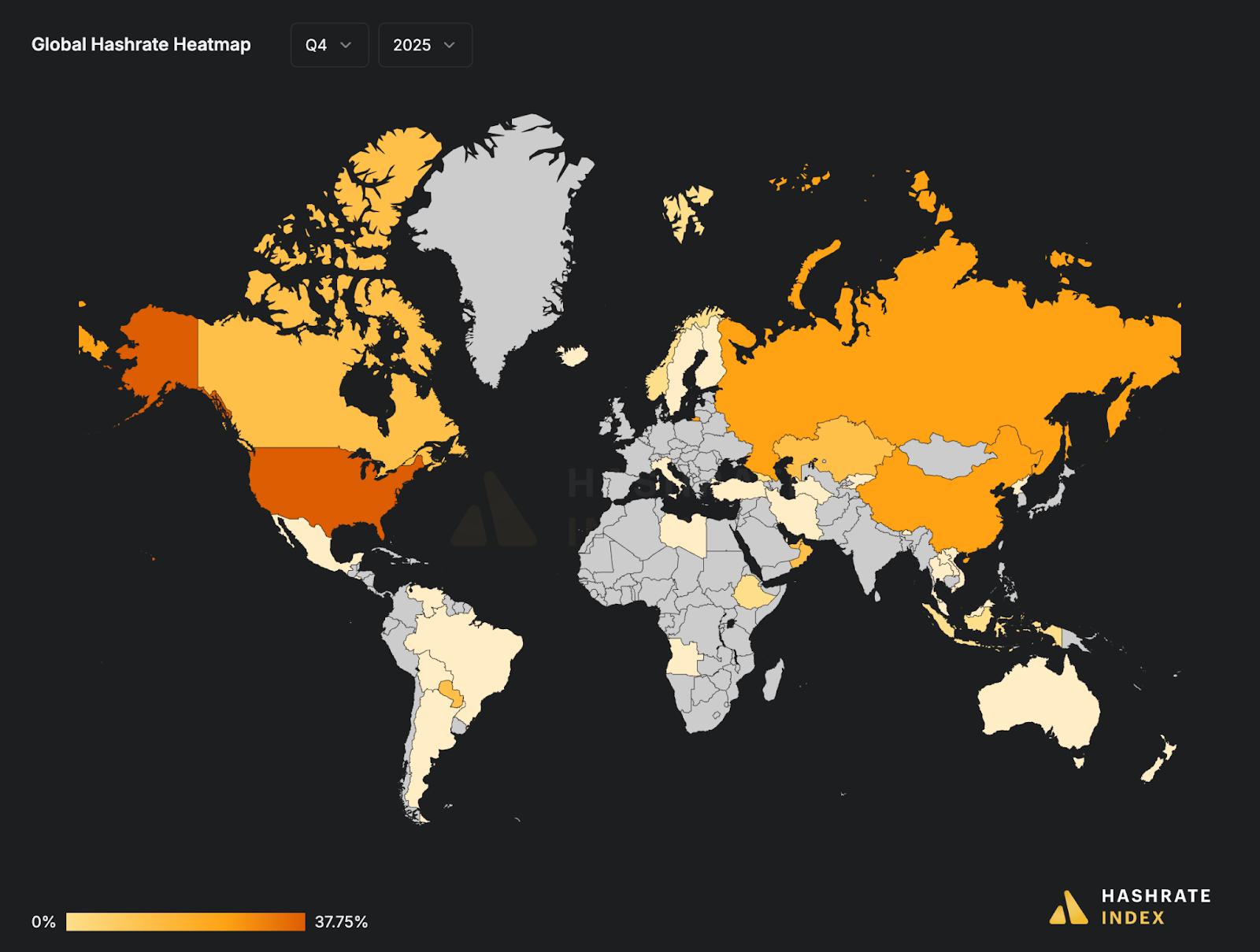 Global hashrate heatmap. Source: HashRate Index.
Should Bitcoin succumb to the same fate, the frontrunners in this race are clear. The United States, leveraging its abundant renewables, now commands 37% of the global hashrate. Texas alone, with its wind-swept plains producing surplus at $0.03-$0.04 per kWh during off-peak hours, hosts mega-farms that could power a city of 1 million. Russia follows at 16%, with its coal-heavy grids, which account for half of its energy, repurposed for mining amid post-Soviet energy gluts.
Even Nordic holdouts like Norway and Iceland, powered by nearly 100% hydro and geothermal, are scaling up, with their cold climates reducing cooling costs by up to 30%. El Salvador famously mined 474 BTC using a volcano-fueled geothermal power plant. France, eyeing its nuclear surplus, is piloting a five-year program to divert excess nuclear output to mining, potentially adding 5%-10% to Europe’s hashrate share.
This realignment is not due to geographical happenstance; rather than merely permitting mining, governments are actively subsidizing it. Incentives range from tax breaks in Texas to outright state-backed operations in Bhutan, where hydropower dams fuel national BTC holdings. The result has been a seismic shift in mining geography. Yet this trend carries its own risks, as state-directed mining can increase centralization pressures, politicize hashpower and expose the network to abrupt policy reversals if national priorities shift.
Bitcoin isn’t choosing sides. Nations are wielding it as a weapon. As hashpower flows to energy enclaves, Bitcoin is evolving from a cypherpunk experiment to a political chess piece. The global ledger endures, with blocks ticking every 10 minutes, but its guardians now wear national colors.
This trend may strengthen Bitcoin, increasing security and renewable adoption. One thing is clear: Bitcoin is now a central actor in the global energy war. The question is no longer whether Bitcoin will shape global power structures, but which nations will harness it soon enough to tilt those structures in their favor.
Opinion by: Vugar Usi Zade, chief operating officer of MEXC.
Disclaimer: The content of this article solely reflects the author's opinion and does not represent the platform in any capacity. This article is not intended to serve as a reference for making investment decisions.
You may also like
Carvana Faces Challenges in Early 2026 After Exceptional 2025: Strategies for Investing in the Stock

Bitcoin bottom signal tips 130% rally, Morgan Stanley to custody crypto: Hodler’s Digest, Feb. 22 – 28

Liquidia Corporation (LQDA) Exceeds Expectations for Q4 Earnings and Revenue
Trending news
MoreCrypto prices
More





