
Unpacking Q4 Results: How Elastic (NYSE:ESTC) Compares to Other Data Infrastructure Companies

Q4 Review: Data Infrastructure Stocks Performance
As the earnings season wraps up, it's an ideal moment to reflect on which data infrastructure companies excelled and which struggled in the fourth quarter. We'll begin our review with Elastic (NYSE:ESTC).
Today, extracting actionable insights from system-level data is a top priority for organizations. However, this requires integrating and analyzing vast amounts of information scattered across different databases. This challenge fuels demand for cloud-based data infrastructure software, which offers greater flexibility and efficiency compared to traditional on-premise solutions.
Among the five data infrastructure companies we monitor, Q4 results were mixed. Collectively, their revenues came in 4% below analyst expectations, and their guidance for the upcoming quarter was 0.5% lower than anticipated.
These results have weighed on share prices, with the group experiencing an average decline of 11.4% since their latest earnings announcements.
Elastic (NYSE:ESTC)
Elastic, built on the widely adopted open-source Elasticsearch platform, delivers a search and AI solution that empowers organizations to uncover insights, monitor systems, and enhance security.
In the most recent quarter, Elastic reported $449.9 million in revenue, marking a 17.7% increase year-over-year and surpassing analyst forecasts by 2.6%. The company also outperformed expectations for EBITDA and provided full-year EPS guidance above consensus estimates.
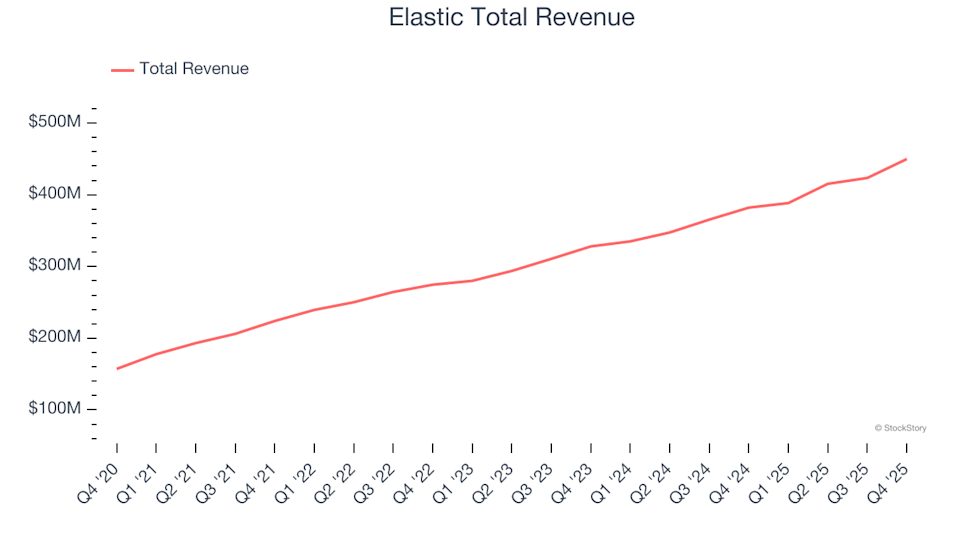
Elastic delivered the largest full-year guidance increase among its peers. However, investor hopes may have exceeded Wall Street’s published projections, resulting in some disappointment. Since the earnings release, Elastic’s stock has dropped 15.7% and is currently trading at $51.94.
Top Performer in Q4: Teradata (NYSE:TDC)
Teradata, a pioneer in data warehousing since the 1980s, now offers cloud-based analytics and AI platforms that help large enterprises unify and analyze data across diverse environments.
For Q4, Teradata posted $421 million in revenue, a 2.9% year-over-year increase and a 5.4% beat over analyst expectations. The company also exceeded forecasts for both next quarter’s EPS and EBITDA.
Teradata achieved the most significant outperformance relative to analyst estimates among its peers. Despite this, the market reaction was muted, with shares falling 1.5% since the report. The stock is currently priced at $28.78.
Q4’s Weakest: C3.ai (NYSE:AI)
C3.ai, originally focused on carbon, cloud computing, and CRM, now delivers enterprise AI software that enables organizations to build and manage large-scale AI applications across industries.
The company reported $53.26 million in revenue for the quarter, a steep 46.1% decline year-over-year and 29.6% below analyst expectations. Both full-year and next quarter revenue guidance also fell significantly short of forecasts.
C3.ai recorded the poorest performance in terms of revenue growth, guidance, and meeting analyst estimates among the group. As a result, its stock has dropped 9.7% since the earnings release and is now trading at $9.31.
Confluent (NASDAQ:CFLT)
Founded by the creators of Apache Kafka, Confluent offers a platform that connects applications, systems, and data layers through real-time data streaming.
Confluent’s Q4 revenue reached $314.8 million, up 20.5% from the previous year and 2.2% above analyst projections. The company also surpassed expectations for both EBITDA and revenue.
Confluent led its peers in revenue growth, adding 34 new enterprise customers paying over $100,000 annually, bringing the total to 1,521. The stock price has remained steady since the earnings report and is currently at $30.76.
Oracle (NYSE:ORCL)
Since its founding in 1977, Oracle has evolved from a database company to a global provider of enterprise software and hardware, supporting mission-critical systems worldwide.
Oracle reported $16.06 billion in revenue for the quarter, a 14.2% year-over-year increase but 0.8% below analyst expectations. The company also missed on both revenue and billings estimates, making for a softer quarter overall.
Following the earnings release, Oracle’s stock has fallen 31.1% and is now priced at $153.68.
Market Overview
Following the Federal Reserve’s interest rate hikes in 2022 and 2023, inflation has gradually eased toward the Fed’s 2% target. Despite higher borrowing costs, the economy has avoided recession, achieving the “soft landing” many investors hoped for. Recent rate reductions (0.5% in September and 0.25% in November 2024) have further supported the stock market, making 2024 a robust year for equities. Donald Trump’s victory in the November presidential election led to additional market gains, with indices reaching new highs. However, ongoing debates about tariffs and corporate taxes are raising concerns about economic stability in 2025.
About StockStory
The StockStory analyst team, comprised of experienced professional investors, leverages quantitative analysis and automation to deliver timely, high-quality market insights.
Disclaimer: The content of this article solely reflects the author's opinion and does not represent the platform in any capacity. This article is not intended to serve as a reference for making investment decisions.
You may also like
Bilibili's Q4 2025: The Profit Beat Was Priced In, the Revenue Miss Wasn't
Iran Tensions: Cryptocurrency Movement Response and Divergence
Ladbrokes parent company discloses £500m loss due to Reeves’s tax increase

The Dow plunges 750 points as higher oil prices keep inflation fears alive
Trending news
MoreCrypto prices
More





