
Wells Fargo's 2018 Enforcement Action Terminated by the Federal Reserve

The Federal Reserve has officially terminated its 2018 enforcement action against Wells Fargo & Company WFC, marking the closure of one of the most significant regulatory penalties imposed on the bank in the aftermath of its fake-account scandal.
The central bank confirmed that WFC has fulfilled all requirements under the order, including strengthening its governance and firmwide risk management. This milestone comes after years of regulatory oversight addressing deficiencies from the 2016 sales-practice scandal.
History of WFC’s 2018 Consent Order by the Fed
The regulatory scrutiny on Wells Fargo began in 2016, when investigations revealed that employees had opened millions of unauthorized deposit and credit card accounts in customers’ names without consent. The misconduct stemmed from a high-pressure sales culture that prioritized cross-selling targets over proper risk management.
In response, multiple U.S. regulators launched investigations into the bank’s governance and risk controls. By 2018, the Fed imposed a formal enforcement action, requiring Wells Fargo to overhaul its governance structure and establish a comprehensive risk management framework across all major business operations. The Fed also mandated that the bank demonstrate the effectiveness of these improvements through two independent third-party reviews.
Alongside these requirements, the 2018 consent order introduced a strict asset growth cap, restricting Wells Fargo from growing any larger than its total assets as of the end of 2017, which amounted to $1.95 trillion. The cap effectively constrained the bank’s ability to expand deposits, lending and securities holdings until regulators were satisfied that governance and risk-management improvements were fully implemented.
Over the following years, Wells Fargo invested heavily in strengthening internal controls, enhancing board oversight and addressing compliance deficiencies across its operations. The bank gradually resolved multiple regulatory orders, demonstrating steady progress in governance and risk oversight.
By June 2025, the Fed lifted the asset cap after confirming that Wells Fargo had met the conditions required under the 2018 enforcement action. The termination of the 2018 order in March 2026 now marks the closure of the final remaining consent order linked to the fake-account scandal, ending nearly a decade of regulatory oversight.
How WFC Benefits From the End of the Fed Enforcement Action?
The termination of the Fed's enforcement action represents a significant milestone in Wells Fargo’s long-running regulatory remediation process. For years, the consent order symbolized the bank’s governance shortcomings and imposed strict oversight on its operations.
With the enforcement action now closed, Wells Fargo enters a new phase where it can focus more fully on strategic expansion rather than regulatory remediation. The earlier removal of the asset cap in 2025 had already unlocked the bank’s ability to expand its balance sheet by growing deposits, increasing lending activities and broadening its securities portfolio.
This operational flexibility allows WFC to scale fee-generating businesses such as payment services, asset management and mortgage origination. The removal of regulatory restrictions also enables the bank to allocate capital more efficiently and pursue growth opportunities across its core franchises.
With removal of regulatory constraints, the bank now appears better positioned to pursue sustainable growth and strengthen its competitive position in the industry. Reflecting management’s confidence in its earnings potential, WFC has expects to achieve return on tangible common equity (ROTCE) target of 17–18% over medium-term.
WFC’s Zacks Rank & Price Performance
WFC shares have gained 3.8% over the past six months compared with the industry’s growth of 2.7%.
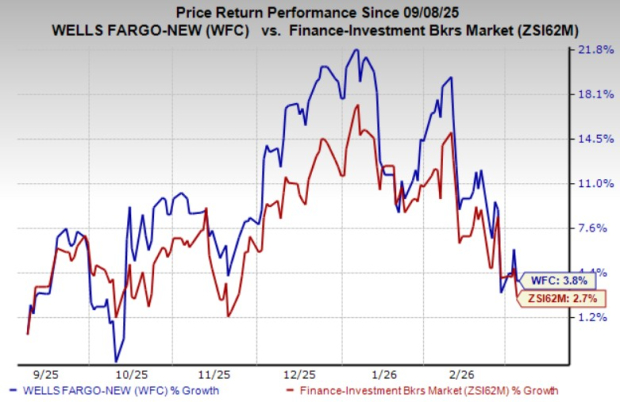
Image Source: Zacks Investment Research
The company carries a Zacks Rank #3 (Hold) at present. You can see the complete list of today’s Zacks #1 Rank stocks (Strong Buy) here.
Other Banks’ Progress to Fix Regulatory Issues
In December 2025, Citigroup, Inc. C has received notable regulatory relief after the Office of the Comptroller of the Currency removed the July 2024 amendment to the bank’s 2020 consent order. This original consent order was focused on longstanding deficiencies in risk management, data governance, internal controls and compliance.
The 2024 amendment required Citigroup to submit a formal resource review process to prove it had enough staffing, systems and governance in place to fix long-standing control issues. The regulatory easing aligns with C’s broader strategy to modernize its technology and control data.
In September 2025, UBS Group AG UBS agreed to pay €835 million ($986.8 million) to resolve a long-running French tax case concerning its cross-border business activities between 2004 and 2012.
Apart from the French tax case, UBS has also settled other regulatory matters in recent years. In August 2025, it agreed to pay $300 million to the U.S. Department of Justice to settle a legacy matter tied to Credit Suisse’s mortgage-backed securities business.
Disclaimer: The content of this article solely reflects the author's opinion and does not represent the platform in any capacity. This article is not intended to serve as a reference for making investment decisions.
You may also like
The $200 Billion Dilemma: Has the Time Come for Amazon to Issue a Dividend?
XOM | Oil Is About To Make a Move | LONG
$15.9B Unrealized Loss Hits BitMine and Strategy
Community banks and crypto industry ‘are allies’ in CLARITY Act debate: Exec
Trending news
MoreCrypto prices
More





