
Oil’s Tangible Disruption Versus Market’s “Brief Surge” Prediction: Wager on Extended Impact Due to Storage-Related Reductions

Market Expectations Face a Critical Test
Financial markets are currently navigating a precarious divide between unfolding events and prevailing forecasts. While a significant supply disruption is taking place in the Gulf region, market sentiment remains anchored to the belief that conditions will soon stabilize. This mismatch sets the stage for a potential opportunity based on differing expectations.
The disruption is substantial: the Strait of Hormuz, a vital passage for about a fifth of global oil shipments, has been nearly shut down for over a week. This is not a minor hiccup but a complete stoppage, forcing major oil producers to reduce output as their storage facilities reach capacity. Iraq, Kuwait, and the United Arab Emirates have all scaled back production, with Iraq’s southern oil output plummeting by 70%. The resulting supply shortfall is both real and significant.
Despite this, market forecasts remain optimistic. J.P. Morgan, for example, projects Brent crude to average around $60 per barrel in 2026, based on expectations of robust global supply growth. The consensus view is that the current price surge is temporary and will ease as tensions subside, treating the disruption as a short-lived event.
However, recent price movements tell a different story. Brent crude surged by 28% in just one week, briefly exceeding $110 per barrel—a level not seen in nearly four years. This dramatic increase is a direct response to the closure of the strait and the subsequent production cuts, signaling that the market is reacting to the new supply reality rather than outdated projections.
This divergence has created a notable gap between expectations and reality. While many anticipate a brief spike, the ongoing supply constraints suggest a more prolonged and damaging impact. The central question is whether market forecasts will adjust to reflect these new conditions. For now, there is an opportunity for those who believe that storage limitations and production cuts will keep prices higher for longer, especially if geopolitical tensions continue.
Asian Markets React: A Sharp Downturn Amid Oil Shock
Asian equities have responded dramatically to the oil supply crisis, providing a clear example of how expectation gaps can play out. After a week of soaring oil prices, stock markets across the region have experienced steep declines, reflecting a reassessment of the economic risks involved. This pattern is reminiscent of the classic “sell the news” phenomenon, where initial panic buying is followed by a more measured evaluation of the consequences.
The downturn has been severe. South Korea’s Kospi index plunged 12% by midday Wednesday, marking its largest single-day drop on record. The technology-focused Kosdaq was halted twice to stem volatility, with tech and semiconductor stocks bearing the brunt. Japan’s Nikkei fell nearly 4%, and Hong Kong’s Hang Seng lost 2.8%. These moves represent more than a routine correction—they are disorderly sell-offs concentrated in sectors sensitive to exports and interest rates.
The underlying concern is that the oil shock could reignite inflation, potentially delaying or reversing anticipated interest rate reductions. Economists warn that persistently high energy prices would drive up import costs, reduce consumer spending power, and raise manufacturing expenses, creating a risk of stagflation. For Asian economies, which all run consistent deficits in oil and gas trade, this poses a direct threat. The market’s reaction suggests that the notion of a fleeting price spike is losing credibility, and the real economic impact is now being factored in.
This selloff underscores the earlier discussed expectation gap. While markets initially anticipated a short-term disruption, the reality of ongoing production cuts and storage issues points to a longer-lasting challenge. Investors are now shifting their focus from the immediate shock to the sustained economic strain. Should the geopolitical crisis drag on, the region’s exposure to elevated oil prices could force central banks to maintain higher interest rates, directly contradicting forecasts of a swift return to normal conditions. The key question is whether this market adjustment is premature or a necessary response to new realities.
Key Triggers and Risks: What Could Shift Market Guidance?
The gap between expectations and reality will only close when concrete developments force a change in market outlook. Currently, the consensus still anticipates a brief price surge, but ongoing supply constraints suggest a longer disruption. Three main factors could prompt a reset in guidance.
- Reopening the Strait of Hormuz: Restoring access to this critical shipping route would normalize oil flows and likely lead to a sharp drop in prices. Estimates indicate that this could take several weeks at worst. Until then, production cuts in Iraq, Kuwait, and the UAE will persist, and any delay beyond a few weeks would reinforce the scenario of a prolonged supply shock.
- Geopolitical Escalation: The recent appointment of Mojtaba Khamenei as Iran’s new supreme leader suggests that hardline policies may continue, potentially extending the conflict and the supply disruption. If hostilities spread, oil prices could surge past $120 per barrel, raising the risk of a global recession and forcing a fundamental reassessment of the economic outlook.
- Central Bank Responses in Asia: The region’s dependence on imported energy makes it highly sensitive to sustained price shocks. If inflation data shows a persistent rise due to higher energy costs, expectations for interest rate cuts will be revised. This could intensify the equity selloff, especially in sectors already vulnerable to higher borrowing costs. The initial “sell the news” reaction in Asian markets may only be the beginning if economic indicators confirm the shock’s durability.
For investors seeking to capitalize on this environment, the opportunity lies in anticipating that ongoing supply constraints will keep oil prices elevated longer than the consensus expects. The outcome depends on whether the strait reopens soon or if the crisis drags on. The risk is that markets adjust their forecasts too late, exposing portfolios to an extended period of stagflationary pressure.
Disclaimer: The content of this article solely reflects the author's opinion and does not represent the platform in any capacity. This article is not intended to serve as a reference for making investment decisions.
You may also like
Advance Auto Parts (AAP) is Hurt by Inflation Dynamics and Consumer Behavior

Unusual Machines, Inc. (UMAC) Reports Q4 Loss, Beats Revenue Estimates
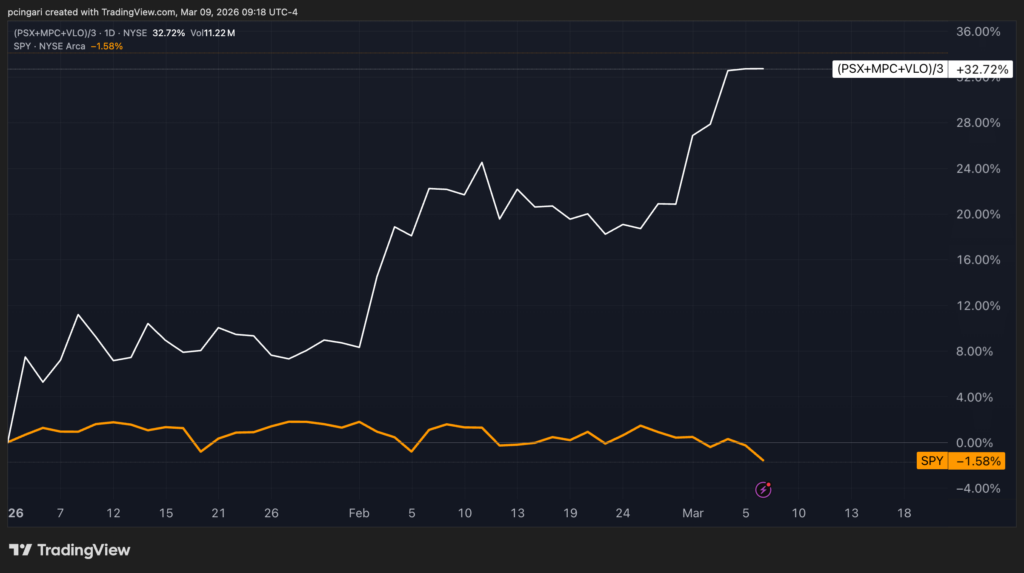
The Diesel Crisis Crushing America Is A Goldmine For These 3 Refiners
Kim Geoseok Donates 100,000 XRP to the Korean Red Cross Society
Trending news
MoreCrypto prices
More





