
Iran’s oil price surge unsettles Fed’s projections and sparks new debates on interest rates

Federal Reserve Faces New Challenges Amid Oil Price Surge
Just over a week ago, the Federal Reserve's internal discussions were quite different from what they are today.
The ongoing conflict in Iran has driven oil prices to nearly $100 per barrel, disrupting the Federal Open Market Committee’s anticipated trajectory for interest rates this year.
The rapid escalation in oil prices is influencing both inflation and economic growth. Depending on the duration of the conflict, it could either push inflation higher, slow economic expansion, or potentially do both.
Luke Tilley, chief economist at Wilmington Trust, shared with Yahoo Finance, “Looking ahead a year, the bigger impact is likely on economic growth. While the spike in oil will immediately affect headline inflation measures like CPI and PCE, it’s unlikely to significantly influence core inflation. The greater risk is to growth rather than inflation.”
Historical studies indicate that when oil price shocks are caused by supply disruptions, they tend not to result in persistently high core inflation—which excludes volatile food and energy prices—even though headline inflation will rise.
Instead, Tilley pointed out, research consistently finds that sharp increases in oil prices tend to dampen economic growth.
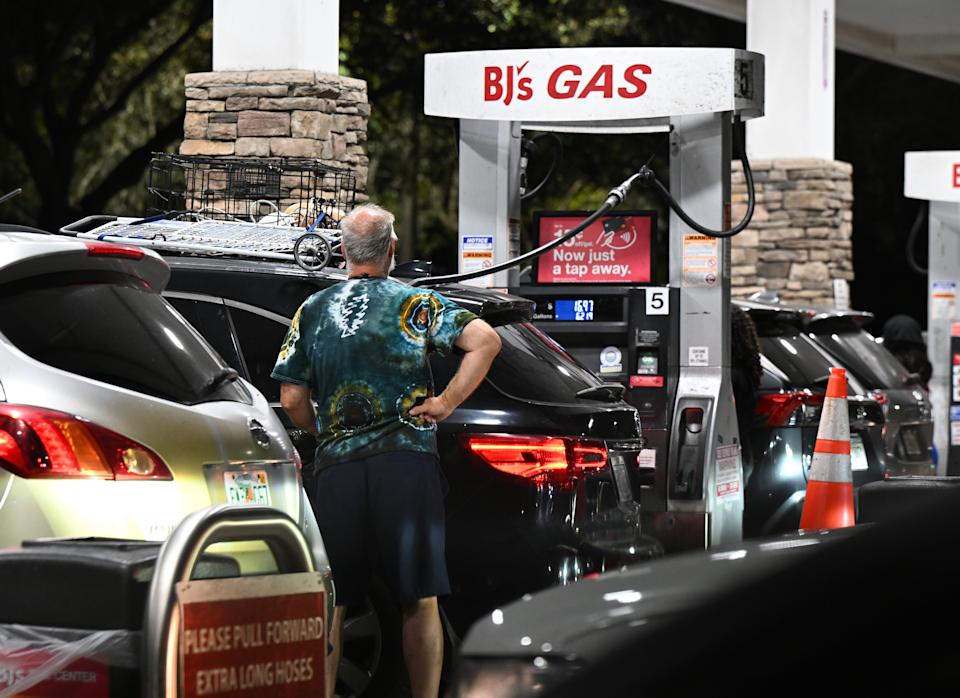
A customer fills up at a BJ's gas station on March 8, 2026, in Fort Lauderdale, Florida. (mpi04/MediaPunch /IPX)
The most pressing issue is the duration of the conflict. Tilley estimates that if oil remains at $100 a barrel for three months, the economy could be on the brink of a recession.
“The longer elevated oil prices persist—from a brief spike to several months—the greater the drag on economic activity,” Tilley explained.
He compared the rise in oil prices to a tax hike, noting that as fuel costs climb, consumers have little choice but to pay more, leaving them with less disposable income—especially concerning given the current fragility of the job market.
Labor Market Worries Add to Economic Uncertainty
Simultaneously, the labor market’s stability has come into question after February’s jobs report revealed a surprising loss of 92,000 payroll positions, casting doubt on earlier signs of improvement.
Just over a week ago, Federal Reserve officials were optimistic, expecting the economy to benefit from tax refunds, lower fuel costs, a strengthening job market, and easing tariff pressures in the latter half of the year. After three interest rate cuts last autumn aimed at supporting employment, many policymakers were comfortable keeping rates steady, with an eye toward future reductions.
Tilley believes the Federal Open Market Committee’s focus will shift from debating whether the current federal funds rate is neutral to considering if monetary policy should become more supportive of growth.
If the latter view prevails, it could strengthen the case for lowering interest rates.
However, policymakers still wary of inflation may become even more cautious due to the oil price shock. At the most recent meeting, some officials argued that additional rate cuts would be appropriate if inflation declined as expected. Others, however, supported a more flexible approach, leaving room for potential rate increases should inflation stay above the Fed’s 2% target.
Esther George, former president of the Kansas City Fed, commented in an interview that she would prefer the central bank stop focusing on when to resume rate cuts, given the already uncertain outlook for inflation and other economic factors.
“This isn’t the moment to try to pinpoint the neutral rate, as the economy faces multiple unpredictable forces,” George remarked.
For Fed members already concerned about inflation, George said the oil price spike likely delays any discussion of rate reductions until next year.
“Even if the situation resolves within a month or two, the effects of higher prices will linger into the fall,” she added.
With consumer spending making up 70% of U.S. economic growth—and households already strained by years of rising prices—George warned that it wouldn’t take much to trigger a pullback in spending.
She also noted that ongoing tariffs and a labor market behaving “unusually” could further slow economic momentum.
Rapid Shifts in Economic Outlook
How quickly have expectations changed? Since late February, traders have removed one full rate cut from their forecasts for Fed policy moves.
“All the key factors are shifting rapidly,” Tilley observed.
Disclaimer: The content of this article solely reflects the author's opinion and does not represent the platform in any capacity. This article is not intended to serve as a reference for making investment decisions.
You may also like
HPE’s AI Networking Surge and Missed Revenue Set Up Classic Expectation Arbitrage Trade
Zcash Surpasses Bitcoin in Growth After Leading Developer Group Secures $25 Million
Many Investment Opportunities Emerge in the Stock Market During Times of Turmoil
ARIA (Aria.AI) fluctuated by 49.4% in 24 hours: Trading volume surged by 796%, driving intense price volatility
Trending news
MoreCrypto prices
More





