
Mission Produce vs. Dole: Which Fresh Produce Company Holds the Advantage?

Comparing Mission Produce and Dole: Strategies in the Global Fresh Produce Market
The international market for fresh produce is highly competitive, with factors such as scale, supply chain effectiveness, and product specialization often determining which companies lead. Within this environment, Mission Produce, Inc. (AVO) and Dole plc (DOLE) showcase two contrasting methods for expanding market share and solidifying their roles in the fruit sector.
Mission Produce has carved out a niche by focusing exclusively on avocados. As a top global supplier of fresh Hass avocados, the company manages a fully integrated operation that covers everything from cultivation and sourcing to ripening and distribution. This targeted approach enables Mission Produce to benefit from the increasing worldwide appetite for avocados, while maintaining strong partnerships with both retailers and foodservice providers.
On the other hand, Dole operates as a broad-based produce powerhouse. Its extensive product range includes bananas, pineapples, berries, citrus fruits, and vegetables. Dole leverages its worldwide sourcing capabilities and established brand reputation to maintain a strong foothold across a variety of fruit categories and international markets.
The differing strategies of specialization versus diversification make the comparison between AVO and DOLE particularly interesting for investors and industry observers.
Mission Produce: Focused Growth in Avocados
Mission Produce has positioned itself as a global leader in the fast-growing avocado segment. In fiscal 2025, the company achieved record sales of 691 million pounds of avocados, generating $1.39 billion in revenue and marking a 7% increase in volume compared to the previous year.
Over the past 40 years, Mission Produce has developed a vertically integrated business model that ensures a steady supply year-round and fosters strong relationships with major retailers and foodservice clients. This integration has helped the company thrive in a market where demand for nutritious, plant-based foods is on the rise.
To fuel further expansion, Mission Produce is focusing on global growth, diversifying its offerings, and building data-driven partnerships with customers. The company has made significant inroads in Europe and Asia, with European avocado sales up 40% in 2025. While avocados remain the primary driver, Mission Produce is gradually adding blueberries and mangoes to its portfolio, with mangoes already capturing a 5.2% market share.
The brand’s emphasis on freshness, dependability, and healthy eating resonates with younger consumers and those seeking nutritious options. Digital tools and category insights also support retailers in boosting promotions and increasing household penetration.
Financially, Mission Produce continues to demonstrate strong profitability and cash flow. In the fourth quarter, the company reported an adjusted EBITDA of $41.4 million and has generated over $180 million in operating cash flow over the last two years, maintaining a healthy balance sheet with leverage below 1X.
Although factors like tariffs, price swings, and supply issues from key regions such as Mexico and Peru can impact short-term margins, Mission Produce’s diversified sourcing and global distribution help mitigate these risks. With avocado consumption on the rise and international reach expanding, the company is well-positioned for sustained growth in the fresh produce sector.
Dole: Diversification and Global Reach
Dole holds a prominent place in the global produce market, thanks to its scale, wide-ranging product lineup, and strong brand recognition. In the fourth quarter of 2025, Dole reported revenues of $2.4 billion, contributing to solid annual growth fueled by robust demand and improved pricing in several fruit categories.
The company’s operations span bananas, pineapples, berries, citrus, and vegetables, making it one of the most diversified suppliers worldwide. Bananas remain a key product, with strong demand in both North America and Europe. This broad product base allows Dole to serve a wide range of consumers and reduces reliance on any single fruit market, including avocados.
Dole’s strategy centers on an integrated global network for sourcing, logistics, and distribution, ensuring a consistent supply to retailers and foodservice partners. Its well-known brand positions Dole as a trusted source of fresh, healthy produce for mainstream and health-conscious consumers alike.
The company is also expanding in high-growth categories like berries and is using data-driven planning and supply chain efficiencies to improve pricing and demand forecasting. These efforts enhance Dole’s competitive edge in a market increasingly shaped by convenience, quality, and nutrition.
In 2025, Dole posted an adjusted EBITDA of about $395 million, demonstrating resilience despite weather-related challenges and cost pressures. The company also initiated a $100-million share buyback program, reflecting confidence in its long-term financial strength. While changes in tariffs and trade policies can affect cross-border pricing and supply, especially for tropical fruits, Dole’s global sourcing and distribution help manage these risks and support ongoing growth.
Analyst Estimates: AVO vs. DOLE
According to Zacks, Mission Produce’s projected sales and earnings per share (EPS) for fiscal 2026 are expected to decline by 10.2% and 10.1%, respectively, with no changes to EPS estimates in the past month. For fiscal 2027, both sales and earnings are anticipated to rise by 1.7% and 4.2% year over year.
AVO’s Estimate Revision Trend
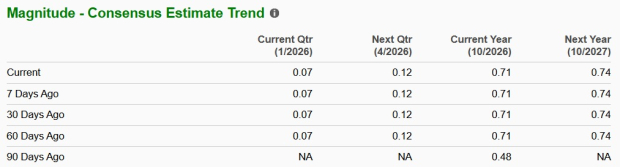
Image Source: Zacks Investment Research
For Dole, the Zacks Consensus Estimate for 2026 points to year-over-year growth of 3.7% in sales and 19.2% in EPS, with no changes to EPS estimates in the last 30 days. In 2027, Dole’s sales and earnings are projected to increase by 2.6% and 6.8%, respectively.
DOLE’s Estimate Revision Trend
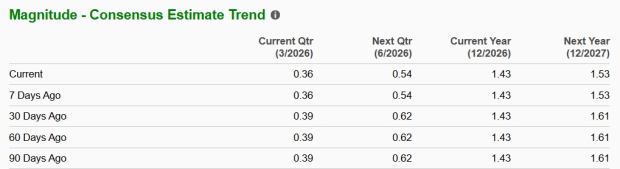
Image Source: Zacks Investment Research
Stock Performance and Valuation
Over the past year, Mission Produce’s shares have outperformed, climbing 33.9%, compared to Dole’s 4.3% gain. AVO has also surpassed the S&P 500’s 24.1% return, while DOLE has lagged behind the index.
1-Year Price Performance: AVO vs. DOLE
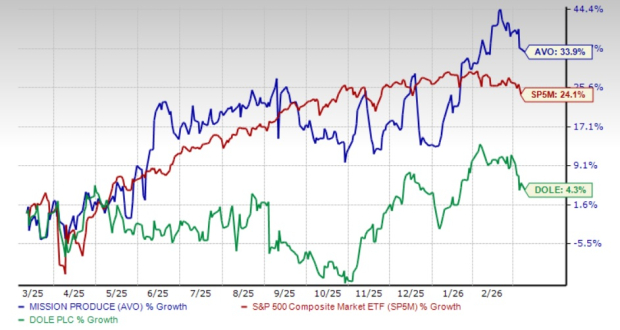
Image Source: Zacks Investment Research
In terms of valuation, Mission Produce is trading at a forward price-to-earnings (P/E) ratio of 21.42, which is above its five-year median of 21. This is also higher than Dole’s forward 12-month P/E of 10.39, with a five-year median of 10.
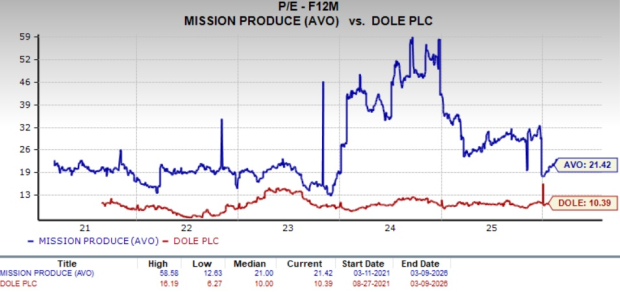
Image Source: Zacks Investment Research
Currently, AVO’s premium valuation reflects investor confidence in its focused, high-growth business model and global expansion. In contrast, DOLE’s lower valuation may attract value investors, supported by its diversified revenue streams, steady cash flow, and well-known brand. However, this diversification can sometimes mean slower growth and greater exposure to commodity price fluctuations and supply challenges.
Conclusion: Which Stock Stands Out?
Mission Produce and Dole offer two distinct investment opportunities in the fresh produce industry. Mission Produce’s specialization in avocados, integrated operations, and expanding global presence underpin its growth story, as seen in its strong stock performance over the past year.
Dole, meanwhile, benefits from a broad product portfolio, international scale, and a trusted brand. Its expected earnings growth and lower valuation suggest potential for value-oriented investors. Ultimately, AVO may appeal more to those seeking growth, while DOLE could be attractive to investors focused on value. Both currently hold a Zacks Rank #3 (Hold).
Disclaimer: The content of this article solely reflects the author's opinion and does not represent the platform in any capacity. This article is not intended to serve as a reference for making investment decisions.
You may also like
Oracle's $7.53 Billion Trading Volume Ranks 9th as Cloud Growth Struggles with Debt and Market Volatility
Brady's Gravotech Integration Could Justify Premium Valuation—If Execution Delivers
Trending news
MoreCrypto prices
More





