
The Quiet Retail Compounder Investors Keep Buying on Every Dip


Casey’s General Stores (NASDAQ: CASY) is a long-term retail holding that has tended to reward a buy-the-dip strategy. This company is as quality as they come, internally funding growth, consolidating in a still-fractured market, generating ample cash flow, and returning capital to investors. The sum of these factors has resulted in a steady uptrend in the share price, underscoring the effectiveness of this strategy. And in early March 2026, CASY stock is pulling back and setting up its next buying opportunity.
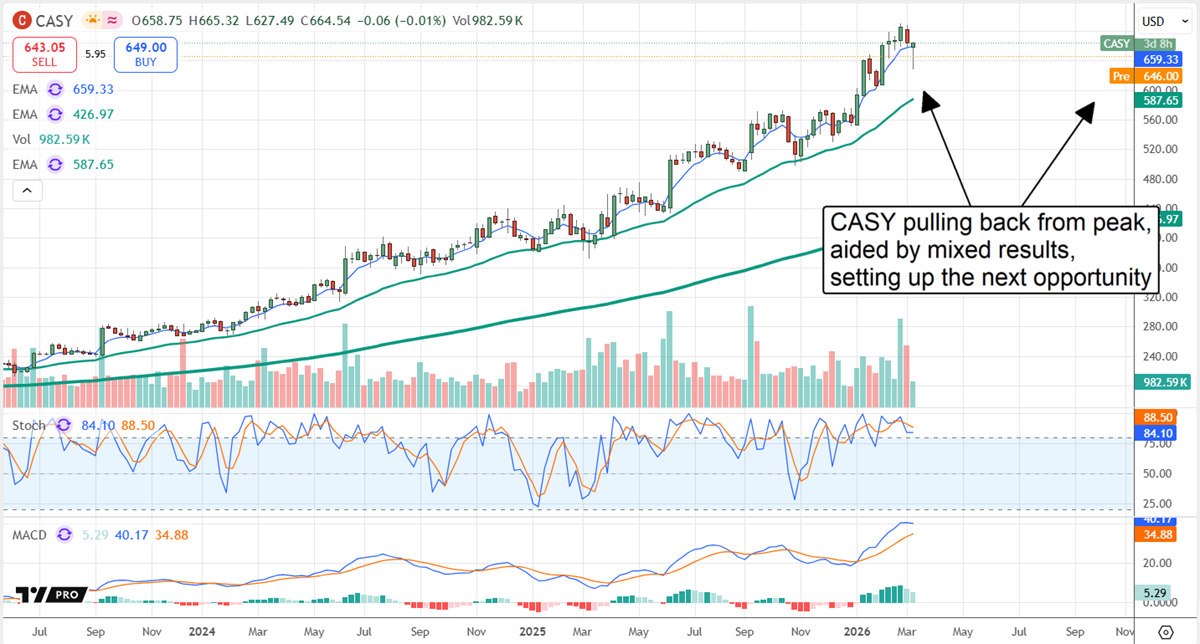
Mixed Results Spark Drop in Casey’s Shares
Casey’s General Stores had a solid fiscal third quarter despite revenue falling short of the consensus estimate. Revenue growth of 0.5% was underpinned by strength across both segments, including higher store counts and margins, revealing Casey doing what Casey does best: managing costs, driving growth, and generating profitable cash flow.
Segmentally, Inside sales were strongest, up 4% on a comp store basis, driven by a 3.3% increase in grocery sales and a 4.7% increase in prepared foods. Gasoline sales were also positive, up by 0.4%, with a 4.6-cent (or 11.2%) increase in fuel margin. Rewards club membership, another indicator of business momentum, surpassed 10 million for the first time.
The margin news was the strongest. The robust Inside performance and fuel margin increase drove improvement down the stack. EBITDA increased by 27.5%, net income by 49.3%, and GAAP earnings by 50%, all well ahead of the top-line growth. The good news is that margin strength is expected to persist through year’s end, leading management to raise its profit guidance, underpinned by inside strength. The bad news, which is unlikely to impact share prices in the long term, is that the 2026 revenue outlook is shy of the consensus.
Casey’s Capital Return Trumps Revenue Miss
Casey’s revenue miss and soft guidance are a concern, as they reveal weaker-than-expected business traffic, but they are offset by margin strength, cash flow, and the capacity to return capital. The company was already in a robust position, able to pay dividends and buy back shares. The margin strength reveals that distributions are reliable, and growth is likely to continue.
As it stands, the company’s dividend yields about 0.34%, a token figure, but it is reliable at 10% of the earnings outlook, which helps increase buy-and-hold investment, and the distribution history qualifies it as a Dividend Aristocrat. Casey’s has increased its payment for more than 25 consecutive years and can sustain the trend indefinitely.
Buybacks in fiscal year 2026 (FY2026) are also at token levels but significant nonetheless. Not only did Casey’s resume repurchases during the year, after having paused to build cash for an acquisition, but it also reduced the share count on a year-over-year (YOY) basis in Q3. The share count fell by 0.3%, increasing shareholder value, and buybacks will likely continue at this pace in Q4. The company has sufficient capital left under the current authorization for three quarters at the Q3 pace and will likely increase the authorization in FY2027 if no acquisition targets arise.
Casey’s balance sheet reflects the accretive impact of its operations and the Fike’s acquisition. Highlights at the quarter’s end include increased cash, current and total assets offset by smaller increases in liabilities. Long-term debt is down and equity up about 9.8% (another boost to shareholder value), with leverage remaining persistently low. The company’s long-term debt, including lease obligations, is less than 1X equity, leaving it in a healthy and flexible financial position.
Institutions and Analysts Drive Casey’s Stock Price Higher
The institutional and analyst trends are solidly bullish, pointing to higher prices for Casey’s stock. MarketBeat tracks 14 analysts rating the stock as a Moderate Buy; the Buy-side bias is 57%, and the price-target trend is upward. The consensus lags price action as of early March but is up more than 50% on a trailing-12-month (TTM) basis, with recent revisions pushing it toward the high end of the range. The high-end $725 target was set the day before the Q3 release, and activity following the report affirms it. The highest target suggests at least 10% upside remains possible, but the trend is likely to push targets to higher highs over time.
Institutional trends are equally supportive, with this group owning more than 85% of the stock and aggressively accumulating it. MarketBeat’s data show they have been buying on balance for six consecutive quarters, with activity ramping to record highs in Q1 2026. The balance in Q1, leading into the report, is greater than $2 bought for each $1 sold, providing a tailwind for price action. The likely outcome is that institutions and analysts will continue to lean into the trade and buy it on the post-release dip.
Where Should You Invest $1,000 Right Now?
Before you make your next trade, you'll want to hear this.
MarketBeat keeps track of Wall Street's top-rated and best performing research analysts and the stocks they recommend to their clients on a daily basis.
Our team has identified the five stocks that top analysts are quietly whispering to their clients to buy now before the broader market catches on... and none of the big name stocks were on the list.
They believe these five stocks are the five best companies for investors to buy now...
See The Five Stocks Here
The article "The Quiet Retail Compounder Investors Keep Buying on Every Dip" first appeared on MarketBeat.
Disclaimer: The content of this article solely reflects the author's opinion and does not represent the platform in any capacity. This article is not intended to serve as a reference for making investment decisions.
You may also like
IBM (IBM): Should You Buy, Sell, or Hold After Q4 Results?
3 Key Reasons to Offload CSCO and One Alternative Stock Worth Buying
Rapid Micro Biosystems to Participate in KeyBanc Capital Markets Healthcare Forum

China: Exports anchor growth as Middle East risks rise – UOB
Trending news
MoreCrypto prices
More





