
Reeves has stalled economic expansion, and the Bank of England is

Britain’s Economic Outlook: A Challenging Start to the Year
Rachel Reeves’s hopes of revitalizing the UK’s sluggish economy have encountered immediate setbacks. According to the Office for National Statistics (ONS), economic growth was stagnant in January, falling short of the anticipated 0.2% increase and slipping from the 0.1% growth seen in December.
This lack of momentum emerged even before the recent escalation of conflict in Iran, which began at the end of February and is expected to further impact the economy.
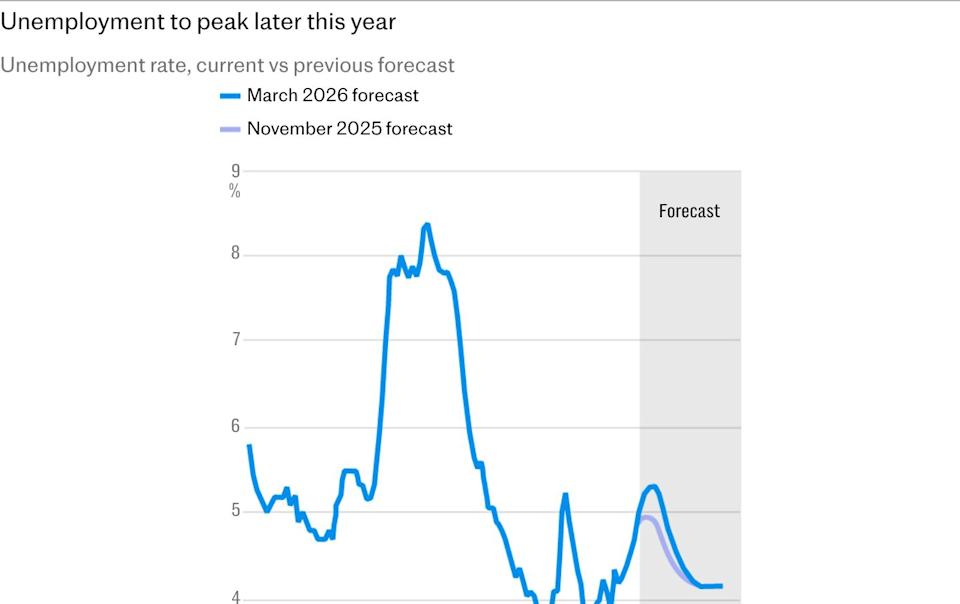
These developments spell trouble for the job market, which is already experiencing its highest unemployment rate since the pandemic. Many experts caution that unemployment could soon reach levels not seen in over a decade, potentially leaving around two million people jobless.
Under normal circumstances, such weak growth would prompt the Bank of England to consider lowering interest rates to stimulate the economy. However, the current environment is far from typical. Andrew Bailey and the Monetary Policy Committee are facing what Deutsche Bank’s Sanjay Raja describes as a difficult balancing act: they must weigh the risk of renewed inflation, driven by rising oil prices due to Middle East tensions, against the need to support employment and growth.
“The MPC will have to tread carefully to prevent the UK from slipping into a deeper downturn,” Raja warns.
Just weeks ago, forecasts suggested that inflation would soon drop to the Bank of England’s 2% target, down from the current 3%. This outlook had led traders to expect two interest rate cuts this year.
However, the situation changed dramatically following President Donald Trump’s intensified military actions in Iran. The resulting disruption to global oil supplies has been unprecedented, threatening to drive up prices throughout the economy.
Brent crude oil prices have surged to around $100 per barrel, compared to $60 at the close of last year. Oil remains a vital component of the UK economy, powering transportation, serving as a raw material for various industries, and fueling vehicles.
Natural gas prices, which heavily influence UK electricity costs, have also climbed sharply. Additionally, the blockade of the Strait of Hormuz has disrupted the fertilizer market, further complicating matters.
For Bank of England Governor Andrew Bailey, memories of the last energy crisis are still vivid. Inflation soared to 11.1% following Russia’s invasion of Ukraine.
James Smith of ING notes, “The experience from 2022 suggests that if the energy shock persists, the Bank should tighten policy to keep inflation expectations in check and limit the knock-on effects on services inflation.”
In essence, this would mean raising interest rates to control rising prices. But unlike the previous crisis, the economy is now stagnant and unemployment is higher.
Uncertain Prospects for Interest Rate Cuts
Smith points out that with a weaker labor market, the usual feedback mechanisms are less effective. As a result, the Bank of England faces a much tougher challenge. One thing is clear: hopes for a rate cut in March have all but disappeared, and investors are increasingly doubtful that any rate reductions will occur this year.
This is particularly concerning given the economy’s fragile state at the start of the year, with little sign of support from the central bank on the horizon.
Widespread Economic Weakness
ONS data reveals that the slowdown was broad-based: the services sector showed no growth, manufacturing shrank by 0.1%, and construction managed only a modest 0.2% increase.
Yael Selfin, chief economist at KPMG, describes the figures as “a disappointing start to the year, with growth likely to remain elusive.”
Businesses are already grappling with a £26 billion increase in employer National Insurance contributions, substantial hikes in the minimum wage, and higher business rates under Reeves’s leadership. Now, they are facing a second energy shock in just four years.
Selfin adds, “Borrowing costs have risen recently, as investors now expect the Bank of England to maintain higher interest rates for longer. This will be a significant challenge for businesses already dealing with immediate increases in energy and other input costs. The combination of weaker growth prospects and mounting cost pressures will likely cause companies to scale back investment in the coming year.”
Risks of Stagnation and Recession
Paul Dales of Capital Economics warns that the latest shock could nearly erase economic growth in 2026. “It’s clear the economy was already subdued before the recent spike in energy prices caused by Middle East tensions. We previously projected 1% GDP growth this year, but depending on how long and severe the energy price surge is, growth could fall to 0.6%, 0.4%, or even 0.1%,” he explains.
Dales continues, “From March onward, higher energy prices will start to erode the real spending power of both households and businesses. At this rate, the economy is more likely to lose momentum in the coming months.”
There is even a risk that the UK could slip into recession. Tomasz Wieladek of T. Rowe Price notes, “The UK has recently been among the weakest advanced economies in terms of growth. The current oil price shock is likely to not only fuel inflation but also push the economy into recession, increasing unemployment and reducing GDP. Stagflation may be imminent.”
If these trends persist, Rachel Reeves may soon be facing the prospect of record-high unemployment, a recession, and a renewed cost-of-living crisis.
Disclaimer: The content of this article solely reflects the author's opinion and does not represent the platform in any capacity. This article is not intended to serve as a reference for making investment decisions.
You may also like

Trending news
MoreCrypto Market News Today: SOL & ETH Will Benefit From Mastercard’s Partner Program, but Deepsnitch AI Has Explosive 100X Potential, With More Than $2 Million Funding Secured in Stage 7
Crypto Market News Today: SOL & ETH Will Benefit From Mastercard’s Partner Program, but Deepsnitch AI Has Explosive 100X Potential, With More Than $2 Million Funding Secured in Stage 7
Crypto prices
More





