Coin-related
Price calculator
Price history
Price prediction
Technical analysis
Coin buying guide
Crypto category
Profit calculator

What is L ($L)?
L basic info
The cryptocurrency industry has evolved far beyond simple digital payments. Today, blockchain networks support decentralized exchanges, perpetual futures, lending protocols, stablecoins, and many other financial applications. However, many platforms still struggle to balance speed, transparency, and decentralization. Centralized exchanges offer fast execution but require users to trust the platform operator, while decentralized finance platforms often face slow transactions, network congestion, and high fees during periods of heavy activity.
Nexus was created to solve these challenges through a blockchain architecture designed specifically for exchange infrastructure and financial markets. The project focuses on perpetual futures, order matching, liquidations, margin systems, and real-time trading operations while also supporting Ethereum-compatible smart contracts. Nexus describes this model as “verifiable finance,” where high-performance trading infrastructure operates within a transparent blockchain environment. In this article, we will learn what Nexus (NEX) is, how the project works, who created it, and the role of the NEX token within the Nexus ecosystem.
What Is Nexus (NEX)?

Nexus (NEX) is a high-performance Layer 1 blockchain designed for exchange-based financial activity and verifiable finance. Unlike traditional blockchains that treat trading as a separate application layer, Nexus integrates key exchange functions closer to the core protocol itself. The project focuses on areas such as perpetual futures, order matching, real-time price feeds, margin systems, and liquidations, with the goal of providing fast and transparent onchain trading infrastructure. According to the official documentation, Nexus aims to build a decentralized “Internet Exchange” where assets, markets, and information streams can be traded within a cryptographically verifiable environment.
The Nexus ecosystem combines two main execution environments: NexusCore and NexusEVM. NexusCore is designed for high-speed financial execution and specialized market operations, while NexusEVM provides Ethereum compatibility for smart contracts and decentralized applications. This dual architecture allows Nexus to support both low-latency trading and broader DeFi composability. The network’s native token is NEX, which serves as the digital currency of the Nexus blockchain and plays a role within the project’s broader economic model alongside the Nexus Exchange and USDX stablecoin.
Who Created Nexus (NEX)?
Nexus was founded by Daniel Marin, who serves as the project’s Founder and CEO. Marin graduated from Stanford University and previously worked at Google before entering the blockchain and Web3 industry. Nexus originally began as a research-driven project focused on verifiable computation and zero-knowledge technology before expanding into a broader Layer 1 blockchain and exchange infrastructure platform.
The Nexus founding and leadership team also includes several experienced figures from the blockchain industry. Jens Groth serves as Chief Scientist and was previously the Research Director at DFINITY, where he worked on cryptography and distributed systems. Alex Fowler is the Chief Strategy Officer of Nexus. Fowler is also a member of Plural VC and one of the co-founders of Blockstream. In terms of financing, Nexus has completed two funding rounds, raising a total of $27.2 million. The project raised $2.2 million in its seed round led by Dragonfly, followed by a $25 million Series A round co-led by Lightspeed Venture Partners and Pantera Capital.
How Nexus (NEX) Works
Nexus operates through a dual-architecture system designed to separate high-speed financial execution from general smart-contract activity. The network combines NexusCore, a specialized execution environment for trading and financial operations, with NexusEVM, an Ethereum-compatible environment for decentralized applications and smart contracts. This structure allows Nexus to support low-latency market activity while still maintaining compatibility with the broader Ethereum ecosystem.
The project also uses a dual-block execution model. According to the official documentation, NexusCore blocks are designed to process every 50–100 milliseconds for real-time trading operations, while NexusEVM blocks are produced every few Core blocks to synchronize smart-contract activity. The goal of this system is to prevent high-frequency trading operations from being slowed down by general-purpose EVM execution.
Key components of the Nexus ecosystem include:
-
NexusCore: A specialized execution layer designed for financial applications such as perpetual futures, lending, payments, liquidations, and order matching. It is optimized for deterministic execution and low-latency performance.
-
Co-processors: Native protocol-level modules inside NexusCore that handle specialized financial operations more efficiently than traditional smart contracts. The first major co-processor is the Nexus Exchange.
-
NexusEVM: An Ethereum-compatible execution environment that supports Solidity, Vyper, Ethereum bytecode, and standard developer tools, allowing developers to deploy EVM-based applications with minimal changes.
-
Dual-block execution: A system that separates fast trading execution from slower smart-contract synchronization in order to improve throughput and execution speed.
-
Nexus Exchange: The project’s exchange infrastructure focused on perpetual futures trading. The current Exchange Alpha provides a testnet environment for BTC-USD perpetual futures with leverage support.
-
Perpetual futures infrastructure: Nexus integrates functions such as matching, margin systems, liquidation mechanisms, and funding-rate calculations directly into NexusCore rather than relying entirely on smart contracts.
-
USDX stablecoin: A stablecoin component within the Nexus ecosystem designed to serve as a settlement and collateral asset for trading activity across the network.
Through this architecture, Nexus aims to combine the speed of centralized trading systems with the transparency and composability of blockchain technology. The project positions itself as an exchange-focused Layer 1 network built for verifiable financial markets and real-time onchain trading infrastructure.
Nexus (NEX) Tokenomics
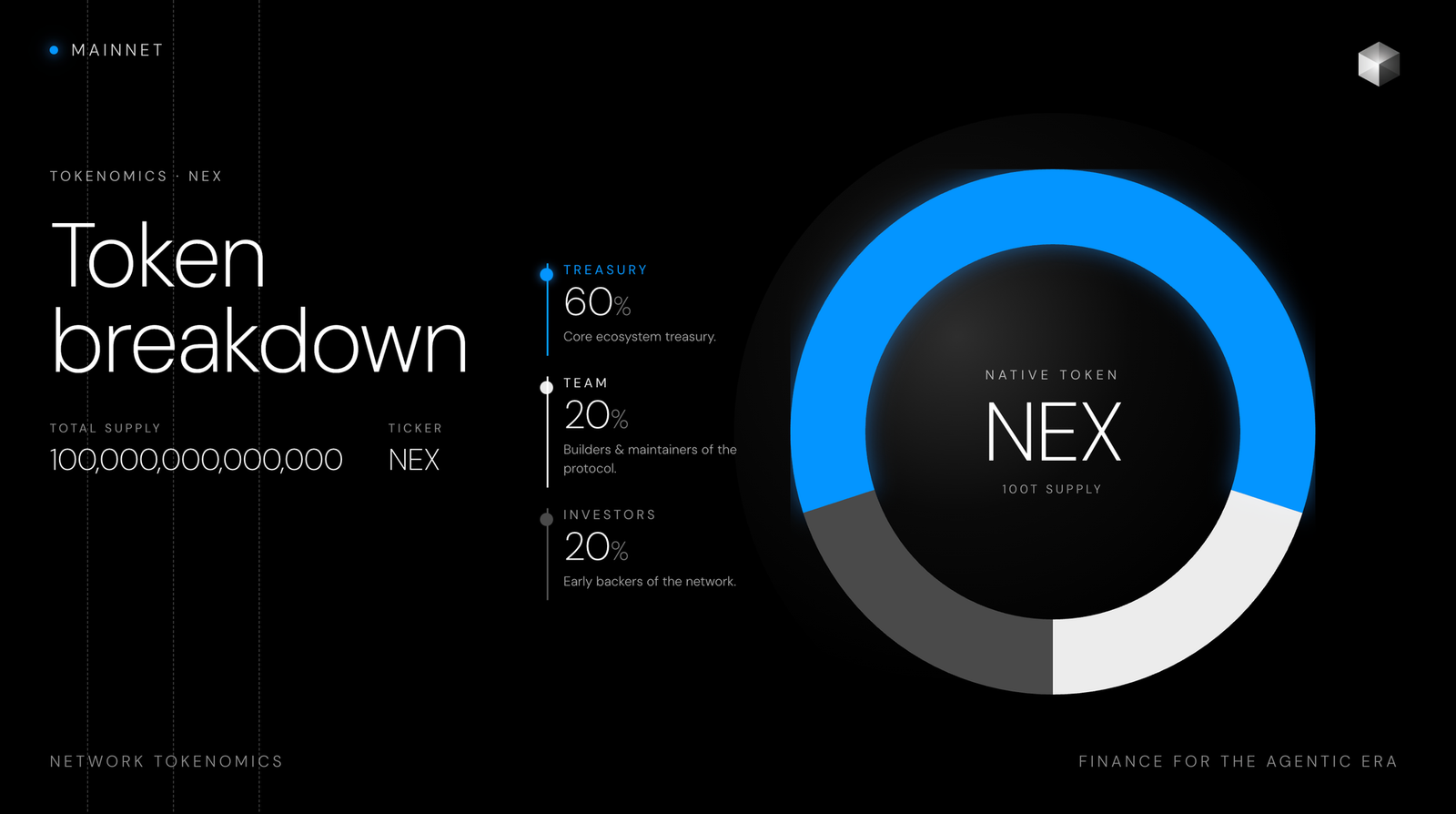
NEX is the native token of the Nexus blockchain and serves as the core digital currency within the ecosystem. The token is designed to support network activity, ecosystem operations, and the broader economic structure surrounding the Nexus Layer 1, Nexus Exchange, and USDX stablecoin. The total supply of NEX is fixed at 100 trillion tokens.
NEX Token Allocation
The initial token allocation is divided into three main categories:
-
60% Treasury: Reserved for ecosystem development, research, partnerships, incentives, and long-term protocol growth.
-
20% Team: Allocated to the founding team and contributors.
-
20% Investors: Allocated to early backers and funding participants.
Vesting Schedule
Both the team and investor allocations follow a three-year vesting schedule with a one-year cliff. After the first year, 33% of the allocation unlocks, while the remaining tokens unlock gradually over time. According to Nexus, the treasury allocation is intended to support ongoing development and ecosystem expansion across the network.
Role of NEX in the Ecosystem
NEX also plays a role within the project’s broader economic model known as the “Nexus Trifecta,” which consists of the Nexus Layer 1 blockchain, the Nexus Exchange, and USDX. Within this system, USDX is designed to function as a settlement and collateral asset for trading activity, while NEX serves as the native currency of the network.
Nexus (NEX) Goes Live on Bitget
We are thrilled to announce that Nexus (NEX) will be listed in the spot market. Check out the details below:
-
Deposit: Open
-
Trading: Opens on May 20, 2026, 15:00 (UTC)
-
Withdrawal: Opens on May 21, 2026, 16:00 (UTC)
-
Spot trading link: NEX/USDT
Convert: Opens within 10 minutes after trading begins. You can exchange tokens for BTC, USDT, and other tokens supported by Bitget Convert, with no transaction fees.
Conclusion
Nexus (NEX) is a Layer 1 blockchain project that aims to bring exchange infrastructure directly onto the blockchain through a combination of high-speed execution, Ethereum compatibility, and verifiable financial systems. By integrating technologies such as NexusCore, NexusEVM, and dual-block execution, the project seeks to create an environment where onchain trading can become faster, more scalable, and more transparent. The broader ecosystem also includes the Nexus Exchange, perpetual futures infrastructure, USDX stablecoin design, and the NEX native token.
Although Nexus is still in its early stages, the project has already attracted attention for its exchange-focused architecture and long-term vision for verifiable finance. Several ecosystem components are still under development, but the introduction of the Exchange Alpha provides an early look at how the network may evolve in the future. For investors and blockchain users interested in Layer 1 infrastructure, decentralized trading, and onchain financial markets, Nexus is a project worth following as its ecosystem continues to develop.
Disclaimer: The opinions expressed in this article are for informational purposes only. This article does not constitute an endorsement of any of the products and services discussed or investment, financial, or trading advice. Qualified professionals should be consulted prior to making financial decisions.
$L resources
$L supply and tokenomics
Links
What is the development prospect and future value of $L?
The market value of $L currently stands at $0.00, and its market ranking is #999999. The value of $L is not widely recognized by the market. When the bull market comes, the market value of $L may have great growth potential.
As a new type of currency with innovative technology and unique use cases, $L has broad market potential and significant room for development. The distinctiveness and appeal of $L may attract the interest of specific groups, thereby driving up its market value.
Is $L worth investing or holding? How to buy $L from a crypto exchange?
How to get L through other methods?
What is L used for and how to use L?
Want to get cryptocurrency instantly?
Buy cryptocurrencies instantly with a credit cardTrade popular cryptocurrencies nowHow to buy popular cryptocurrenciesSign up now!Want to view similar cryptocurrencies?
What are the prices of popular cryptocurrencies today?What would have happened if you had bought popular cryptos?What are the price predictions for popular cryptocurrencies from 2025 to 2050?Learn about other cryptos