
The US Clarity Act is facing a March 1 deadline for the inclusion of texts before a review. For now, the bill has not explicitly mentioned stablecoins. In its current state, the bill treats stablecoins as a separate lane, and mostly as a means of payment.
Stablecoins, however, have varying mechanisms of sharing yield. Some may share the yield of their underlying bonds, while others can use the yield from decentralized finance. This issue, however, has not received a carveout in the bill.
As Cryptopolitan reported earlier, the banking lobby has so far prevailed in blocking stablecoin rewards. The yield or rewards were seen as a competitive attack against traditional banking.
Stablecoins remain a contentious issue for the Clarity Act
Stablecoins are, for now, still regulated under the Genius bill, but lack the carveouts for crypto-native activity mentioned in the text of the Clarity Act.
The Clarity Act was supposed to end the years of uncertainty and separate cleanly the assets and activities under the oversight of the US Securities and Exchange Commission (SEC), or the Commodities Futures Trading Commission (CFTC).
The lack of carve-outs for stablecoins could limit new institutional inflows. Stablecoin yields are one of the newly emerging use cases, shifting crypto away from token speculation and into passive income.
Allowing stablecoins as a yield-bearing asset would be bullish for crypto, said Utkarsh Ahuja, the founder of Moon Pursuit Capital for Cryptopolitan.
‘
For now, the Clarity Act has a strong carveout for DeFi activity, including the producers of code, smart contracts, and API. This means DeFi may not be directly affected, but front-end access points may still face attempts to enforce KYC and de-anonymization.
Clarity Act may turn into law by the end of 2026
The chances are rising that the Clarity Act will become law by the end of 2026. The bill was pushed forward multiple times, with shifting support.
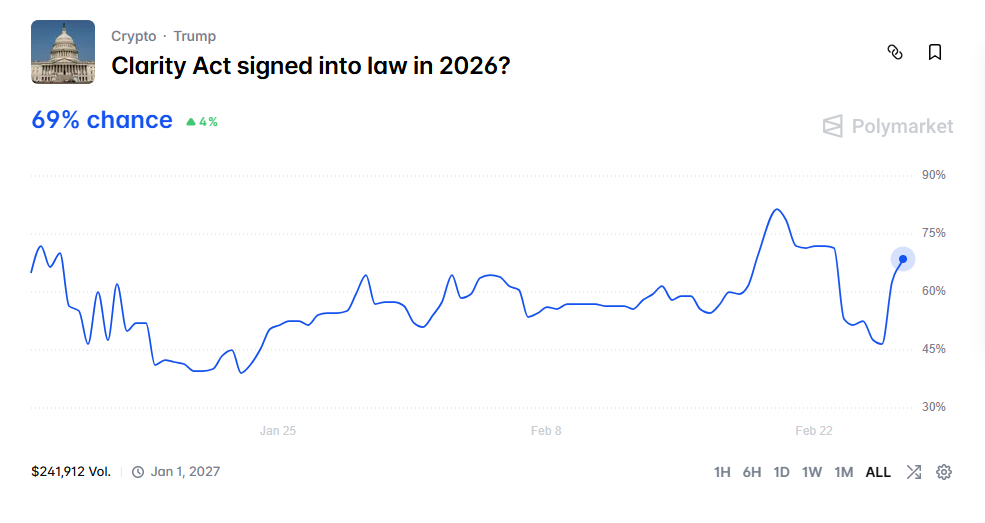 The Clarity Act increased its probability of being voted into law by the end of 2026. | Source:
Polymarket
The Clarity Act increased its probability of being voted into law by the end of 2026. | Source:
Polymarket
Based on Polymarket odds, the bill may turn into law with 69% probability. Over the past day, the probability has risen again as the deadline for text inclusion approaches.
The recent enthusiasm for the bill followed the rapid BTC recovery to $68,000 after a period of range-bound pessimism. However, in this form, the bill will still lack the texts on stablecoin yield, making crypto platforms less attractive to new liquidity inflows.